Boulder, fossil-fuel companies face off at the Supreme Court in high-stakes climate case

Attorneys representing two Colorado local governments are set for a high-stakes legal showdown over climate change Monday at the U.S. Supreme Court, where they’ll ask justices to allow Boulder’s lawsuit seeking monetary damages from two fossil fuel companies to proceed in state court.
With help from the Trump administration, the two companies, Suncor Energy and Exxon Mobil, have asked the court to step in and quash the lawsuit, which was filed in 2018 by Boulder County and the city of Boulder. The plaintiffs are seeking monetary damages under state tort law “for the substantial role (the companies) played and continue to play in causing, contributing to and exacerbating climate change.”

Monday’s Supreme Court hearing in the case, known as Suncor v. Boulder, follows another unprecedented summer of record heat, extreme drought conditions and destructive wildfire activity impacting communities across Colorado. Boulder’s suit is one of more than 30 similar cases filed to date by state and local governments nationwide as human-caused climate change, mostly the result of fossil-fuel combustion, pushes average global temperatures to dangerous new highs.
A few months ago, a coalition of state attorneys general filed briefs urging the justices to let the case stay in state court, as detailed in our report on attorneys general asking the Supreme Court to let Boulder's climate lawsuit proceed.
Legal scholars weighed in on the broader implications shortly after the court agreed to hear arguments, as covered in legal experts' views on how the Supreme Court should handle energy policy and climate lawsuits.
“This case is really about who’s going to bear the costs of all of these accelerating effects that we’re experiencing on the front lines here in Colorado,” Chris Winter, an environmental attorney and executive director of the Getches-Wilkinson Center at the University of Colorado School of Law, said in an interview. “Are those costs just going to fall on the shoulders of all of the taxpayers and citizens and our local governments? Or is the oil industry going to be at least partially responsible for their role in contributing to this crisis?”
Exxon and Suncor, a Canadian oil giant that operates Colorado’s only fossil fuel refinery, argue that federal law preempts Boulder’s efforts to hold the companies accountable in state court. The defendants have tried and failed repeatedly to have the case dismissed or removed to federal court, most recently in May 2025, when the Colorado Supreme Court issued a ruling allowing the case to proceed.
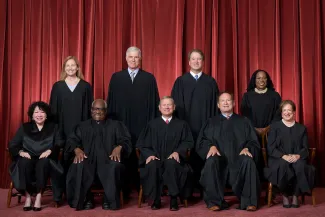
Memebers of the Supreme Court of the United States 2022 - WIkimedia - Public Domain
Soon after that ruling, however, the companies asked the U.S. Supreme Court, where conservatives hold a 6-3 majority, to step in. Their petition asks the nation’s highest court to rule that federal statute “precludes state-law claims seeking relief for injuries allegedly caused by the effects of interstate and international greenhouse-gas emissions on the global climate.”
In February, justices agreed to hear the case, which is set to be among the most closely watched proceedings on the court’s docket for the 2026-27 term, and one of its highest-profile climate change decisions ever. A ruling from the court could have profound consequences for the dozens of other lawsuits seeking climate-related damages from fossil fuel companies, as scientists warn that catastrophic impacts from higher temperatures will continue to accelerate.
When the court agreed to take up the case in February, our report on the Supreme Court accepting Boulder's climate lawsuit against Suncor and Exxon laid out what was at stake.
In an unusual move, President Donald J. Trump’s administration filed an unsolicited brief in support of Suncor and Exxon’s petition shortly after it was filed, urging the court to overturn the Colorado Supreme Court’s decision, which it called “contrary to the Constitution.” Alongside petitioners and respondents, U.S. Solicitor General John Sauer will be given time during Monday’s oral arguments to represent the Trump administration’s position in support of the companies.
“We’ve seen this administration really bend over backwards to serve the interests of the fossil-fuel industry, and this case is just one of many examples,” Winter said. “A lot of us who watch the court and have studied these issues for a long time are quite troubled by some of the legal arguments this administration has used, to try to undercut the ability of the states to protect (their) citizens, and to insulate the oil industry from liability for its actions.”
Alito’s recusal
In another unusual development, Justice Samuel Alito, one of the Supreme Court’s most conservative members, recused himself from further proceedings in the case last week.
Though the court’s announcement did not explain why, environmental advocates had called for Alito’s recusal because he owns stock in at least two oil companies. He previously stepped aside from a separate environmental case involving the oil industry in January of this year.
PROMO 64J1 People - Associate Justice Samuel Alito SCOTUS Supreme Court - Wikimedia - Public Domain
Critics say Alito’s abrupt recusal, announced just days before oral argument, raises the question of why he nonetheless participated in the court’s deliberations over whether to take up the case in the first place. Known as granting a writ of certiorari, that process requires at least four of the court’s nine justices to agree to accept a petition. The court does not release such votes publicly.
“We don’t know whether Alito’s vote made the difference, and that uncertainty is precisely the problem,” Alexandra Nagy, organizing director of the nonprofit Consumer Watchdog, said in a statement last week. “The Court is preparing to hear a case of enormous national consequence after one of the justices who participated in granting review concluded days before the hearing that he should no longer participate. If Alito was the fourth vote, this case should be dismissed.”
In their petition, Suncor and Exxon raise the specter of “potentially crushing monetary liability” imposed on fossil fuel companies for what they repeatedly refer to as the “alleged harms” of climate change.
“The requested damages in any one case could reach into the billions,” attorneys for the companies wrote. “And if claims such as Boulder’s are allowed to proceed, every political jurisdiction in the Nation could bring a similar suit against any subset of the world’s fossil-fuel producers.”
Attorneys for Boulder’s city and county governments say it’s far too early for the Supreme Court to weigh in on the case — which, despite having been filed eight years ago, has not even proceeded to the trial stage amid the protracted jurisdictional challenges made by the companies. Neither the Constitution nor any legislation passed Congress preempts the state’s authority to try the case under tort law, they argue.
“Unwilling to let either the federal legislative or the state judicial process play out, (Suncor and Exxon) have run to this Court at the case’s outset, claiming that something implicit in the Constitution resolves the debate,” Boulder’s attorneys wrote in a response to the court.
“The conservative justices, and conservative line of thinking, usually interprets the Constitution in a way that protects the authority of the states, unless there’s been a very explicit grant of limited authority to the federal government that’s found in the text of the Constitution,” Winter said. “But this case flies directly in the face of that typical way of looking at the Constitution — because there’s nothing in the text of the Constitution that says states are preempted in this field.”