Colorado appeals court panel questions severity of Tina Peters’ sentence

A trio of Colorado judges in a hearing Wednesday brushed aside the most sweeping arguments made by attorneys for former Mesa County Clerk Tina Peters in her appeal of her criminal convictions — but the panel expressed serious concerns about a procedural error in one of her felony charges and the overall fairness of her sentence.
The oral arguments presented by Peters’ attorneys and the state attorney general’s office to the Colorado Court of Appeals, the state’s second-highest court, were the latest episode in a scattershot campaign of legal maneuvering and political coercion seeking the release of the prominent election conspiracy theorist, who is serving a nine-year sentence in state prison for her role in a 2021 breach of her office’s secure voting equipment.

©
A Mesa County jury convicted Peters on multiple felony counts in a 2024 trial during which the county’s former top elections official continued to spread conspiracy theories about voting machines, including in a rambling 40-minute statement just before her sentencing.
But Judges Craig Welling, Ted Tow III and Lino Lipinsky de Orlov of the appellate court raised concerns about that trial during Wednesday’s hearing, questioning whether an improper jury instruction led to Peters’ conviction on a felony charge despite drawing language from a misdemeanor statute. More broadly, the panel appeared sympathetic to arguments made by Peters’ attorneys that her sentencing — which followed statements made by presiding District Court Judge Matthew Barrett calling Peters a “charlatan” who peddled “snake oil” — violated her right to free speech.
“My read of the (sentencing) transcript is that the judge considered that, and it went into the calculation of the sentence,” Welling said. “And that’s a First Amendment problem.”
He added that the issue “fundamentally calls into question the fairness of the sentence.”
Peters’ appeal asks the court to dismiss the case against her entirely, or else remand it to the district court for further proceedings.
Question of jurisdiction
Since President Donald Trump’s return to power in 2025, Peters’ allies, including senior administration officials, have worked to bring about her release through a series of overlapping legal maneuvers, including the appeal of her criminal case; a petition for a writ of habeas corpus in federal court; a Department of Justice request seeking her transfer to federal custody; and a presidential pardon that does affect her state-level conviction.
© JJ Gouin - iStock-2074087177
Though the Court of Appeals case is a direct appeal of her criminal conviction, Peters’ attorneys have also sought to use it as a venue to test an unsupported legal theory holding that the presidential pardon power applies to state charges. A filing in the case last month asked the court to “enter an order indicating that it lost jurisdiction and finding that … the Pardon which was issued on Dec. 5, 2025, was effective and vitiated the convictions against Tina Peters in the State of Colorado.”
The pardon issue wasn’t raised at all during Wednesday’s hearing. John Case, one of Peters’ attorneys, instead reiterated a handful of other arguments made in briefs before the court, including a claim that Peters was immune from prosecution under the U.S. Constitution’s supremacy clause because she was carrying out her duty to preserve election records under federal law — and, further, that the merits of such an argument can’t be decided by state courts.
“Our position is that state courts have no jurisdiction to determine supremacy clause immunity,” Case said.
That prompted a bemused reaction from the appellate judges, who noted that two federal courts had previously rejected attempts to remove Peters’ criminal trial to the federal level.
“If you’re right, and we can’t decide it — then doesn’t the conviction just stand?” Welling said to Case. “I’m not sure you really want what you’re asking for.”
Erroneous language
The charges on which Peters was convicted included a felony count of conspiring to commit criminal impersonation, stemming from her misrepresentation of election conspiracy theorist Conan Hayes as a county employee, Gerald Wood, during the 2021 secure elections software update at the center of the case.

© tussik13 - iStock-908521486
Peters’ indictment, and the instruction to the jury in her trial, erroneously included language drawn from the criminal statute for misdemeanor impersonation. The misdemeanor standard requires only that the crime “might” have exposed the impersonated individual to liability, while the felony charge requires the liability to be proved. The appeals panel noted that the felony conviction in question added 15 months to Peters’ prison sentence.
The state’s appellate brief contends that this is not a “reversible error,” because “the evidence overwhelmingly established that the conduct would and did subject Mr. Wood to criminal liability.”
“I am baffled as to the position that’s being taken — that we can somehow overlook that … because the evidence that was presented at trial would have supported the felony,” Welling said.
“I understand it’s a difficult position for the people to be in,” said Lisa Kay Michaels of the attorney general’s office, who represented the state.
Michaels also argued that the trial court judge’s comments during sentencing about Peters’ role in spreading election conspiracy theories was distinct from the reasoning he gave for the severity of her sentence.
“I think the court made some comments, and then, the court, if you look at the transcript, talks about the basis of the sentence, which is her criminal conduct,” she said.
Pressure on Polis
Concurrently with Peters’ legal appeals, the Trump administration has launched an unprecedented pressure campaign targeting Colorado, including the veto of a unanimously passed bill to fund a southern Colorado water project, the denial of two disaster declaration requests, and the proposed dismantling of Boulder’s National Center for Atmospheric Research. The moves follow Trump’s threat to take “harsh measures” against Colorado if Peters wasn’t released, and an unnamed senior official last month appeared to acknowledge their retaliatory motive in comments to the New York Times.
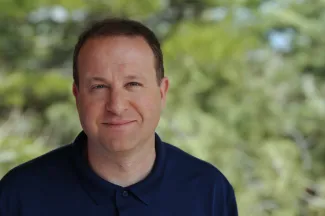
Since last year, Governor Jared Polis has maintained that he will review any request for a pardon or commutation for Peters as he would any other request. But he appeared to go further in an interview with CBS Colorado last week, for the first time describing Peters’ sentence as “harsh.”
The comment has again raised alarm bells among Colorado elections officials, including Secretary of State Jena Griswold and the Colorado County Clerks Association, who in a joint letter Tuesday renewed their repeated requests to Polis not to grant leniency to Peters.
“Peters was found guilty of seven felonies and misdemeanors by a jury of her peers, in conservative Mesa County,” the letter said. “Today, she remains one of the only people to face real accountability for attacking American elections. She has taken no responsibility for her actions and has shown no remorse.”
The letter — signed by Griswold, CCCA director Matt Crane and Hayle Johnson, the Republican Jackson County Clerk and CCCA president — said a pardon or commutation of Peters’ sentence would “embolden election denialism in Colorado and across the country.”
“It would send a loud message to those who would attack our elections and democracy that they too may have immunity. It also would send the demoralizing message to those of us who protect our elections and democracy — our county clerks, their staff, election judges, and Secretary of State staff — that our work is meaningless.”