Colorado’s historic winter warmth shatters previous temperature records

Colorado’s warm winter broke the previous record for highest average temperature by nearly 2 degrees Fahrenheit, researchers at Colorado State University confirmed Tuesday.
The record-shattering heat makes Colorado one of nine states in the West to have experienced their warmest winter on record in 2025-26, according to the National Oceanic and Atmospheric Administration. County-level NOAA data shows roughly one-third of the U.S. population experienced record winter warmth as measured by daytime highs.
In Colorado, average temperatures from December through February were more than 8 degrees Fahrenheit above the 20th-century average and 1.6 degrees above the previous record, set in the winter of 1980-81.
©
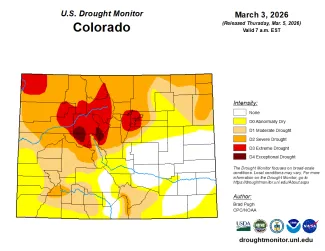
The unprecedented heat has been accompanied by well below-average precipitation in many parts of the state. In the mountains, statewide snowpack remains at its lowest levels in more than 40 years, and some northeastern parts of the state saw their driest winters on record.
“Although northeastern Colorado is typically quite dry during winter, this year was even drier than usual,” CSU’s Colorado Climate Center wrote in its monthly report. “The mountains received below-average snowfall and the western slope remained dry as well.”
In Fort Collins, nearly half of all days in December, January and March reached a high temperature of at least 60 degrees Fahrenheit, roughly twice the previous record. Records were also broken for most 60-degree days in Denver, Colorado Springs, Greeley, Alamosa and Cortez.
The state’s climate summary highlights what it calls a “staggering” statistic maintained by NOAA’s National Centers for Environmental Information: the one-, two-, three- and five-year periods ending in February are the warmest such periods on record in Colorado’s 131-year history of collected temperature data.
Rising levels of greenhouse gases in the Earth’s atmosphere, mostly the result of fossil-fuel combustion, caused average global temperatures to rise by more than 2.3 degrees Fahrenheit over pre-industrial levels as of 2024, according to NOAA data. Global warming is the driving factor in the “megadrought” that has impacted the Colorado River Basin in the last 25 years, the worst dry spell the region has experienced in more than a millennium.
Hotter, drier conditions in Colorado have stressed water supplies, made the state’s forests more vulnerable to insects and diseases, and greatly increased wildfire risk. The three largest wildfires in Colorado history all occurred in 2020, and the state’s 20 biggest fires on record have all occurred in the past 20 years.
In a report released last month, the progressive Colorado Fiscal Institute estimated that rising temperatures could cost the state at least $36 billion by 2050, largely through added public health costs attributable to excess heat, property losses from wildfires, increased stress on infrastructure and other factors.
“Because not every climate impact can be modeled with available data, these estimates should be viewed as conservative,” the report says. “They cover major, quantifiable pathways but do not include every hazard, indirect economic spillover, or nonfatal health effect.”