CSU’s new wildlife tracking collar uses biodegradable material

Click play to listen to this article.
Wildlife researchers often use GPS tracking collars to monitor key species to understand population health and activity but traditional collars do not always fall off in a predictable or safe way for the animals.
It is important for collars to detach because researchers cannot approach animals after collars are put on for safety reasons. Engineers at Colorado State University are developing an alternative to mechanical or cloth collar fasteners.
Kirk McGilvray, associate professor of mechanical engineering, said a polymer used in the new fasteners slowly degrades after exposure to rain, sunlight and animal sweat.
Courtesy USFWS/Ryan Moehring.
"Basically, the environmental inputs cause it to become weaker and weaker over time," McGilvray explained. "Eventually, it breaks. Well, when it breaks, it just harmlessly just drops off the collar for us."
McGilvray has a background in mechanical engineering and applied similar principles using tools in biomedicine. Polymers can be engineered for use in medical procedures, such as repairing a torn rotator cuff. As the cuff heals, the polymer eventually breaks down and is absorbed into the body.
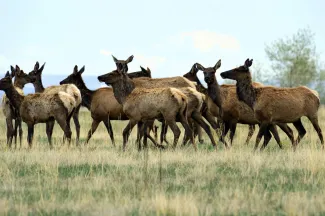
McGilvray’s team is currently testing the new collars with Colorado Parks and Wildlife on bighorn sheep and elk at the Foothills Wildlife Research Facility. Data gleaned from GPS tracking collars on deer have been used to identify where high-traffic migration corridors meet roads and highways in order to site wildlife overpasses.
"It’s very important for us to understand where they're moving through Colorado," McGilvray stressed. "This can help us develop systems such that they can avoid traffic and being hit by cars, for example."
GPS tracking collars often come with other sensors, including microphones, so researchers can better understand how animals communicate with each other. McGilvray added collecting data about how wild animals behave in their natural environment can also help us ensure they thrive.
"As humans start building houses and become more involved in rural areas, understanding how they behave so we don’t disrupt them becomes very important," McGilvray emphasized. "We don’t want to disrupt the local ecosystem."