Drought worsens dramatically across Colorado as warm, dry conditions persist

© KiowaCountyPress.net
Drought conditions worsened dramatically across Colorado during the past week as an unseasonably warm and dry late winter continued to grip the state, according to the latest report from the National Drought Mitigation Center. The new map, released Thursday and valid through March 24, reflects some of the most severe spring drought conditions the state has seen since 2021.
Snowpack
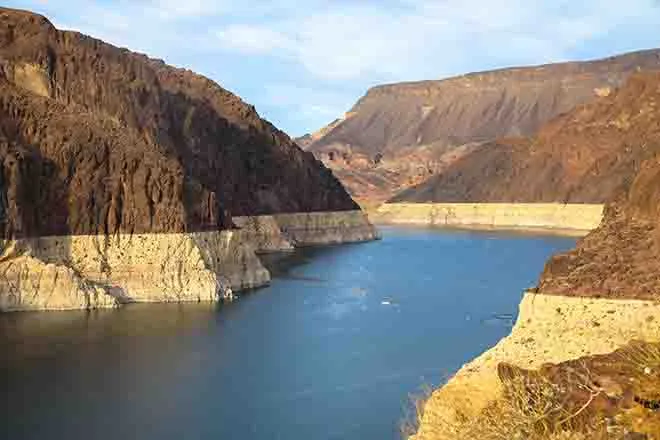
Low mountain snowpack remains a critical concern heading into the spring runoff season. Statewide snow water equivalent stood at approximately 54 percent of median as of last week, with no river basin in Colorado above 65 percent of average. Western Colorado monitoring stations are recording snowpack at or near their lowest levels in more than four decades.
The situation is a sharp contrast to one year ago, when the statewide snowpack was near average after a wet March delivered above-median precipitation across the state. Denver recorded its second warmest meteorological winter on record, and February 2026 was the second February in recorded history with no measurable snowfall in the city.
Drought Conditions
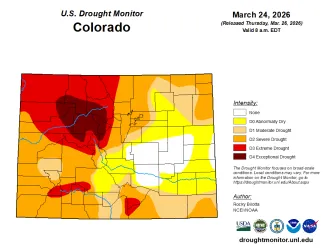
The newest drought monitor shows significant deterioration from the previous week. Exceptional drought — the most severe category — expanded substantially in northwest Colorado, while extreme drought spread across much of the state. No drought improvements were made in Colorado this week. Temperatures soared up to 25 degrees above normal during the past week, with little to no precipitation across most of the state.
©
Mountain counties are among the hardest hit. Eagle County is entirely covered by extreme or exceptional drought, with 95 percent of the county in exceptional drought. Summit County is similarly impacted, with 89 percent in exceptional drought and the remainder in extreme conditions. In Grand County, 49 percent is in exceptional drought and 51 percent in extreme drought. Pitkin County has 29 percent in exceptional drought and 71 percent in extreme conditions. Jackson County and Routt County are entirely in extreme or exceptional drought, with Routt County at 38 percent exceptional.
On March 16, Governor Jared Polis activated Phase 2 of Colorado’s Drought Response Plan and convened the state’s Drought Task Force. National Weather Service outlooks indicate that warmer- and drier-than-normal conditions are expected to continue through at least the first week of April.
Statistics
Overall, just 9 percent of Colorado is drought-free, down from 14 percent the previous week, while an additional 17 percent is abnormally dry. Moderate drought decreased from 29 to 15 percent, while severe drought expanded from 27 to 35 percent. Extreme drought rose from 12 to 18 percent, while exceptional drought surged from one to six percent.
One year ago, 38 percent of Colorado was drought-free, while 33 percent was abnormally dry. Twenty percent of the state was experiencing moderate drought, with seven percent in severe conditions. Extreme drought accounted for one percent of the state. None of Colorado was in exceptional drought — the worst category.
Colorado Drought Percentages for March 24, 2026
Week | Date | None | D0 | D1 | D2 | D3 | D4 |
|---|---|---|---|---|---|---|---|
| Current | 3/24/26 | 9 | 17 | 15 | 35 | 18 | 6 |
| Last Week to Current | 3/17/26 | 14 | 16 | 29 | 27 | 12 | 1 |
| 3 Months Ago to Current | 12/23/25 | 37 | 26 | 21 | 14 | 1 | 1 |
| Start of Calendar Year to Current | 12/30/25 | 29 | 33 | 22 | 13 | 2 | 1 |
| Start of Water Year to Current | 9/30/25 | 46 | 9 | 9 | 22 | 14 | 0 |
| One Year Ago to Current | 3/25/25 | 38 | 33 | 20 | 7 | 1 | 0 |
Just over 3,629,000 Colorado residents live in a drought-impacted area. Colorado’s 2023 population was estimated at 5,877,610.
Drought categories include (ranked from least to most severe) abnormally dry (D0), moderate (D1), severe (D2), extreme (D3), and exceptional (D4) drought.