Extreme drought tightens grip on Colorado high country as severe conditions spread

© KiowaCountyPress.net
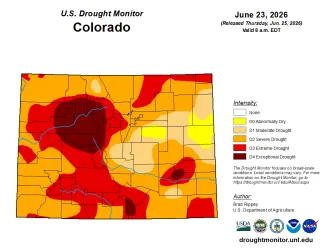
Drought tightened its hold on Colorado this week, with extreme and exceptional conditions blanketing the central mountains and severe drought spreading across much of the state, according to the National Drought Mitigation Center. The U.S. Drought Monitor map released Thursday, June 25, reflecting data through Tuesday, June 23, showed no part of Colorado free of drought, with the most punishing conditions concentrated in the high country of the central and northern Rockies.
©
Snowpack
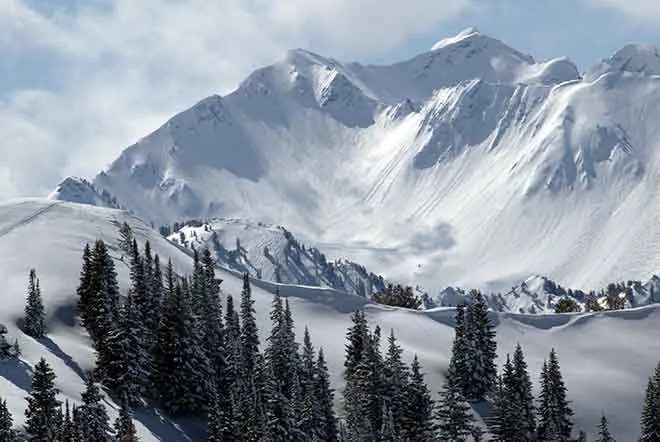
By late June, Colorado’s seasonal mountain snowpack has all but melted out across the state, a normal seasonal transition that turns attention to soil moisture, streamflow and reservoir storage as summer settles in. This year, however, the snow gave way to ground already running a deficit after a dry winter and spring, leaving little cushion against the heat and wind now driving conditions downhill.
The toll is clearest in the mountains, where the U.S. Drought Monitor now rates broad areas of the central and northern Rockies in extreme and exceptional drought. The contrast with a year ago is stark: on June 24, 2025, no part of Colorado had reached exceptional drought and extreme drought covered only about 5 percent of the state. Today exceptional drought alone grips nearly a tenth of Colorado, and the worst of it sits squarely over the headwaters that feed the state’s rivers and reservoirs.
Drought Conditions
Exceptional drought (D4), the most severe category on the scale, now covers the entirety of the central mountains’ hardest-hit counties, according to the U.S. Drought Monitor. Eagle and Pitkin counties were each rated 100 percent in exceptional drought. In Summit County, exceptional drought covered 88 percent of the land, with the rest in extreme drought. Grand County stood at 54 percent exceptional and 41 percent extreme drought, while Routt County registered 33 percent exceptional and 13 percent extreme.
Statewide, the footprint of the worst drought grew over the week. Extreme drought or worse expanded to cover 38 percent of Colorado, up from about 35 percent a week earlier, while severe drought or worse climbed to nearly 85 percent of the state, according to the U.S. Drought Monitor. The shift reflected moderate drought areas sliding into more serious categories rather than any meaningful relief.
The deterioration tracked with a broader regional pattern. In its weekly summary, the National Drought Mitigation Center noted that “deterioration was observed in parts of Colorado and Wyoming” even as rains improved conditions farther east in Nebraska and Kansas. The strain showed up on the land as well: 63 percent of Colorado’s winter wheat and 63 percent of its rangeland and pastures were rated in very poor to poor condition as of June 21, among the worst ratings in the High Plains.
Statistics
The U.S. Drought Monitor reported no part of Colorado free of drought for a second straight week. Abnormally dry conditions (D0) edged up to 3 percent of the state from 2 percent, and moderate drought (D1) eased to 12 percent from 18 percent as those areas worsened into higher categories. Severe drought (D2) rose to 47 percent from 45 percent, extreme drought (D3) climbed to 29 percent from 26 percent, and exceptional drought (D4) held steady at 9 percent.
A year ago, Colorado’s drought picture was far less severe. On June 24, 2025, 40 percent of the state was free of any drought, moderate drought covered 23 percent and severe drought 17 percent. Extreme drought reached just 5 percent of Colorado, and no part of the state had fallen into exceptional drought — the category that now grips nearly a tenth of Colorado.
| Week | Date | None | D0 | D1 | D2 | D3 | D4 |
|---|---|---|---|---|---|---|---|
| Current | 6/23/26 | 0 | 3 | 12 | 47 | 29 | 9 |
| Last Week to Current | 6/16/26 | 0 | 2 | 18 | 45 | 26 | 9 |
| 3 Months Ago to Current | 3/24/26 | 9 | 17 | 15 | 35 | 18 | 6 |
| Start of Calendar Year to Current | 12/30/25 | 29 | 33 | 22 | 13 | 2 | 1 |
| Start of Water Year to Current | 9/30/25 | 46 | 9 | 9 | 22 | 14 | 0 |
| One Year Ago to Current | 6/24/25 | 40 | 14 | 23 | 17 | 5 | 0 |
Just over 4,960,000 Colorado residents live in a drought-impacted area. Colorado’s 2023 population was estimated at 5,877,610.
Drought categories include (ranked from least to most severe) abnormally dry (D0), moderate (D1), severe (D2), extreme (D3), and exceptional (D4) drought.