Feds announce water cuts under new Colorado River plan

The Bureau of Reclamation released its two-year operating plan on Friday detailing how the agency will manage the Colorado River, and the nation’s two largest reservoirs Lake Powell and Lake Mead, amid ongoing drought and record low water storage.
Under the new federal framework, Nevada, California, and Arizona will be required to reduce their water use by 1.25 million acre-feet over the next two years, with Nevada facing a reduction of 50,000 acre-feet. Arizona will have to reduce its water use by 760,00 acre-feet, while California will have to cut about 440,000 acre-feet.
The three states will also provide an additional 700,000 acre-feet of water conservation over the next two years under the plan.
© iStock - ventdusud
The stalemate reflects ongoing tensions that prompted the federal government to impose cuts on lower basin states earlier this year as the drought deepened.
If conditions worsen, the Lower Basin states could be required to cut up to 3 million acre-feet of water– roughly about 40% of their supply per year. The plan doesn’t outline how those cuts would be divided among the three states.
“These decisions provide a water management strategy for Basin stakeholders to respond to the prolonged drought by incorporating flexible tools and voluntary actions while leaving room for consensus agreements,” said Andrea Travnicek, the Interior Department’s assistant secretary of water and science.
The federal government also released its record of decision finalizing a 10-year framework that emphasizes voluntary reductions and flexibility for future adjustments as Colorado River basin states continue to work towards a consensus agreement.
For the last three years, the Upper Basin states and the Lower Basin states have blown through deadline after deadline in attempts to come to a seven-state consensus.
The states have struggled to find lasting solutions, with federal officials acknowledging that the current plan is a temporary fix rather than a permanent answer to the crisis.
JB Hamby, chairman of the Colorado River Board of California and California’s chief negotiator, said the framework established “a workable path for the next two years” but warned it was “a bridge, not a permanent solution.”
Hamby called on Upper Basin states – Colorado, Utah, Wyoming, and New Mexico – to cut water use and “maintain sustainable deliveries to the Lower Basin.”
© iStock - Molina86
Reclamation set a target for voluntary water cuts in Upper Basin states of up to 200,000 acre-feet, but the framework does not include mandatory water cuts for Upper Basin states.
Tom Buschatzke, the director of the Arizona Department of Water Resources and the state’s top water negotiator, said he welcomed the short-term agreement which he said would allow Lower Basin states to focus on a “longer-term, equitable, basin-wide outcome that includes shared sacrifices along with our Upper Basin partners in an effort to avoid protracted litigation.”
The new guidelines will be issued every two years, based on the framework, and implemented through annual plans.
The new framework is a departure from the 1922 Colorado River Compact, which allocated 7.5 million acre-feet for each basin. That measure was based on a faulty model that assumed the river system could supply 15 million acre-feet annually.
Officials acknowledge only 12.4 million acre-feet flows from the river each year, meaning more than 3 million acre-feet of cuts are needed to bring the Colorado River back into balance. Since the turn of the century, Lake Mead has lost more than 65% of its storage.
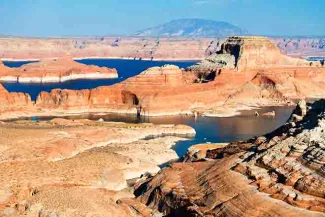
Lake Powell and Lead Mead both hit record lows this month. Water levels at Powell sat at 3,519 feet above sea level on August 20 — just 9 feet above the level Reclamation says is critical for continued hydropower at Hoover Dam. Combined the two reservoirs have not been this low since Lake Powell began filling in 1963, according to Reclamation.