Heat advisory covers Kiowa County Sunday as triple digits settle over southeast Colorado

The National Weather Service has placed Kiowa County under a heat advisory for Sunday, when forecasters expect temperatures of 100 to 105 degrees from 10 a.m. to 9 p.m. The advisory, issued from the weather service's Pueblo office at 1:52 a.m. Saturday, warns that "hot temperatures may cause heat illnesses."
Kiowa County is one of a dozen Colorado counties drawn into a heat event that stretches well beyond the state line. A separate advisory took effect at 11 a.m. Saturday for Otero, Bent and Prowers counties — including La Junta, Las Animas and Lamar — where 100 to 105 degrees was expected. Those same counties are forecast to reach 103 to 108 degrees Sunday, the hottest readings in the region. Crowley and Baca counties join the Sunday advisory, along with parts of the Front Range and northeastern plains.
Forecast highs for the towns the Press follows most closely climb through the weekend: Eads is expected to reach 100 Saturday and 105 Sunday, Cheyenne Wells 100 and 104, and Lamar 104 Saturday and 107 Sunday. Monday brings little relief, with Lamar forecast at 107 again and Eads and Cheyenne Wells near 102.
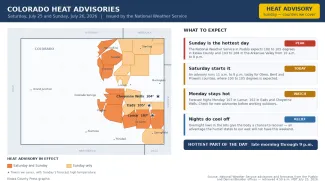
At a glance: where the advisories are in effect
©
Heat advisories issued by the National Weather Service offices in Pueblo and Denver/Boulder, retrieved 4:50 a.m. MDT Saturday, July 25, 2026. Advisory areas are the weather service's own forecast zones. Star temperatures are Sunday's forecast highs.
(Kiowa County Press)
What the weather service is saying
Forecasters at the Pueblo office, which covers Kiowa, Prowers, Bent, Otero, Crowley and Baca counties, said upper-level high pressure sitting over the region will keep hot temperatures in place through the weekend, with daily showers and storms limited mostly to the higher terrain to the west. The advisory's guidance to residents is brief and specific: "Drink plenty of fluids, stay in an air-conditioned room, stay out of the sun, and check up on relatives and neighbors."
© iStock - Xurzon
A heat advisory is the weather service's mid-level heat product. The agency defines it as an alert issued "for dangerous heat conditions that are not expected to reach warning criteria," and advises the public to "consider postponing or rescheduling outdoor activities, especially during the heat of the day." The more serious product, an extreme heat warning, is reserved for what the agency calls "extremely dangerous heat conditions." Readers who remember the term "excessive heat warning" should note it was retired in March 2025; the current name is extreme heat warning.
One local detail is worth understanding when comparing forecasts across the state line. The Pueblo office is expressing this weekend's danger in plain air temperature — "temperatures of 100 to 105 expected." Weather service offices in Goodland and Dodge City, Kan., are using heat index values for the same weekend, because humidity there is far higher. Weather service policy directs local offices to set heat criteria for their own climates, so the two regions are being measured with different yardsticks. One figure applies everywhere: the heat index assumes shade, and the agency notes that "exposure to full sunshine can increase heat index values by up to 15°F."
A heat wave centered east of Colorado
Colorado sits on the western, drier edge of a much larger event. As of Saturday morning, Colorado had 10 heat advisories in effect and no extreme heat warnings. Kansas had three extreme heat warnings, 12 advisories and two watches, with heat index values forecast as high as 113 in the eastern part of the state. Nebraska had five extreme heat warnings, Oklahoma three and South Dakota two. Wyoming, Utah and Texas were also under heat products.
The nearest warnings to Kiowa County are in Kansas. Counties along the Colorado border served by the Goodland office — including Sherman, Wallace and Greeley — were under a heat advisory Saturday with heat index values up to 110.
Southeast Colorado does hold one advantage this weekend. Overnight lows are forecast in the mid-60s at Eads and Cheyenne Wells and near 70 at Lamar, giving the body a genuine chance to recover after dark. The weather service notes that its warning criteria elsewhere account for nighttime lows staying at or above 75 degrees, a threshold this region is not expected to reach.
Know the difference: heat exhaustion and heat stroke
Heat exhaustion and heat stroke are not the same emergency, and the distinction matters most in a county where an ambulance may be a long drive away. The symptom lists below are published by the National Weather Service, which credits the Centers for Disease Control and Prevention, and appear in identical form on the Colorado Department of Public Health and Environment's heat page.
Heat exhaustion: heavy sweating; weakness or tiredness; cool, pale, clammy skin; a fast, weak pulse; muscle cramps; dizziness; nausea or vomiting; headache; fainting. Move the person somewhere cooler, loosen clothing, apply cool, wet cloths or have them sit in a cool bath, and offer sips of water. Seek immediate medical attention if the person vomits, becomes confused, or symptoms worsen or last longer than an hour.
Heat stroke — call 911: throbbing headache; confusion; slurred speech; nausea; dizziness; a body temperature above 103 degrees; hot, red, dry or damp skin; a rapid, strong pulse; fainting; loss of consciousness. The weather service's instruction is unambiguous: "Call 911 or get the victim to a hospital immediately. Heat stroke is a severe medical emergency. Delay can be fatal." Move the person somewhere cooler and reduce body temperature with cool cloths or a bath — but do not give fluids.
One point deserves emphasis because it runs against common assumption: sweating does not rule out heat stroke. The weather service lists the skin as "hot, red, dry or damp." As Colorado's health department puts it, "heat stroke means your body's cooling system is failing, so you may not be sweaty."
The Occupational Safety and Health Administration takes an even simpler line for people working in the heat, cautioning against trying to sort out which illness is occurring: "Diagnosis is often difficult because symptoms of multiple heat-related illnesses can occur together. Time is of the essence." Its instruction is to cool the person and call 911 when in doubt, and never to leave someone with heat illness alone.
Who is most at risk
The weather service lists young children and infants, older adults, people with chronic medical conditions and pregnant women among those most vulnerable to heat. The CDC notes that older adults do not adjust as well to sudden temperature changes, are more likely to have a chronic condition that changes the body's response to heat, and are more likely to take prescription medicines that affect the body's ability to control temperature or to sweat.
Colorado's health department names rural isolation directly, urging residents to "check on your neighbors to ensure people in more isolated settings — rural settings, older individuals living alone, and those with disabilities — stay safe during higher temperature events."
For households without central air conditioning, the weather service adds a warning that is easy to get wrong: "Do not direct the flow of portable electric fans toward yourself when room temperature is hotter than 90 degrees. The dry blowing air will dehydrate you faster, endangering your health." The agency gives the same caution in its heat stroke first aid, advising that a fan may make a person hotter once heat index values climb into the high 90s.
The weather service also repeats a warning that applies every summer: it is never safe to leave a child, a person with a disability or a pet in a parked car. The agency reported 31 children died in hot cars in 2025.
Working outdoors: the first days are the dangerous ones
For farm and ranch work, the most striking federal statistic is about timing rather than temperature. OSHA reports that "almost half of heat-related deaths occur on a worker's first day on the job or a worker's first day back after an extended absence," and that "over 70 percent of heat-related deaths occur during a worker's first week."
That matters this weekend because of how broadly the agency defines a new worker. OSHA's list includes not only those returning after a week or more away, but "workers who work on days when the weather is significantly warmer than on previous days" — a heat wave, in other words, leaves nearly everyone less adapted than they think. The agency recommends building up exposure gradually, beginning at about 20 percent of the normal workload on the first day and increasing by no more than 20 percent per day, and notes full acclimatization can take two weeks or longer.
The National Institute for Occupational Safety and Health adds two details worth knowing: tolerance is largely lost after a week away but can be regained in two or three days back in the heat, and air conditioning does not cause a person to lose it. Sleeping or taking breaks in a cooled room does not undo heat tolerance, and OSHA recommends air conditioning for rest breaks.
Where a buddy system is not possible, OSHA advises checking on workers several times an hour to make sure they are using water and shade and are not showing symptoms.
Colorado's farm and ranch heat rule was rewritten in February
Colorado has binding heat requirements for agricultural employers, and the rule was replaced in full effective Feb. 1, 2026 — so guidance saved from earlier years is out of date. The Agricultural Labor Conditions Rules, adopted by the state Department of Labor and Employment, apply on days when the temperature at an agricultural worksite is, or is forecast to be, at least 80 degrees.
Under the rule, employers must provide at least 32 ounces of water per hour per employee, kept at 60 degrees or cooler, located no farther than a quarter mile from the worksite for workers on foot. The rule is unusually specific about what does not count as shade: it excludes any area where machinery, exhaust or heat-radiating structures add heat, anything farther than a quarter mile away, spaces too small for workers to sit fully shaded without touching one another, and the cab of a vehicle that is not air conditioned.
A second tier of requirements applies in what the rule calls increased risk conditions — including a forecast or measured high of at least 95 degrees, an air quality advisory, or shifts longer than 12 hours. In those conditions, no more than two hours of work may be performed before at least 10 minutes of rest. Notably, the rule treats an employee's first four workdays as an increased risk condition in itself, placing a new hand in the same category as a 95-degree day.
The rule also anticipates the distances involved in ranch country. Where a range or ranch worker spends most of the day mobile — on horseback or an ATV — employers must comply as fully as possible, including resupplying water whenever they visit the worker and providing a means to carry water. Employers must designate someone to call emergency services and to give responders directions to reach the worker.
These requirements govern agricultural employers and their hired employees; questions about who is covered should go to the state Division of Labor Standards and Statistics. The same measures are what federal agencies recommend for anyone working in heat, hired or not.
Watching livestock: the panting score
The U.S. Department of Agriculture's Agricultural Research Service publishes a six-stage panting score that requires nothing but a look at the pen. Early stages show elevated breathing, restlessness and more time standing. By stage three, cattle show excessive drooling or foaming; at stage four, open-mouth breathing; at stage five, open-mouth breathing with the tongue protruding and pushing from the flanks.
Stage six carries a detail worth committing to memory: breathing becomes labored and the respiration rate may actually decrease, with the head down and individual animals isolating from the herd. A producer watching only for faster breathing can mistake a failing animal for a recovering one. The agency's guidance is that as more animals show signs of increasing heat stress, action should be taken.
For water, the research service notes summer intake may exceed nine gallons per head per day, and that intake falls once water temperature climbs above 80 degrees — a reason to keep pipes shaded and buried at least two feet. It also recommends checking tank refill rates, since many animals drink at once in heat, and allowing 1.5 inches of tank perimeter per head.
Its guidance during a heat event begins with a single instruction in capital letters: do not move animals. Observe them for signs of heat stress, and consider wetting the animals or the ground.
The days ahead
The heat is forecast to ease only gradually. After Sunday's peak, Monday remains hot — 107 at Lamar and near 102 at Eads and Cheyenne Wells — before highs settle back into the mid- and upper 90s at Eads and Cheyenne Wells by midweek. Lamar is forecast to stay near or above 100 through Thursday. Because advisories are issued a day or two at a time, residents planning outdoor work Monday should check for new products rather than assume the weekend's advisories are the end of it.
Forecasters in Pueblo say another surge of monsoon moisture is expected next week, which would ease the heat but raise a different hazard: the office flagged flash flooding concerns over burn scars and already-saturated soils.
Current watches, warnings and advisories are available at weather.gov. Heat safety information is published by the National Weather Service at weather.gov/safety/heat, by the Colorado Department of Public Health and Environment at cdphe.colorado.gov/heat-health, and for outdoor workers by OSHA at osha.gov/heat.