How party politics divided Colorado in 1876 — and eased its path to statehood

© ogichobanov - iStock-1088402018
The headline in the Jan. 23, 1876, edition of the Rocky Mountain News was a calculated provocation: “Jeff Davis Elected President.”
The column that followed, which purported to be a dispatch from “Nov. —, 188–,” told the fictional history of a future presidential campaign won by the “arch-traitor” Jefferson Davis.
“The ‘On to Washington’ that Davis proclaimed from the capital of the Confederacy in 1861, for all the blood that was spilt to prevent it, is at last, after many years, realized,” the News wrote.
© Evgeniy Grishchenko - iStock-2155580431
The unusual editorial was occasioned by the biggest national political controversy of January 1876: In the U.S. House of Representatives, lawmakers were debating whether to grant amnesty to about 750 of the most senior ex-Confederate officials, nullifying their disqualification from office-holding under the insurrection clause of the 14th Amendment.
Most rank-and-file Confederates had received similar relief in a series of general amnesty measures a few years earlier. The details of these amnesty measures, and the widespread fear they could lead to a President Jefferson Davis, would be raised again in Colorado politics 147 years later, in the trial over an attempt to bar President Donald Trump from the state’s 2024 ballot under the insurrection clause, an effort that was ultimately blocked by the U.S. Supreme Court.
The House’s 1876 measure failed, falling short of the two-thirds majority for amnesty required under the 14th Amendment. But the broadside from the News — published by William Byers, a leading figure in the Colorado Territory’s dominant Republican Party — reflected the growing anxiety among GOP leaders about the party’s souring electoral fortunes and the future of Reconstruction in the South.
The fact that an issue like amnesty for high-ranking ex-Confederates had been taken up by Congress at all was a sure sign of the Democratic Party’s resurgence. In the 1874 midterms, Democrats had captured the House majority for the first time since the Civil War. With the country still reeling from the Panic of 1873 and President Ulysses S. Grant’s administration plagued by scandal, the opposition party hoped to follow it up with victory in the 1876 presidential election.
Colorado’s admission into the Union ahead of that election was an overtly partisan political maneuver by Republicans, who felt assured of the new state’s three electoral votes. In early 1875, the GOP-controlled Congress had passed a Colorado statehood act even as it defeated a similar measure for Democratic-leaning New Mexico, which wouldn’t be admitted as a state until 1912.
But Democrats had even made inroads in Colorado, where voters in 1874 had elected Democrat Thomas Patterson, an Irish-born Denver lawyer, as the territory’s non-voting delegate to Congress, the first Democratic electoral victory after 14 years of Republican control of the lone delegate seat.
Partisan conflict in the territory
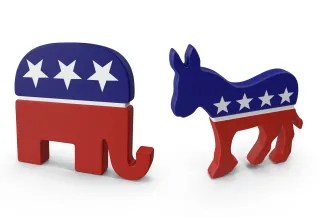
Though Americans in the 19th century were often bitterly divided along party lines, the nature of partisan conflict was less ideological than it would later become. Differences of opinion on the major social and economic questions of the day — tariffs, monetary policy, corporate regulation, suffrage, temperance and more — existed within both parties, making partisan affiliation in the 1870s “as much about identity as issues,” writes historian Richard White.
Especially in the relatively small and remote Colorado Territory, community ties and patronage networks often mattered more to party loyalists than Republicans’ support for civil rights in the South or Democrats’ populist attacks on the national banks.
© fitimi - iStock-528483210
“These broad general stances … were only partly what made people Democrats or Republicans,” White writes in “The Republic for Which It Stands,” a history of Reconstruction and the Gilded Age. “Nurtured by the blood of the Civil War and deep ethnic, religious, and regional loyalties, parties demanded a richer diet than principles could provide.”
Denver, by far the Colorado Territory’s largest city, was a Republican stronghold, still controlled by the “Denver Ring” of influential businessmen, including Byers, the Rocky Mountain News proprietor, who in the late 1860s had triumphed over the “Golden Gang” to make Denver the territory’s capital and main railroad hub. Republican control of territorial offices and civil service positions under the Grant administration further solidified the loyalties of Colorado’s nascent GOP political establishment.
Southern Colorado, with its large Hispanic population, was solidly Democratic, an association strengthened by the party’s generally pro-Catholic stance in an era when strains of nativism and anti-Catholicism still ran through the Republican Party. Three Hispanic delegates to Colorado’s constitutional convention — Casimiro Barela, Jesús María García, and Agapito Vigil — had been elected as Democrats from Las Animas and Bent counties.
The Hispanos of the San Luis Valley had been the first non-native people to settle Colorado, traveling north from New Mexico to found towns like Costilla and San Luis a decade before the Pikes Peak gold rush kicked off in 1859. But since the territory’s organization in 1860 its southern counties had felt neglected and discriminated against by the government in Denver. Some Hispanos even unsuccessfully petitioned for three San Luis Valley counties to be reannexed by the New Mexico Territory.
Laws in three languages
During the 1860s, a decade in which Hispanos in southern Colorado frequently found themselves targeted by land grabs, intimidation and mob violence, Spanish-speaking delegates to the territorial assembly had fought to require the use of an interpreter in legislative sessions and the translation of all territorial laws.
© tussik13 - iStock-908521486
They succeeded, despite objections voiced in newspaper editorials that frequently veered into abject racism, as well as the more genteel prejudices of men like Byers, who, though he advocated “treat(ing) our Spanish citizens in a fair and friendly way,” also wished for them “to become Americanized as rapidly as possible.”
At the Jan. 25, 1876, meeting of the constitutional convention, García moved to consider a resolution introduced earlier in the month by Barela, amending it slightly to enshrine in the new constitution a requirement that the “General Assembly … at each session, provide for the publication of all laws, general and special, in English and Spanish.”
Frederick J. Ebert, a Republican delegate from Denver and a member of the city’s growing German-American population, moved to further amend the proposal, “to provide for the printing of all laws in the German language, as well as English and Spanish.”
The resolution would be referred to a committee and undergo further revision, but the constitution adopted later in 1876 retained a requirement for Spanish and German translation until the year 1900, making Colorado “the only state which had at any one time parallel editions of session laws in three languages.”