Oregon policy driving low rates of childhood vaccinations

In honor of Immunization Awareness Month, the federal government used a new presidential executive order to continue its assault on childhood immunizations. It was surprising and dangerous to hear the same claims used to scare and confuse parents for years now being used to justify changes to national vaccine policy.
And it could not come at a worse time.
New data released earlier this year shows Oregon’s schoolchildren have some of the lowest
rates of immunization in the nation, and that state policies are driving that reality.
© PeterHermesFurian - iStock-1346531706
Immunizations are our central defense against the spread of communicable diseases, including the current outbreaks of measles and whooping cough. In a time when misinformation is being spread at the highest level in an effort to confuse parents and complicate vaccine access, we need state policies that stand firm on the safety and importance of widespread vaccination.
Yet Oregon allows unvaccinated children to attend schools and daycare if parents choose to simply exempt a child from vaccination requirements. Legislators should change that policy to protect our kids.
The Oregon Health Authority recently reported that the share of parents claiming a non-medical exemption from school vaccination requirements hit a record high in the 2025-2026 school year, over one in 10 students.
Use of these exemptions, distinct from those obtained for medical necessity, has grown dramatically over the last decade and is a primary contributor to why we have some of the lowest youth immunization rates in the country. Currently, our percentage of kindergarteners up to date on vaccinations is 85.6%.
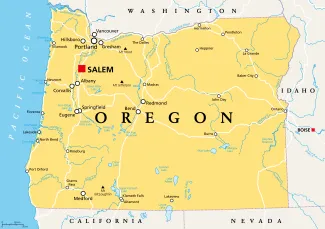
Despite the dangers that come with measles and polio returning to our communities, Oregon’s school vaccine laws continue to be some of the most permissive in the nation; our non-medical exemption rate is the third highest in the nation, behind only Idaho and Utah.
© iStock - Geerati
A big reason why we have such high rates of non-medical exemption is that in Oregon, it is easier and faster to get a non-medical exemption to school vaccine requirements than it is to get your child
vaccinated. It takes watching one 30-minute presentation online, and after you complete it once, your child is exempt for their whole school career.
As a community, we need to have a 95% vaccination rate for vaccines to do their jobs effectively and provide collective immunity. As our non-medical exemptions increase, our vaccination rates drop well below 95%, which exponentially increases our risk of dangerous diseases spreading throughout our communities and hitting our most vulnerable populations, like newborn babies, elderly grandparents, and cancer patients.
If you look at pertussis (whooping cough) vaccination rates for Oregon’s kindergartners between 2011 and 2025 next to the rates of reported pertussis cases during that time period, you can see that once we dropped below collective immunity thresholds in 2022, our pertussis cases skyrocketed.
The data is clear: personal or philosophical exemptions that allow unvaccinated children to attend school have led to rising measles, whooping cough, or pertussis cases. Infants and young children, the most vulnerable to these diseases, have been especially hard hit by these outbreaks.

© iStock - undefined unedfined
The Center for Outbreak Response Innovation published a map that confirms that places like Oregon with lower vaccination rates have higher cases of measles. The CDC’s own study from last year found that 82% of measles cases occurred in communities with lower vaccination rates.
In states like Florida and South Carolina, where school vaccine laws are weak and immunization rates are low, measles cases are exploding, with 670 cases in South Carolina alone.
As U.S. Health and Human Services Secretary Robert F. Kennedy Jr. continues to threaten vaccine access and spread dangerous misinformation, vaccination rates are dropping across the country — except in states that don’t allow non-medical exemptions.
As a mom, I see measles cases as not only a threat to my newborn niece or my at-risk mother, but as a disruption of our community. When measles outbreaks happen, schools and childcare centers close. Many of us do not have backup childcare or the ability to take indefinite time off work.
Parents lose their jobs, and our state has to fund a public health response we can’t afford. The CDC study of the 2019 measles outbreak in Clark County, Washington, estimated $2.3 million in public health response costs, $76,000 in direct medical costs, and $1 million in productivity losses.
We have a clear, scientifically proven solution to this problem: close the loophole and remove non-medical exemptions in Oregon.
A recent poll found that 73% of Oregon voters support school vaccination requirements and 60% oppose non-medical exemptions.
When Maine implemented legislation to remove non-medical exemptions, the state reached collective immunity levels and avoided a widespread outbreak this year when an individual brought measles into the state after traveling. Strong policies send a strong message to parents, which we need desperately as the federal government works to dismantle trust in vaccines.