State Senator Julie Gonzales launches primary challenge against Senator Hickenlooper

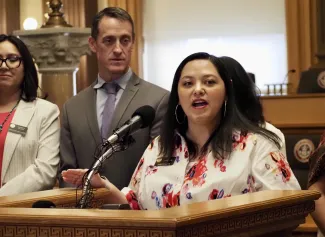
Democratic state Senator Julie Gonzales on Monday announced she is running to unseat U.S. Senator John Hickenlooper in 2026, aiming to ride a wave of liberal and progressive dissatisfaction with Democratic leadership to an upset primary victory.
Gonzales’ announcement, rumored for weeks, sets up a clash in Colorado between a leading progressive voice at the state Legislature and a business-friendly moderate who has been a fixture in Colorado politics for roughly three decades.
©
In an interview, Gonzales called the 2026 midterm elections “a defining moment for the future of the Democratic Party.”
“What sort of party do we want to be?” Gonzales said. “Do we want to send back John Hickenlooper, a go-along-to-get-along incrementalist, or do we want to send a proven legislator, with a track record of taking on big fights against a well-funded corporate lobby, who’s gotten s*** done?”
Gonzales said Hickenlooper has failed to offer a “bold and fierce critique” of President Donald Trump’s second term agenda, faulting him for his votes earlier this year to confirm many of Trump’s Cabinet appointees. The path forward for Democrats after a bitter defeat in the 2024 election, she argued, is to embrace “policies that will have transformative impacts on everyday working people’s lives,” like “Medicare for All” and universal child care.
“The work begins day one, to remind folks that we can actually have nice things — you just need people willing to fight for them,” Gonzales said. “We have the opportunity to get the profit motive out of our health care system, and to enact universal health care. We have the opportunity to enact universal care for children, for elders. It requires us to reassess our policy priorities.”
Hickenlooper, a former brewpub entrepreneur and real estate developer, was elected mayor of Denver in 2003 and served two terms as Colorado governor beginning in 2011. During an ill-fated 2020 presidential campaign, he insisted he was “not cut out to be a senator,” but months later acquiesced to party leadership’s efforts to recruit him to challenge former GOP Senator Cory Gardner, whom he went on to defeat soundly to help Democrats capture a razor-thin Senate majority.
Hickenlooper was among a group of 22 Democrats and Republicans who crafted the 2021 Bipartisan Infrastructure Law, championing provisions to expand broadband access and boost investment in electric vehicle charging stations, and he was credited by activists with keeping alive the negotiations that ultimately led to Democrats’ passage of billions in spending to fight climate change in the 2022 Inflation Reduction Act.
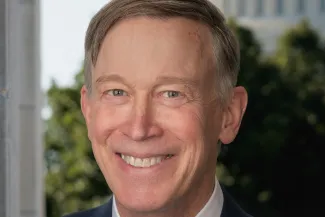
Colorado Senator and former Governor John Hickenlooper
He would be 80 years old by the end of another six-year Senate term, which he has said would be his last. In an interview with 9News in April, Hickenlooper said that while he had considered passing the torch to a new generation, his breadth of experience as a mayor, a governor and a small business owner brings a “unique and valuable perspective to making decisions.”
The winner of the June 30 Democratic Senate primary will be heavily favored to win in the general election in November. Republicans have not won a statewide race in Colorado since 2016. Historical precedent, early polling data and special election results this year all suggest the party faces strong headwinds in the 2026 midterms. Two little-known Republican U.S. Senate candidates, former state Representative Janak Joshi and Marine Corps veteran George Markert, have raised a combined total of about $267,000 in campaign contributions, less than one-tenth of the $3.6 million war chest that Hickenlooper reported at the end of September, according to Federal Election Commission disclosures.
Gonzales, who began her career as a community organizer before running for the state Senate in 2018, expects much of that financial firepower to now be directed at her.
“I expect them to throw everything that they’ve got at me, but that’s not going to stop me. I have never backed down from a fight,” she said. “We might not outraise John Hickenlooper — we’ll sure as hell outwork him.”
Calls for generational change
It’s extremely rare for a sitting U.S. senator to be unseated by a primary challenge, though that rarity is a relatively recent development.
In 18 regularly scheduled elections between 1946 and 1980, a total of 36 Senate incumbents were defeated in primary elections, according to data compiled by the Brookings Institution. But in the 22 federal elections held since then, it’s happened just eight times. The last senator to suffer such a fate was former GOP Senator Richard Lugar of Indiana in 2012.
Gonzales’ Senate bid is more than just a challenge to Hickenlooper — it’s a breach of protocol within a Democratic Party that has, both at the national level and in Colorado specifically, placed a heavy premium on deference to seniority and the appearance of party comity.
Colorado’s strong Democratic bench includes three rising-star U.S. House members in their forties and plenty of prominent up-and-comers at the state and local levels. But twice in recent years — in Hickenlooper’s switch to the 2020 Senate race, and fellow U.S. Senator Michael Bennet’s unexpected run for governor in 2026 — a decision by a more senior party figure has largely cleared the field and put an end to announced and rumored candidacies by younger hopefuls.

© Baris-Ozer - iStock-1420488382
Gonzales, 42, would be the first woman elected to the U.S. Senate from Colorado, and the first Latina elected to any statewide office.
“I’ve worked hard, and I’ve followed all the rules — but I am not willing to sit around and wait for the boys’ club to say, now it’s time for a woman to run,” she said.
Calls for generational change within the Democratic Party have grown louder in the wake of a 2024 election loss widely attributed to former President Joe Biden’s failure to withdraw from the race earlier than he did. Criticism of the party’s “gerontocracy” may have reached a tipping point in 2025, a year during which three Democratic U.S. House members died in office — leaving their seats empty at a time when the GOP majority advanced its sweeping tax and spending bill by a one-vote margin.
At least three longtime House Democrats — former House Speaker Nancy Pelosi and Representatives Jerry Nadler of New York and Jan Schakowsky of Illinois — announced their retirements in recent months after drawing young primary challengers who voiced explicit concerns about their ages. In Massachusetts, 79-year-old Senator Ed Markey faces a primary challenge from 47-year-old Representative Seth Moulton, and in Maine, polls show first-time candidate Graham Platner, 41, with an early advantage over two-term incumbent Governor Janet Mills, party leadership’s pick to take on GOP Senator Susan Collins.
Three other lesser-known Democratic candidates — attorney Karen Breslin, software engineer Brashad Hasley and accountant A.J. Zimpfer — have also formally filed to run against Hickenlooper. To qualify for the Senate primary ballot, candidates can either submit 12,000 valid petition signatures by March 18 or win support from at least 30 percent of delegates at the 2026 state party assembly, scheduled for March 28 in Pueblo.
“I’ve seen hundreds of thousands of Coloradans take to the streets to proclaim ‘No Kings,'” Gonzales said, referring to this year’s nationwide anti-Trump demonstrations. “There is no guarantee for any elected official — you have to earn those votes. I think that when primary voters in Colorado have the opportunity to weigh in about the future of the leadership that they want representing them in Washington, D.C., they will support my candidacy.”
Different political eras
Gonzales said she first seriously considered a Senate bid during a special legislative session in August, when Colorado lawmakers were called back to the Capitol to close a billion-dollar budget gap triggered by congressional Republicans’ passage of their tax and spending law.
After two four-year terms representing Senate District 34, which includes much of north, west and downtown Denver, Gonzales is term-limited in 2026. She currently serves as chair of the Senate Judiciary and Ethics committees. Her proudest legislative accomplishments, she said, include sponsoring the Reproductive Health Equity Act, an abortion-rights law passed before the U.S. Supreme Court’s 2022 reversal of Roe v. Wade, and two immigrants rights bills — House Bill 19-1124 and Senate Bill 25-276 — that she said helped protect Colorado from overreach by Trump’s immigration authorities.
“Both are times when (some) Democrats — some of my more moderate colleagues, some of my more incrementalist colleagues — would say, ‘This is a lot. This is too hard to do,'” Gonzales said.
As governor, Hickenlooper presided over a much different era of state politics — one in which Republicans frequently controlled at least one chamber of the Legislature, along with the offices of attorney general and secretary of state. His moderate stances often frustrated many within his party, especially when it came to energy and environmental issues, which roiled the state during the 2010s fracking boom that coincided with his governorship.
An August poll by Magellan Strategies found that 49 percent of Coloradans disapproved of Hickenlooper’s job performance, compared to 37 percent who approved. A separate poll found that his favorability rating had declined to 43 percent last month from 49 percent in March.
Colorado’s increasing Democratic lean has made Hickenlooper an outlier in the Senate, a Newsline analysis found earlier this year. During the first three months of 2025, he voted with Trump and Republicans nearly 30 percent of the time despite representing a state that voted against Trump by 11 percentage points. No other Democratic senator had a voting record that was more at odds with their state’s partisan vote share.
After years of community organizing work, Gonzales won the District 34 primary in 2018 with 64 percent of the vote, after winning endorsements from progressive groups including the Working Families Party and the Denver Democratic Socialists of America. She joined the DSA in 2018, because they were “engaging young people in a manner that I hadn’t seen take place in years,” she said, though her membership has since lapsed. She cited New York City Mayor-elect Zohran Mamdani’s victory last month, however, along with wins for progressives at the local level in Colorado, as evidence that Democrats need to propose policy solutions that “meet the scale of the problems that we face.”
“Across the country, we saw progressives who led with their values, and who were unapologetic about being fighters for the working class, win,” Gonzales said.
It’s the same lesson that she takes from her tenure in the Legislature, where Democrats, despite frequent predictions of a backlash from voters, have been able to build durable majorities in both the House and Senate.
“Colorado is a blue state, and at the state Capitol, we have led,” Gonzales said. “We need that same type of partner in Washington, D.C., who is willing to be bold, unapologetic and relentless — and I’ve done that my entire career.”