Supreme Court takes anti-LGBTQ+ Catholic preschools case against Colorado

The U.S. Supreme Court will hear another case from Colorado involving the balance of state anti-discrimination protections for LGBTQ+ people and religious exemptions.
The Archdiocese of Denver and two Catholic preschools allege in a lawsuit that they were unable to participate in Colorado’s universal preschool program, known as UPK Colorado, because the state will not allow the religious educational institutions to exclude LGBTQ+ children and parents.
The St. Mary Catholic Parish in Littleton and the St. Bernadette Catholic Parish in Lakewood both operate preschool programs that were not part of UPK since the state requires providers to accept applicants without regard to the family’s religion, sexual orientation or gender identity.
© flickrcc - Alan Levine
The schools applied for public funding through the universal preschool program and were denied when they requested religious exemptions from the statutory equal-opportunity requirement. They claimed their rights under the free exercise clause of the First Amendment were violated by their exclusion.
A U.S. District Court of Colorado judge ruled in June 2024 that the UPK requirement that prohibits discrimination against LGBTQ+ families is valid. The Denver-based 10th Circuit Court of Appeals upheld the district court’s decision in October.
In the case, the Supreme Court will weigh in on aspects of a 1990 ruling in another case that raised the question of religious exemptions to state laws. The court held in Employment Division v. Smith that a person’s religious beliefs are not an exemption from compliance with a law against conduct the state is free to regulate.
The lawsuit is filed against Lisa Roy, executive director of the Colorado Department of Early Childhood.
Mardi Moore, CEO of LGBTQ+ advocacy organization Rocky Mountain Equality, said it “should be clear” that taxpayers should not fund discrimination.
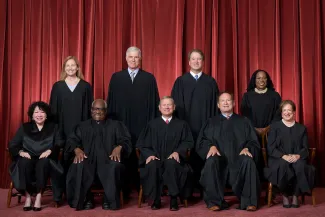
Memebers of the Supreme Court of the United States 2022 - WIkimedia - Public Domain
“Public funding carries public responsibility, and that basic contract cannot be selectively applied,” Moore said in a statement. “Rocky Mountain Equality stands firmly with the Colorado families fighting to uphold the nondiscrimination protections that Colorado has enshrined in law, and we urge the Court to affirm that equal rights and public funding are inseparable.”
Several court cases related to LGBTQ+ discrimination in Colorado have made their way to the nation’s highest court. Most recently, the court sided with a Christian counselor against Colorado’s law that bans licensed providers from conducting “conversion therapy,” a discredited practice of trying to change a person’s sexual orientation, such as to eliminate same-sex attraction, or gender identity. Other cases include one in which the Supreme Court said a Colorado web designer does not have to make websites for same-sex couples, and another in which the court said a cake shop owner could deny a same-sex couple a wedding cake based on religious beliefs.
Nick Reaves, an attorney with Becket Fund for Religious Liberty who represents the plaintiffs in the UPK case, said the state promised free preschool for all, but “slammed the door” on families who selected a religious preschool.
“After three losses in religious freedom cases at the Supreme Court, Colorado should know better,” Reaves said in a statement. “The Supreme Court has repeatedly held that states cannot exclude families from government benefits because of their faith. We’re confident the Court will say the same thing here and put a stop to Colorado’s no-Catholics-need-apply rules.”
Attorney General Phil Weiser, a Democrat running for Colorado governor, declined to comment. The attorney general’s office argues on behalf of the state when it is a defendant before the Supreme Court.