Unlocking tech innovation potential on U.S. farms

Click play to listen to this article.
The ag industry is fitting farmers with a host of tech gadgets to make their operations more efficient. But with environmental pressures mounting, one South Dakota farmer amplifies findings from a new report that calls for more aggressively flooding the market with solutions.
The Environmental Defense Fund said it analyzed nearly 400 companies and innovations in the climate-smart agriculture market. Examples include remote sensing – such as the use of drones to monitor crop health, so farmers can be more precise about the fertilizer used on their fields.
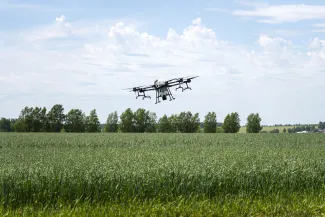
© Diy13 -iStock-1583942713
Rodney Koch farms near Garretson, with machinery that has automatic shutoffs to keep inputs in check. He said he's always learning.
"Just because we've done things the way we've done 'em doesn't mean that they're always necessarily the right or the best way," he said. "So, I continue to try to look for ways to improve."
Whether it's technology or plants such as cover crops, Koch said upfront costs are not easy to balance for a farmer dipping their toes in these waters.
The EDF report cites similar barriers for widespread adoption of agricultural innovations. The authors stress the need to protect and expand access to public-private partnerships, competitive grants and demonstration projects, so that farms of all sizes can try out these tools with confidence.
The EDF report says lack of awareness and digital literacy are other obstacles that may prevent innovations in farming. There are longstanding federal programs designed to help farmers become climate-smart producers. But Koch said he feels there should be greater incentives and messaging – in both public and private sectors – that focuses less on mass-production, and more on quality.
"Yeah, we might not have the top yield in the country – but we don't need it," he said. "We need to be able to take care of our land."
As these conversations evolve, the report cites data showing that agriculture accounts for more than 10 percent of U.S. greenhouse-gas emissions and remains the nation’s largest source of methane and nitrous oxide emissions. EDF says expanding innovation helps address those impacts, and can cut a farmer's costs and make them more competitive.