USDA designates 33 Colorado counties as drought disaster areas, unlocking emergency farm loans

The United States Department of Agriculture has designated 33 Colorado counties as primary natural disaster areas due to severe drought conditions, making farm operators across a wide swath of the state eligible for emergency loan assistance through the Farm Service Agency.
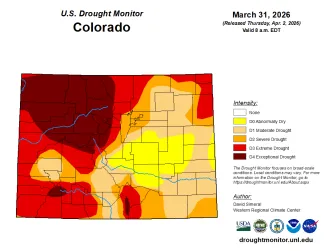
The federal disaster designation comes as exceptional drought has expanded sharply across northwest Colorado, with record warmth compounding already dire conditions across the region.
© iStock - Melissa Kopka
The designation, announced Monday, in a letter from the USDA Deputy Under Secretary for Farm Production and Conservation to Governor Jared Polis, was issued under 7 CFR 759.5(a). According to the U.S. Drought Monitor, the affected counties experienced drought intensity of D2 (severe) for eight or more consecutive weeks, or D3 (extreme) or D4 (exceptional) during the growing season.
The state had already activated its Phase 2 drought response as conditions reached historic severity levels before the federal designation was announced.
The 33 primary counties span much of central, northern, and western Colorado: Adams, Arapahoe, Boulder, Broomfield, Chaffee, Clear Creek, Costilla, Delta, Denver, Douglas, Eagle, Garfield, Gilpin, Grand, Gunnison, Huerfano, Jackson, Jefferson, Lake, Larimer, Las Animas, Logan, Mesa, Moffat, Montrose, Ouray, Park, Pitkin, Rio Blanco, Routt, Sedgwick, Summit, and Weld.
©
An additional 20 Colorado counties were named as contiguous disaster areas under Section 321(a) of the Consolidated Farm and Rural Development Act: Alamosa, Baca, Bent, Conejos, Custer, Elbert, El Paso, Fremont, Hinsdale, Lincoln, Morgan, Otero, Phillips, Pueblo, Saguache, San Juan, San Miguel, Teller, Washington, and Yuma. Contiguous counties in adjacent states were also included: four in Nebraska, three in New Mexico, four in Utah, and four in Wyoming.
The Secretarial disaster designation makes farm operators in both primary and contiguous counties eligible to apply for Farm Service Agency emergency loan assistance, provided they meet eligibility requirements. The FSA evaluates each application individually, considering production losses on the farm and the borrower’s security and repayment ability.
Farmers in eligible counties have eight months from the date of the declaration to apply for emergency loans. Local FSA offices can provide affected farmers with further information about the application process and eligibility requirements.
For more information about drought conditions, visit the U.S. Drought Monitor at droughtmonitor.unl.edu. Contact your local FSA office for details about emergency loan applications.