1876 marked the start of Colorado’s decades-long ‘free silver’ crusade

© ogichobanov - iStock-1088402018
The special cargo arrived on the evening of May 3, 1876, on a westbound express train to Denver, where it was watched carefully and wheeled in through the side door at the Colorado National Bank.
The barrel looked “quite as unpretentious and common as an ordinary beer keg,” the Rocky Mountain News reported the following day — but inside were five heavy sacks full of a product that would dominate the soon-to-be state of Colorado’s politics for the next quarter century.
“SILVER ONCE MORE,” blared the News’ headline.
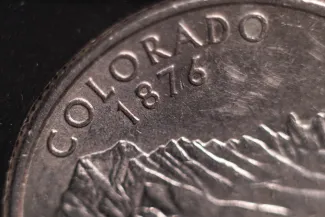
“(The) keg full of silver shiners, fresh and bright from the mint … contained 275 pounds of coin, in the denominations of quarters and halves,” read the report. “The Colorado National also received, per the afternoon train, a bag of $100 in specie from their correspondents in St. Louis, the coin consisting of halves, quarters, and dimes, tied up in small paper packages.”
© Evgeniy Grishchenko - iStock-2155580431
Similar shipments were being made to banks across the country following Congress’ April 1876 passage of a bill to resume the minting of silver coins, which had been out of circulation for 14 years, having been replaced during the Civil War by fractional paper currency — also known as postage currency, since the designs of the paper notes, in denominations ranging from 5 to 50 cents, had been adapted from U.S. postage stamps.
“The pockets of all classes of tradesmen were jingling last night with the old time quarters and halfdollar pieces,” said the News in a follow-up on May 5. “It was only silver coin, but it had the right jingle about it, and a fistful of it had a solid, honest feeling.”
“The child that was ten years old in 1861 is twenty-five years old now, and has grown from youth to manhood without any experimental knowledge of hard currency,” mused an item in the Kansas City Journal, republished on May 4 by the Pueblo Chieftain.
In Colorado, more than almost anywhere else in the country, there was much more than nostalgia motivating this renewed appreciation for the musical qualities of pocket change. In 1874, the value of the silver mined in the territory had exceeded that of gold for the first time, and a series of silver booms in the San Juan Mountains, Leadville, Aspen and Creede would help make Colorado the nation’s leading silver producer in the decades that followed.
The U.S. government had officially adopted a dual gold-and-silver monetary standard in 1792. But for most of the 19th century, the value of silver as a commodity exceeded its coinage value, which was fixed at a 16:1 ratio with gold. Though the lesser metal was debased for use in fractional coins, there were virtually no silver dollars in circulation, since producers profited more from selling silver on the open market than from redeeming silver bullion to be coined by the U.S. Mint. In 1873, with few objections, Congress passed a law ending the minting of silver dollars altogether, effectively adopting a single gold standard for the first time.
But things changed rapidly in the mid-1870s as mining booms in Nevada, Colorado and elsewhere caused a global slump in the price of silver — a trend that coincided with an economic downturn that followed the Panic of 1873. Suddenly, mining interests across the country were deeply interested in silver coinage.
“As silver touched bottom and as the depression showed no signs of ending, legislators and other Americans entered on a great debate over whether, and in what ways, silver ought to have a more prominent place in the monetary system,” wrote historian Walter Nugent.
iStock
Congressional approval of new fractional silver coins in early 1876 was among the first concessions to these demands — and the excitement that greeted Denver’s first keg of freshly minted quarters and dimes was an early example of what would evolve into a political mania in the Centennial State in the final decades of the 19th century.
The Silverite movement, which advocated for a return to bimetallism — or “free silver,” as advocates called it — united mining interests in the West with populist firebrands across the country, who accused wealthy capitalists in the East and overseas of “demonetizing” silver in order to artificially limit the money supply.
By the end of the Centennial year, Colorado newspapers were regularly publishing editorials on what they described as “Patrician Gold Against Plebian Silver,” and letters alleging that “the money kings of Europe, with the Rothchilds at their head, have undertaken to make gold the only medium of exchange in the world.” The 1873 Coinage Act, which had been uncontroversial at the time of its passage, would later be christenedby Colorado Senator Henry Teller, in a speech on the Senate floor, as the “Crime of 1873.”
While they trafficked freely in such conspiracist rhetoric and offered various ideological justifications for free-silver policies, Colorado papers could also be blunt about the state’s material interest in producing as much of the metal as possible.
“Silver mining,” editorialized Georgetown’s weekly Colorado Miner in 1880, “has built up both the mountain and the valley towns, has caused the extension of thousands of miles of railroads throughout the State, has doubled our population in the last three years, has given employment to the ranchman, the mechanic, the stockman, the merchant, as well as to the miner; has brought millions of capital into our mountains, and has made Denver the Queen City of the Plains.”
“Every citizen of Colorado ought to feel a lively interest in maintaining this prosperity, and in encouraging the production of silver,” the paper went on. “How a citizen of Colorado can entertain other views and still believe himself a friend of the interests of the State, we cannot readily understand.”
The Silverites would eventually win partial victories like the Bland-Allison Act of 1878 and the Sherman Silver Purchase Act of 1890, both of which required the Treasury to buy and mint a certain amount of silver each year.
But the federal government never again allowed unlimited silver coinage, and the purchase laws were repealed in an emergency session of Congress after being blamed as one of the major causes of the Panic of 1893. Democrat William Jennings Bryan unsuccessfully pressed the free-silver issue in the 1896 presidential campaign, but his victorious opponent, President William McKinley, went on to sign legislation reaffirming the gold standard, which remained in place until 1971.
Selected sources
- The Rocky Mountain News, May 4–5, 1876
- Smith, Duane. “The Trail of Gold and Silver: Mining in Colorado, 1859–2009”
- Nugent, Walter. “Money and American Society, 1865–1880”
- Barnett, Paul. “The Crime of 1873 Re-Examined.” Agricultural History, July 1964