Arizona asks US Supreme Court to halt prison healthcare takeover in ‘Hail Mary’ filing

Attorneys for Arizona’s prison system ran to the U.S. Supreme Court on Wednesday to make one last plea to delay a court-ordered takeover of its healthcare system.
A federal district court judge and the 9th U.S. Circuit Court of Appeals already denied the Arizona Department of Corrections, Rehabilitation and Reentry’s request to put off receivership of the prison healthcare system until an appeals court makes a final call.
But in a final attempt to buy more time, a lawyer for the Corrections Department argued the state is entitled to the opportunity to fully argue its case before it loses control of its employees, its contractors and its multimillion-dollar healthcare budget.

© Akarawut Lohacharoenvanich - iStock-1436012592
“The gravity of that action and the costly and disruptive consequences for the department and the state are hard to overstate,” former U.S. Solicitor General Paul Clement wrote in an application to stay filed with the high court on September 16.
An attorney representing the roughly 25,000 inmates in Arizona prisons called the request a “Hail Mary” and noted they had yet to receive a deadline to respond to the stay request. But in any case, Corene Kendrick, deputy director of the American Civil Liberties Union National Prison Project, said their clients cannot wait any longer for constitutional healthcare.
“You wish that the time and money that they’re spending on fancy Supreme Court attorneys to write these briefs for them were better spent focusing on improving the healthcare and implementing the reforms and working collaboratively so that the receiver can get in place.” Kendrick said.
Inmates first sued the department in 2012, alleging prison medical, mental and dental care posed a threat of serious injury and death and constituted “cruel and unusual punishment” under the Eighth Amendment.
After more than a decade of litigation and an ultimately unsuccessful settlement agreement, Judge Roslyn Silver issued a final injunction in 2023, finding the department’s healthcare system was “plainly grossly inadequate.”
Two years after the order, attorneys for the plaintiffs claimed slow progress by the department and continual harm to the state’s incarcerated population warranted a takeover of prison healthcare.
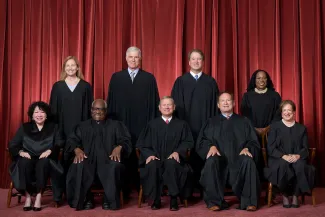
Memebers of the Supreme Court of the United States 2022 - WIkimedia - Public Domain
And in February, citing after court-appointed monitors reported the department’s failure to comply with 131 of the court order’s 154 “quality indicators” and eight deaths in custody, Silver greenlit receivership.
She then appointed Annette Chambers-Smith, former director of the Ohio Department of Rehabilitation and Correction, to serve as receiver, effective October 19.
The department immediately sought a stay to delay Chambers-Smith’s start date until after the receivership issue was decided by the appellate court.
The 9th Circuit Court of Appeals declined to press pause but agreed to speed up briefing on the appeal.
The department then filed a last-ditch request for a stay on the Supreme Court’s “shadow docket,” where justices can decide on emergency and procedural orders without oral argument, extensive briefing or written opinions.
In the filing, Clement argued receivership is meant to be the “remedy of last resort” but has not been treated as such by the district court.
“Rather, the court reached for one of the most powerful and federalism-defying tools in its arsenal as a first resort when the state did not promptly live up to the court’s expectations under a wide-ranging and demanding injunction,” Clement wrote.
He claimed Silver had ignored the improvements the department has made since she issued her final injunction in March 2023 and incorrectly focused on the more than decadelong history of litigation. The arguments are largely the same as the Corrections Department argued before Silver and the appellate court when they asked those courts to pause the receivership.

Clement contended the department had made “tangible” progress since Silver’s final order, pointing to the department’s work growing its healthcare staff by more than 50%, opening and improving facilities, increasing access to treatment for substance-use disorder and implementing a new model of care.
He added that Silver’s order was “impatient,” too, as the receiver was allowed a minimum of five years to fix the healthcare system, while the department had less than three between the final injunction and the receivership order.
At bottom, Clement said Silver was legally required to start with the least invasive fix and move toward receivership only after initial attempts to compel compliance failed.
“The district court inverted that approach here, dropping the proverbial nuclear bomb without exhausting less devastating firepower,” Clement wrote.
Kendrick noted that Silver had, in fact, taken steps to push the department in the right direction.
“The facts and the history shows that (Silver) has bent over backwards for years, and court judges before her tried to avoid receivership,” Kendrick said. “But ADCRR was just so intransigent that she found that it was absolutely necessary.”
Kendrick said attorneys for the plaintiffs are waiting on the justices to set a deadline for response.
Meanwhile, the 9th Circuit Court of Appeals is starting to delve into the merits of the receivership order itself.
In an opening brief filed September 15, the department’s attorneys leaned on the same arguments presented in the bid to the Supreme Court.
A response from the plaintiffs is due October 15.