Exceptional drought sweeps the San Luis Valley as the eastern plains ease

© KiowaCountyPress.net
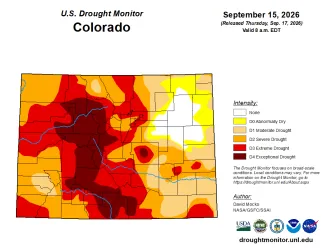
Exceptional drought - the most severe category tracked by the National Drought Mitigation Center - pushed south out of Colorado’s central mountains and across the San Luis Valley over the past week, even as several counties on the southeastern plains recorded their first meaningful improvement in more than a month. The U.S. Drought Monitor map released Thursday, September 17, reflects conditions as they stood at 8 a.m. Tuesday, September 15.
©
Exceptional drought now covers 15 percent of Colorado, up from 13 percent a week ago, according to the U.S. Drought Monitor. Extreme and exceptional drought combined eased slightly to 44 percent of the state from 47 percent, as gains in the mountains were offset by improvement along the Arkansas Valley. The National Drought Mitigation Center reported that Colorado “had drought degradations in the center part of the state, with drought improvements in both the southwest and southeast parts.”
Snowpack
With the water year closing September 30, mountain snowpack is only beginning to rebuild, and water-year precipitation remains the more useful measure of where Colorado stands. A pair of early-season storms left a trace of snow across the high country this week: 44 of 117 Colorado SNOTEL sites reported measurable snow water equivalent Thursday, according to the Natural Resources Conservation Service, though most held only a tenth of an inch. The deepest reading came from Never Summer in the northern mountains at 2.2 inches.
Water-year-to-date precipitation across 105 reporting SNOTEL sites averaged 77 percent of the 1991-2020 median as of Thursday. Nineteen of those sites finished below 70 percent. The driest readings again came from the southern mountains, with Whiskey Creek at 46 percent of median, Chapman Tunnel at 49 percent, Trinchera at 50 percent and Culebra #2 at 52 percent.
Only a few sites closed the year near normal. Vallecito and Beartown each reported 102 percent of median and Upper Rio Grande came in at 101 percent, all in the San Juans. A year ago at this point, no part of Colorado was in exceptional drought and extreme drought covered 15 percent of the state, compared to 29 percent now.
Drought Conditions
The sharpest change this week came in the San Luis Valley. All of Alamosa County is now in exceptional drought, up from 95 percent a week ago, according to the U.S. Drought Monitor. Rio Grande County went from no exceptional drought at all to 43 percent, with another 52 percent in extreme drought. Costilla County climbed from 39 to 71 percent exceptional, and Conejos County from 14 to 40 percent. Saguache County reached 67 percent exceptional, up from 59 percent, with the remainder of the county in extreme drought.
The long-standing core over the central mountains held. Eagle County and Lake County remain entirely in exceptional drought, and Pitkin County stands at 99 percent. Summit County reports 88 percent exceptional and 12 percent extreme drought, while Chaffee County is 78 percent exceptional and 22 percent extreme. Park County more than doubled its exceptional coverage, rising from 15 to 33 percent, and exceptional drought appeared for the first time in El Paso County, covering 11 percent of the county. Gunnison County was one of the few mountain counties to improve, easing from 50 to 43 percent exceptional.
On the southeastern plains, the picture brightened for the first time in weeks. Kiowa County cut its extreme drought coverage in half, falling from 43 to 22 percent, with 55 percent of the county in severe drought and 24 percent in moderate drought. Otero County saw severe drought collapse from 72 to 19 percent, and Bent County from 54 to 18 percent, with both counties now largely in moderate drought. Crowley County trimmed extreme drought from 24 to 5 percent, and Cheyenne County reduced severe drought from 22 to 5 percent. Prowers County was unchanged at 22 percent severe and 78 percent moderate drought, as was Baca County, which remains the driest county on the plains at 44 percent extreme drought.
Statistics
Compared to the previous week, drought-free area held steady at 6 percent of Colorado and abnormally dry conditions were unchanged at 6 percent. Moderate drought expanded from 13 to 16 percent and severe drought held at 28 percent. Extreme drought contracted from 33 to 29 percent, while exceptional drought grew from 13 to 15 percent - a trade reflecting deep deterioration in the mountains and valleys set against broad improvement along the Arkansas River corridor.
One year ago, the picture was far milder. On September 16, 2025, 42 percent of Colorado was free of drought and none of the state had reached the exceptional category. Abnormally dry conditions covered 11 percent, moderate drought 9 percent, severe drought 22 percent and extreme drought 15 percent. Conditions at the start of the current water year on September 30, 2025, were similar, with 46 percent of the state drought-free and no exceptional drought.
| Week | Date | None | D0 | D1 | D2 | D3 | D4 |
|---|---|---|---|---|---|---|---|
| Current | 2026-09-15 | 6 | 6 | 16 | 28 | 29 | 15 |
| Last Week to Current | 2026-09-08 | 6 | 6 | 13 | 28 | 33 | 13 |
| 3 Months Ago to Current | 2026-06-16 | 0 | 2 | 18 | 45 | 26 | 9 |
| Start of Calendar Year to Current | 2026-01-06 | 26 | 28 | 30 | 11 | 4 | 1 |
| Start of Water Year to Current | 2025-09-30 | 46 | 9 | 9 | 22 | 14 | 0 |
| One Year Ago to Current | 2025-09-16 | 42 | 11 | 9 | 22 | 15 | 0 |
Just over 4,662,000 Colorado residents live in a drought-impacted area. Colorado’s 2023 population was estimated at 5,877,610.
Drought categories include (ranked from least to most severe) abnormally dry (D0), moderate (D1), severe (D2), extreme (D3), and exceptional (D4) drought.
Colorado drought conditions - September 15, 2026 - National Drought Mitigation Center