Colorado bill would neutralize proposed constitutional amendment requiring road funding

© ISerg - iStock-1333705544
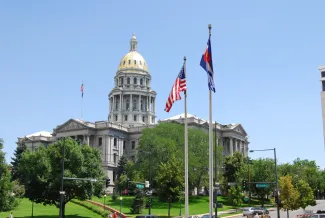
Colorado Democrats want to pass a bill in the final days of the state legislative session to offset a potential constitutional amendment on this year’s ballot that would divert revenue to maintain and repair the state’s roads.
Lawmakers warn that the initiative would reroute money from priorities like public education and healthcare amid a difficult budget reality. The Legislature recently approved a state budget that had to close a $1.5 billion deficit, and future years are not expected to be easier.
They say the authors of the ballot initiative are telling voters it would fund roads without raising taxes, but that funding would actually come at the cost of other state programs.
“If you ask the voters, ‘Would you like to fix roads but defund public education? Would you like to fix roads but impact the ability to seek healthcare in your community?’ Then that’s something we have to pay attention to,” said Representative Andy Boesenecker, a Fort Collins Democrat. “But that’s not the question they’re asking voters. The question they’re asking voters is, ‘For no additional dollars to you, would you like to repair roads in our community?’ Who wouldn’t say yes to that? I think it’s our obligation as a Legislature to be truthful.”
Initiative 175, whose backers are collecting petition signatures to get it on the November ballot, would direct existing taxes and fees related to gas and car use to fund road repairs and “road transportation,” to the tune of about $700 million annually. It is backed by the Restore Our Roads Coalition and funded by the Colorado Construction Industry Coalition.
The initiative specifically concerns taxes on gas and car sales and the sales tax related to car “parts, equipment, materials and accessories.” The hundreds of millions of dollars from these sources would automatically head towards repairs for roads and bridges, driver safety, the Colorado State Patrol and road engineering. Right now, some of that revenue heads toward a mix of transportation projects, like transit systems and electric vehicle infrastructure. Initiative 175 would shift the money entirely towards road construction.
That mandated spending could further restrict budget flexibility and “handcuff” the state to long-term spending commitments, Democratic lawmakers say.
“If we had an extra $700 million to fund transit in our state, we probably would have used it this last budget cycle to not cut (Medicaid) reimbursement rates,” Boesenecker said.
75% of signatures gathered
A nonpartisan fiscal analysis of the initiative predicts that the state would need to spend about $2 billion a year on roads if it passes, including about $540 million from the state’s general fund, which is where most of Colorado’s discretionary spending comes from. It could also draw in money from parts of the state budget that are not directly related to road repairs, such as cash funds for pedestrian infrastructure, law enforcement training and emergency medical services, according to the fiscal analysis, though initiative authors say that’s not their intent.
© iStock - Devonyu
The measure proposed by Democrats, House Bill 26-1430, would effectively offset state spending under Initiative 175 if it passes by lowering that state’s road usage fee, gas tax, special fuel excise tax and some vehicle registration fees. That reduced revenue would create more general fund spending space under the Taxpayer’s Bill of Rights, which caps how much the state can spend before returning money to taxpayers.
Initiative backers say Colorado’s roads are overdue for more investment. Last year, the libertarian think tank Reason ranked Colorado 43rd in the country for its road conditions, and even lower for rural roads.
“By moving this bill now, legislators are telling Coloradans their votes don’t matter,” Tony Milo, the president and CEO of the Colorado Contractors Association, said in a statement. “If politicians can rewrite the rules to get around a citizen led road funding measure before it even reaches the ballot, they’re not just undermining transportation policy, they’re overriding the will of the voters and setting a dangerous precedent for every future statewide campaign.”
Initiative supporters say they have collected about 75% of the required signatures with a deadline at the end of the month.
Groups including the Bell Policy Center, Colorado Center on Law and Policy, Sierra Club Colorado and Colorado Education Association are against the initiative.
HB-1430 has its first committee hearing Tuesday. The legislative session ends on May 13.