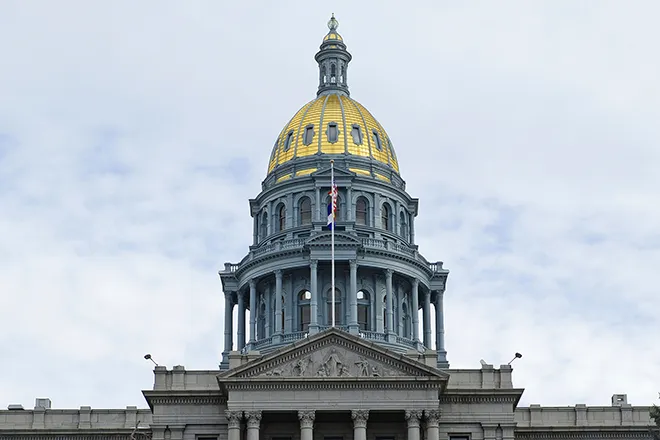
Colorado graduated income tax proponents rally canvassers ahead of petition deadline

© Svanblar iStock-146069215
With just two weeks to go before a petition deadline, supporters of a ballot measure to put a graduated income-tax system in the Colorado constitution rallied canvassers in Denver for a final sprint of signature-gathering.
More than a dozen Democratic state lawmakers endorsing the Protect Colorado’s Future campaign were on hand at Martin Luther King Jr. Park in the Park Hill neighborhood, where they said the group’s proposed constitutional amendment, Initiative 195, would help bring an end to the last several years of painful budget shortages at the Capitol.

© Jerome Maurice - iStock-1426962165
“What we faced this year was devastating cuts to services that families across Colorado rely on,” said state Representative Lorena Garcia, a Westminster Democrat. “We can avoid that as best we can next year only if we pass the graduated income tax. If you are motivated by that — because you don’t want families to suffer, you don’t want schools and teachers to not get paid, you don’t want childcare centers to shut down, you don’t want more cuts to Medicaid — then you will support the graduated income tax.”
If passed, Initiative 195 would represent the biggest change to date to the Taxpayer’s Bill of Rights, a 1992 constitutional amendment that enacted a number of strict limits on Colorado’s tax system, including annual caps on revenue growth, requirements for voter approval for all tax increases, and a flat-rate structure for income taxes. As required by TABOR, the state income tax rate is currently set at 4.4% for all earners, setting it apart from most states — especially those as Democratic-leaning as Colorado — with progressive or graduated income tax systems, under which higher earners pay higher rates.
Initiative 195 would hike the tax rate to 7.4% for income above $500,000 and gradually increase the rate to 8.4% for income above $1 million. Those higher rates would apply to the top 3% of earners, while the 97% of Coloradans who earn less than $500,000 per year would see a slight income tax reduction.
Nobody thought we'd even get this far ... And when we turn in our petitions on August 3, all I'm going to say is, 'I told you so.'
– State Representative Lorena Garcia
A fiscal analysis by nonpartisan state legislative staff estimates that the measure would raise $2 billion in additional revenue for the state by the 2027-28 fiscal year. That would go a long way toward plugging holes in the state budget caused by rising Medicaid costs and the downstream impacts of congressional Republicans’ 2025 passage of H.R.1, a massive tax and spending cut law. In the most recent legislative session, lawmakers were forced to make cuts to close a budget gap that had grown to $1.5 billion in the wake of H.R.1’s passage.

The text of the measure directs the new revenue to K-12 education, childcare services and healthcare programs, including “replacing Medicaid funding lost due to recent federal legislation.”
“I know that all of my colleagues here will nod their heads when I say … I’m really tired of being told that we can’t provide healthcare and housing and childcare,” said Democratic state Representative Yara Zokaie of Fort Collins. “Because while I’m being told that in the Capitol, Elon Musk became a trillionaire. While families in my district are going hungry, the private jet owners are getting handout after handout from Donald Trump.”
High bar to qualify
As a constitutional measure, Initiative 195 faces a high bar to qualify for the ballot. Backers must gather signatures equal to 2% of the number of registered voters in each of the state’s 35 Senate districts and submit them to the secretary of state’s office by August 3.
“We have 14 days to get this done, and we are so close,” Garcia told the crowd of supporters Saturday. “We have 64 signatures in one district that we’re canvassing that we need. We have 120 in another district. We are that close.”
The Protect Colorado’s Future campaign is relying on a combination of paid canvassers and volunteers as the deadline approaches. Campaign finance disclosures show it’s raised a combined total of about $269,000 in monetary and in-kind contributions from a network of liberal advocacy groups including the Bell Policy Center, New Era Colorado, Great Education Colorado and the Western Colorado Alliance.

© iStock - Ligorko
In aiming to pass a constitutional ballot measure, this coalition of liberal groups is aiming to compete in a space dominated in recent years by a deep-pocketed network of conservative groups led by Advance Colorado, a “dark-money” nonprofit that has spent heavily to pass conservative policies through the ballot box.
Advance Colorado last week turned in petition signatures for Initiative 232, a measure that aims to counter the graduated income tax proposal by capping the state income tax rate at its current 4.4% level. If both measures were to pass, their conflicting provisions would be resolved according to which measure receives the greater number of “yes” votes.
Garcia said in an interview that last month’s Colorado primary elections — during which progressives celebrated a wave of victories up and down the ballot — were a “referendum on moneyed interests” that proves the momentum is with the Protect Colorado’s Future campaign.
“No, we don’t have the resources that (Advance Colorado) has. We’ll never have that,” Garcia said. “But what we have that they don’t is the people — we have the popular policies, we have the will, we have the folks that are willing to come out on a Saturday morning when it’s 90-something degrees and canvas. They don’t have that.”
“Nobody thought we’d even get this far,” she added. “And when we turn in our petitions on August 3, all I’m going to say is, ‘I told you so.'”