Drones return to skies over Lamar-area ranch Thanksgiving week for black-footed ferret research

Drones flew over Lamar's Heartland Ranch throughout Thanksgiving week as researchers tracked newly released black-footed ferrets. The researchers want to learn what happens to the ferrets after release and whether predators are affecting their survival.
Colorado Parks and Wildlife (CPW) and the Southern Plains Land Trust welcomed back researchers from Smithsonian's National Zoo and Conservation Biology Institute. This is the second year of their joint research.
November 18 was moving day. On that day, 38 black-footed ferrets arrived from the U.S. Fish and Wildlife Service's National Black-Footed Ferret Conservation Center north of Fort Collins. The group included 35 kits, or young ferrets, and three adult ferrets. They were released onto Heartland Ranch in Bent County, which the Southern Plains Land Trust operates.
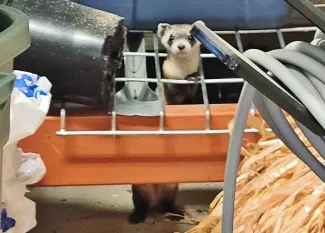
This endangered Black-Footed Ferret popped up in a homeowner's garage in Pueblo West Monday. The homeowner coaxed it into a box and called Colorado Parks and Wildlife. Officers and biologists examined it and determined it was among 9 Black-Footed Ferrets released on the nearby Walker Ranch two weeks ago. After deeming it healthy, CPW officers re-released it on a Prairie Dog colony on the ranch. Photo courtesy of Colorado Parks and Wildlife
At sunset, teams gently guided each ferret from a transport crate into a chosen prairie-dog burrow. The burrows dot the more than 43,000-acre property. Some ferrets popped up to watch biologists leave before slipping underground to explore their new home. Staff placed a food reward near each burrow entrance.
Before release, 22 ferrets were fitted with special collars. The collars carry very high frequency (VHF) radio transmitters and accelerometers. Accelerometers record movement 40 times per second across three axes. The data helps researchers build a three-dimensional picture of ferret activity, including movement underground. This gives researchers a way to learn what ferrets do inside burrow systems, where they cannot watch them directly.
Smithsonian researchers flew the drones with support from the joint team. The drones carried thermal, VHF and Global Positioning System (GPS) sensors to track activity above and below ground. Drone flights use VHF signals and thermal imagery to monitor the release area day and night.
The collars were redesigned this season to stay on longer. In 2025, some collars were scratched off or knocked off after only a few hours or days. A better collar would give researchers more time to track ferrets during their first week in the wild.
In fall 2025, spotlight surveys did not find ferrets released at the ranch in past years. That did not show whether they had survived. But it pointed out how little is known about their movements and fate after release.

Colorado Parks and Wildlife
The research partners are also tracking swift foxes and badgers to help identify predators. With help from Southern Plains Land Trust staff, CPW biologists and support staff trapped, collared and released 15 badgers and 10 swift foxes at the ranch. Each animal was released where it was caught. The World Wildlife Fund provided funding through Southern Plains Land Trust for the 10 fox collars.
When a ferret is confirmed to have been killed by a predator, researchers can compare the timing and location of its movements with collar data from badgers or swift foxes. This can help show which species was responsible, if any. That information could guide future CPW research. One question is whether moving an identified predator away from a ferret release colony affects ferret survival.
Each partner has a role. CPW leads the release and wildlife management. The U.S. Fish and Wildlife Service breeds ferrets at its conservation center. Smithsonian researchers develop and use tracking methods. Southern Plains Land Trust provides the habitat and works alongside field teams.
The research depends on private landowners who provide habitat and access for field teams. More broadly, CPW and its partners work with public and private landowners to maintain reintroduction sites across Colorado's Eastern Plains.
Black-footed ferrets were thought to be extinct until a small population was found in Wyoming in 1981. Eight breeding ferrets from that group became the foundation of the U.S. Fish and Wildlife Service captive-breeding program. Today, ferrets remain endangered in Colorado and across the nation. They depend on prairie-dog colonies for food and shelter. Restoring them returns a native predator to the grassland food web.
Prairie dogs also face sylvatic plague, which can cause colonies to collapse. To protect colonies that support ferrets and other grassland wildlife, CPW and partners use oral vaccine baits. They also put insecticidal dust in prairie-dog burrows to target the fleas that spread plague.
"The goal with our partners from Smithsonian's National Zoo and Conservation Biology Institute is to take this data about how black-footed ferrets are interacting in the wild during their first week and turn it into a useful management strategy," said Katie Merewether, CPW Wildlife Biologist. "The collars can help us understand how ferrets are moving, hunting and resting during their first week in the wild. We want to learn whether they're encountering predators or having difficulty moving across the landscape, and use that information to make future releases more successful."