Drought eases across Colorado after heavy rain, but mountain core remains exceptional

© KiowaCountyPress.net
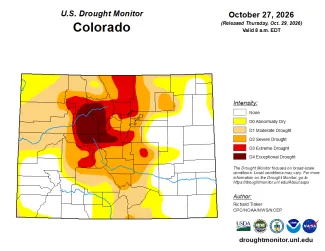
Drought retreated across much of Colorado this week after heavy rain and flooding, but extreme and exceptional drought remains locked over the central and northern mountains, according to the U.S. Drought Monitor, a joint product of the National Drought Mitigation Center and federal partners. The map, released Thursday, October 29, shows conditions as of 8 a.m. EDT (6 a.m. MDT) Tuesday, October 27. About 50 percent of Colorado is in drought, down from 61 percent a week earlier, and the share of the state free of any dryness more than doubled, from 17 percent to 35 percent.
Snowpack
The Drought Monitor’s weekly summary credits the improvement to excessive precipitation and flooding across much of central and southern Colorado, but it does not report new snow for the state. Because early-season snow readings at mountain weather stations are unreliable and the summary does not confirm snowfall, this report looks at precipitation since the water year began on October 1 instead of snowpack.
According to the Natural Resources Conservation Service’s daily SNOTEL report, water-year precipitation so far ranges widely in the counties where drought is deepest. In Summit County it runs from 0.9 inch at Copper Mountain to 2.7 inches at Hoosier Pass. In Grand County it runs from 0.5 inch at Middle Fork Camp and Stillwater Creek to 3.1 inches at Arapaho Ridge, and in Routt County from 1.5 inches at Lynx Pass to 3.2 inches at Elkhead Divide. Pitkin County stations range from 0.8 inch at Nast Lake to 4.8 inches at Castle Peak, and Eagle County stations range from 1.2 inches at Vail Mountain to 1.5 inches at McCoy Park. These are start-of-day values that NRCS has not yet quality-checked.
A year ago, at the same point in the season, 29 percent of Colorado was in drought and just over 1 percent was in extreme or exceptional drought, according to the U.S. Drought Monitor. Mountain basins head into winter this year starting from a much deeper hole.
Drought Conditions
The worst conditions are in the central and northern mountains. According to the U.S. Drought Monitor, Eagle County is 89 percent in exceptional drought (D4) and 11 percent in extreme drought (D3), while Summit County is 88 percent D4 and 12 percent D3. Grand County is 48 percent D4, 40 percent D3 and 12 percent severe drought (D2). Pitkin County is 39 percent D4, 31 percent D3, 26 percent D2 and 3 percent moderate drought (D1), and Routt County is 12 percent D4, 26 percent D3, 21 percent D2 and 41 percent D1.
©
Statewide, 4 percent of Colorado is in exceptional drought and 13 percent is in extreme drought or worse (D3-D4), down from 6 percent and 18 percent a week ago. The Drought Monitor summary says one-category improvements were widespread across the southern half of the state and in northeastern Colorado, and that a few broad areas of south-central and southwestern Colorado that received several inches of precipitation improved by two categories.
On the southeastern plains, the Drought Monitor shows no drought in the home counties. Kiowa County, Cheyenne County and Bent County are each 100 percent free of any dryness. Prowers County is 96 percent free of any dryness and 4 percent abnormally dry (D0), and Baca County is 74 percent free of any dryness and 26 percent D0.
Statistics
Compared with last week, the share of Colorado free of any dryness rose from 17 percent to 35 percent. Abnormally dry (D0) fell from 22 percent to 15 percent, moderate drought (D1) edged up from 20 percent to 21 percent, severe drought (D2) dropped from 23 percent to 16 percent, extreme drought (D3) fell from 12 percent to 8 percent, and exceptional drought (D4) slipped from 6 percent to 4 percent. At the start of the water year, 58 percent of the state was in severe drought or worse; that share is now 29 percent.
One year ago, on October 28, 2025, 51 percent of Colorado was free of any dryness, 20 percent was abnormally dry, 16 percent was in moderate drought, 12 percent in severe drought and 1 percent in extreme drought, with no exceptional drought. Drought covered 29 percent of the state then, compared with 50 percent now, and the share free of drought (None plus D0) was 71 percent, compared with 50 percent now.
| Week | Date | None | D0 | D1 | D2 | D3 | D4 |
|---|---|---|---|---|---|---|---|
| Current | 10/27/26 | 35 | 15 | 21 | 16 | 8 | 4 |
| Last Week to Current | 10/20/26 | 17 | 22 | 20 | 23 | 12 | 6 |
| 3 Months Ago to Current | 7/28/26 | 3 | 6 | 10 | 31 | 37 | 14 |
| Start of Calendar Year to Current | 12/30/25 | 29 | 33 | 22 | 13 | 2 | 1 |
| Start of Water Year to Current | 9/29/26 | 9 | 9 | 24 | 23 | 25 | 10 |
| One Year Ago to Current | 10/28/25 | 51 | 20 | 16 | 12 | 1 | 0 |
About 78 percent of Coloradans live in areas in drought, according to the U.S. Drought Monitor.
The U.S. Drought Monitor ranks conditions from least to most severe: abnormally dry (D0), which is not yet drought, then moderate (D1), severe (D2), extreme (D3), and exceptional (D4) drought.