Drought eases in northern mountains while extreme conditions deepen across southern Colorado

© KiowaCountyPress.net
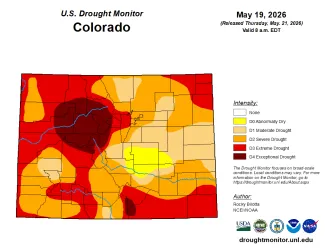
Exceptional drought continued to retreat across the northern Colorado mountains over the past week, even as extreme (D3) drought expanded across the southern half of the state and the southeastern plains, according to the latest map released Thursday by the National Drought Mitigation Center. The map, which reflects conditions through Tuesday, May 19, shows the share of Colorado in extreme (D3) or worse drought easing to roughly 43 percent, down from about 47 percent a week earlier, while exceptional (D4) drought contracted to about 10 percent of the state from 15 percent the prior week.
©
Highly anomalous early-season warmth gripped Kansas and Colorado over the week, with weekly temperatures averaging 6 to 12 degrees Fahrenheit above historical norms across much of the state and pushing more than 12 degrees above normal in places, the U.S. Drought Monitor reported. The unseasonable heat, paired with weekly precipitation totals below 0.10 inches across large parts of southern Colorado, drove the expansion of extreme and severe drought across the southern tier even as heavy rainfall in the central and northern Rockies trimmed back the worst categories elsewhere.
Snowpack
Late-spring precipitation reached parts of northern Colorado over the past week, helping ease the most severe drought categories that had locked into the central and northern mountains through much of the winter and early spring, according to the National Drought Mitigation Center. Most of the high country is now well past peak snow accumulation, and rapid melt has been accelerated by unseasonable warmth across the western slope.
Statewide, temperatures ran 6 to 12 degrees Fahrenheit above normal for the week, with the core of the heat anomaly centered over Colorado and Kansas, the U.S. Drought Monitor reported. The warmth has pushed runoff earlier into the season and limited the residual snowpack feeding the state's headwaters, even in areas that received some late-season moisture.
A year ago, at this point in May 2025, no portion of Colorado was classified in exceptional drought and only about 5 percent of the state sat in extreme drought, with severe or worse drought covering just 21 percent. Conditions deteriorated sharply through the cool season before late-spring storms began chipping away at the most entrenched mountain drought areas.
Drought Conditions
Exceptional (D4) drought, the most severe category, still covers all of Eagle, Summit and Pitkin counties in the central Rockies, according to the U.S. Drought Monitor. Grand County remains 66 percent in exceptional drought and 29 percent in extreme (D3) drought, down from 73 percent exceptional a week earlier, while Routt County saw exceptional drought cut to 33 percent from 94 percent over the past week, with the remainder of the county now in extreme drought.
Further improvement came in Moffat County in the far northwest, where exceptional drought fell to less than 2 percent of the county from 72 percent a week ago. About 78 percent of Moffat County is now in extreme drought and 20 percent in severe (D2) drought. Jackson County, which had been entirely in extreme or exceptional drought, is now 57 percent extreme drought and 43 percent severe drought, according to the U.S. Drought Monitor.
Conditions moved in the opposite direction across the southern half of the state. In the San Luis Valley and southern mountains, Costilla County is now 13 percent exceptional drought, 23 percent extreme drought and 61 percent severe drought, with severe coverage expanding from 66 percent a week ago. Huerfano County sits at 11 percent exceptional drought and 68 percent extreme drought, while Las Animas County is 5 percent exceptional drought and 83 percent extreme drought, according to the U.S. Drought Monitor. Saguache County saw extreme drought more than double, climbing to 32 percent from 13 percent a week earlier, and Conejos County stands at 43 percent extreme drought.
On the southeastern plains, Baca County is essentially entirely in extreme drought, and Prowers County is 40 percent extreme drought with the balance in severe drought. Bent County is 6 percent extreme drought and 94 percent severe drought, while Otero County is entirely in severe drought. Closer to the Kiowa County Press's home county, KiowaCounty remains entirely in moderate (D1) or severe (D2) drought, with about 72 percent of the county in severe drought, unchanged from the prior week.
Statistics
Statewide, moderate or worse drought (D1 through D4) covers 96 percent of Colorado, essentially unchanged from the prior week, while severe or worse drought (D2 through D4) edged down to 79 percent from 82 percent. Extreme drought (D3) expanded to 33 percent from 32 percent as some previously severe areas in southern Colorado deepened, and exceptional drought (D4) contracted to 10 percent from 15 percent as heavy mountain precipitation trimmed back the worst conditions in the central and northern Rockies. Severe drought (D2) was unchanged at 36 percent, and abnormally dry (D0) coverage held at 4 percent of the state, with no portion of Colorado classified as drought-free.
A year ago, no portion of Colorado was in exceptional drought and only 5 percent of the state sat in extreme drought, according to the National Drought Mitigation Center. Severe or worse drought covered just 21 percent of Colorado in mid-May 2025, compared with 79 percent today. Abnormally dry conditions covered 32 percent of the state a year ago, with another 21 percent of Colorado drought-free at this time last year.
| Week | Date | None | D0 | D1 | D2 | D3 | D4 |
|---|---|---|---|---|---|---|---|
| Current | 5/19/26 | 0 | 4 | 17 | 36 | 33 | 10 |
| Last Week to Current | 5/12/26 | 0 | 4 | 14 | 36 | 32 | 15 |
| 3 Months Ago to Current | 2/17/26 | 27 | 17 | 24 | 23 | 8 | 1 |
| Start of Calendar Year to Current | 12/30/25 | 29 | 33 | 22 | 13 | 2 | 1 |
| Start of Water Year to Current | 9/30/25 | 46 | 9 | 9 | 22 | 14 | 0 |
| One Year Ago to Current | 5/20/25 | 21 | 32 | 26 | 16 | 5 | 0 |
Just over 4,470,000 Colorado residents live in a drought-impacted area. Colorado's 2023 population was estimated at 5,877,610.
Drought categories include (ranked from least to most severe) abnormally dry (D0), moderate (D1), severe (D2), extreme (D3), and exceptional (D4) drought.