Durango Fish Hatchery saves and stocks fish following massive flooding impacts

Staff at the Durango State Fish Hatchery worked around the clock to save about 330,000 fish during two historic floods along the Animas River. The two floods hit southwest Colorado within 10 days.
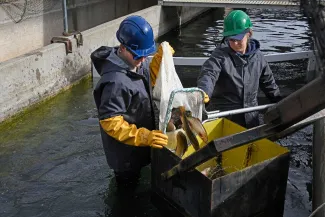
Colorado Parks and Wildlife (CPW) runs the hatchery. On November 13, the hatchery team stocked 2,312 Gunnison River rainbow trout in the Animas River. The team also stocked 617 Colorado River cutthroat trout. The river had dropped to flows of 1,200 cubic feet per second.
Courtesy CPW
The rainbow trout averaged 8.7 inches long. The cutthroats averaged 12.65 inches. Another 350 cutthroats will be stocked in the coming weeks.
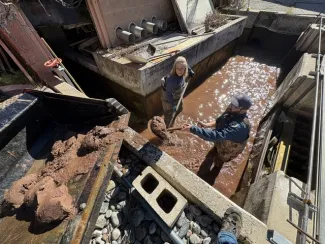
The fish had to leave the hatchery. Floodwater hit raceways on the north side of the hatchery during the second storm, November 1-2. The rainbow and cutthroat trout in those raceways were exposed to water from Junction Creek.
"Our Aquatic Health Lab did a full pathological inspection of free-ranging rainbow trout from Junction Creek on July 28, 2025," Ryan Votta said. "The fish passed the inspection and were found to be negative for regulated pathogens, including whirling disease. The decision to move all the fish that came in contact with surface water was a precautionary measure."
Courtesy CPW
Hatchery manager Votta lives on the property. He said staff worked hard to keep floodwater away from key equipment and buildings.
"The Durango Fish Hatchery had a front-row seat to both of these events," Votta said. "A sandbag wall stacked five high in places was used to keep the Animas River from overwhelming the western section of the fish hatchery property. Hatchery staff utilized portable pumps, wooden boards, and manipulated flows around the facility to prevent flooding surface waters from reaching critical infrastructure."
Votta credited his team for working night and day. The team includes Sarah Gump, Patrick Healy, Chris Lashmett and DaNelle Ellington-Martinez. He also thanked CPW Property Technician Pat Hayden for help with sandbags. He thanked volunteer Tim Gump, who worked all night November 1 during the second storm.
CPW is building a new Southwest Region Office on the property. Votta said Steven Lopez and Doug Huwer with FCI Constructors, Inc. provided a big lift.
"The actions of the Durango Fish Hatchery staff and everyone who chipped in undoubtedly helped to mitigate fish loss and property damage," Votta said.
Record river flows
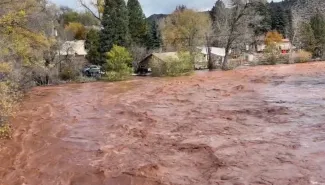
The floods changed the Animas River fishery a great deal. During the first storm, the river peaked at 11,200 cubic feet per second on October 23. That was the highest flow since 1970.
Ten days later, the river went even higher. It reached 13,000 cubic feet per second on November 2. That was the highest since it hit 20,000 cubic feet per second in 1927. The November 2 flows were the third-highest on record. The all-time peak was 25,000 cubic feet per second during a fall flood in 1911.
Courtesy CPW
Residents along the river found dead fish on their land after the water went down. Trout had moved to slower water along the river's edges. When the water dropped, some could not get back to the main channel.
Many fish were likely swept downstream. But CPW Southwest Region Senior Aquatic Biologist Jim White said many will quickly return. Fall is spawning season for the river's brown trout.
"Floodwaters are hard on young fish and fertilized eggs in the gravel," White said. "We can likely expect a year-class failure of brown trout and possibly some young age classes missing in both brown and rainbow trout. Most adult fish are able to ride out a flood by seeking low-velocity habitats in the floodplain. However, some get stranded and die as the waters recede. This is where stocking can play a pivotal role in filling in these missing age classes."
Rebuilding the fishery
The Animas River has faced disasters before. After the 416 Fire and debris flows, the river had a large fish kill. CPW worked for years to bring the fishery back. Gunnison River rainbow trout were a big part of that success. These fish have proven resistant to whirling disease.
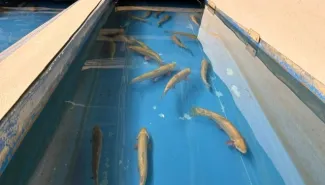
Gunnison River rainbows have been stocked in the Animas since 2019. A total of 91,072 fish have been stocked in that time. The fish stocked November 13 were 18 months old.
Courtesy
"These trout have shown the ability to reproduce naturally in other large river systems within the state," Votta said. "There is evidence they have reproduced naturally in the Animas River in recent years. The hope with this stocking effort is to create a self-sustaining population of rainbow trout in the Animas River."
The Colorado River cutthroat trout stocked November 13 were broodstock fish. CPW had used them to spawn and collect eggs to raise more of the species. This type of fish was also stocked in the Animas River in 2009, 2019, 2022 and 2024.
"This specific Colorado River cutthroat trout is a lineage unique to just the Durango Fish Hatchery," Votta said. "They were created in 2017 by crossing a Weminuche cutthroat with a Trapper Creek cutthroat. This greatly increased the overall genetic diversity of these fish, which leads to a more resilient strain of cutthroat trout."
Saving the San Juan cutthroat
When the first flood hit, the team moved fast to protect the San Juan cutthroat. This is another unique line of Colorado River cutthroat trout. It was thought to be extinct as recently as 2017. Then biologists found a population and rescued it from the 416 Fire in 2018.
Since then, the hatchery has kept San Juan cutthroats in its quarantine building as a broodstock. They are raised to preserve this important line of fish.
"Because the quarantine unit is located on the lowest part of the hatchery property, flood waters were threatening the San Juan cutthroats," Votta said. "Hatchery staff acted quickly to load three year classes of these fish into fish hauling trucks. The fish were then relocated to the main hatchery building where they are currently being cared for."
The other two age classes stayed in the quarantine building. Air stones kept them alive. The hatchery lost 12 fish from the oldest year class left behind in the quarantine unit. Votta was relieved his team moved the most vital year classes and avoided larger losses.
"We have used the progeny of these cutthroats to repopulate habitat reclaimed from non-native trout in a number of streams," White said. "This has been a true conservation success story."
Helping neighbors
After the water went down, the hatchery crew did not rest. They took down the large sandbag walls, loaded them onto trucks and headed north.
On November 3, flooding from Hermosa Creek forced more evacuations in the Animas Valley community. The crew drove into the flood to help residents. They worked to protect homes where Hermosa Creek flows into the Animas River.
"Just when I thought we were in the clear, I received a call from Area 15 Wildlife Manager Adrian Archuleta," Votta said. "He described an emergency situation that was unfolding to the north of Durango along Hermosa Creek. Hatchery staff went into action delivering several truck loads of sandbags to our neighbors to the north."
Looking ahead
Fisheries across southwest Colorado will feel the effects of the flooding. Still, White expects nature to repair itself in time.
"Floods, like fire, are natural events," White said. "Floods can restore and re-sort cobbles and gravels, create new habitat in the form of channels, and add woody debris to a stream, which trout love. They also tend to create a more diverse community of aquatic macroinvertebrates."
The hatchery also raises kokanee salmon, cut-bow trout and brown trout. The team produces about 1 million fish per year. It is the oldest state-owned hatchery in Colorado. Each day, staff work to get fresh spring water and everything else needed to run a hatchery of its size.
"Now that the flood waters have receded, the Durango Fish Hatchery will move forward with restocking efforts, cleanup efforts and infrastructure improvements to prevent future flooding," Votta said. "The Durango Fish Hatchery is truly a special place. It is beloved by our local community and the thousands of visitors that stop by each year. Whether you're here to feed the fish, enjoy the birds and wildlife, or cast a line on Huck Finn Pond, the hatchery has a way of connecting with everyone. The crew takes great pride in working here and enjoys serving as stewards for this one-of-a-kind place."