EarthTalk - Why are Arctic rivers and streams turning orange?

©
Dear EarthTalk:
Why are Arctic rivers and streams turning orange?
Will Mortimer, Largo, FL
Over the past decade, an increasing number of orange rivers and streams have been found in Arctic Alaska’s Brooks Range. These waters tend to be more acidic, turbid, and have higher concentrations of iron than their clearwater counterparts. As the Brooks Range is one of the least populated regions of North America, the typical cause of coloration of these water sources, namely excessive mining, is not probable.
More broadly, these orange rivers and streams are part of the Arctic Network, a larger regional area containing 19.3 million acres of land. In 2018, the National Park Service received reports of one of the first orange streams in the Brooks Range. By utilizing crowd-sourced observations from bush pilots, wilderness guides, other scientists, and rural and Indigenous communities, they found that over 75 streams had become orange in the Arctic Network. The findings of such an extensive number of orange rivers and streams led to growing research into the cause of the issue.
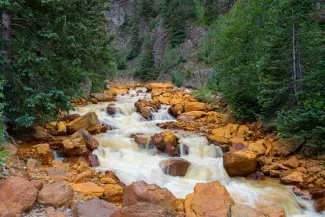
Red Mountain Creek in Colorado © iStock - Aaron Hawkins
After extensive research using what scientists call the Redness Index, researchers determined that the coloration of the rivers and streams was caused by the thawing of permafrost, which is ground that has remained frozen for extended periods of time, due to global warming. As a result, water and oxygen are able to easily enter the soil, breaking down sulfide-rich rocks to create excessive amounts of sulfuric acid that leaches naturally occurring metals into water sources. In particular, researchers found that oxidized iron was what turned the river streams, not unoxidized iron, nickel, zinc, cadmium or copper.
The most obvious effect of orange streams and lakes is the lack of habitat for subsistence fish, such as Dolly Varden, chum salmon and whitefish. In addition, the change in color of these water sources also reduces the amount of light that reaches the bottom, lowering insect larvae numbers. As fewer fish and insects are available, there is an increased amount of stress placed on organisms directly above and below in food chains. Another potential impact of orange streams and lakes are the contamination of drinking sources in the surrounding areas, as there are higher levels of dangerous chemicals.
“There’s no fixing [permafrost melting] once it starts…It’s another irreversible shift driven by a warming planet,” reports Timothy Lyons, a biogeochemistry researcher at the University of California, Riverside. But ordinary people can help by changing small, everyday actions to protect the planet. From using more eco-friendly transportation options to conserving electricity, people can take on multiple approaches to reducing global warming to eliminate the root of the issue.
CONTACTS
- Rivers Are Turning Orange. The Effects Are Disastrous. https://www.popularmechanics.com/science/environment/a66056056/orange-river/
- Timothy Lyons, https://profiles.ucr.edu/app/home/profile/timothyl.
EarthTalk® is produced by Roddy Scheer & Doug Moss for the 501(c)3 nonprofit EarthTalk. See more athttps://emagazine.com. To donate, visit https://earthtalk.org. Send questions to: question@earthtalk.org.