Exceptional drought eases in western Colorado as severe conditions expand on eastern plains

© KiowaCountyPress.net
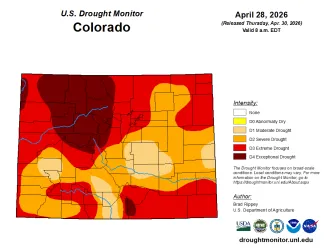
Exceptional drought retreated slightly in parts of western Colorado this week, even as extreme drought continued to spread across the state and conditions deteriorated on the eastern plains, according to the National Drought Mitigation Center’s U.S. Drought Monitor update released Thursday. The map, based on data valid through Tuesday, April 28, shows 18 percent of Colorado locked in exceptional drought (D4), with 59 percent of the state in extreme drought (D3) or worse and 90 percent in severe drought (D2) or worse.
Snowpack
Mountain snowpack continues to fade as Colorado moves through the heart of runoff season. The U.S. Drought Monitor reported that most western mountain snowpack has already melted, with only the northern Rockies still carrying meaningful snow into May. Federal water managers cited the bleak Western water-supply outlook, noting that fears of a hydroelectricity generation crisis in the Colorado River Basin have prompted the Department of Interior to begin sending water from Flaming Gorge Reservoir downstream to Lake Powell, while water normally bound for Lake Mead is being held in Lake Powell to bolster levels.
Spotty precipitation across the West did deliver high-elevation snow and a temporary boost to topsoil moisture in some basins, enough to support a modest pullback of the most severe drought category in parts of western Colorado, the U.S. Drought Monitor reported. The reprieve is narrow, however; the agency cautioned that recent precipitation has not changed the broader spring and summer water-supply picture for 2026.
Conditions remain a sharp contrast to one year ago. In late April 2025, 39 percent of Colorado was drought-free and no portion of the state was classified in exceptional drought. A year of precipitation shortfalls and above-normal temperatures has since driven most of Colorado into the two worst drought categories.
Drought Conditions
Exceptional drought (D4) still blankets Colorado’s headwater counties, but the footprint contracted modestly this week, the U.S. Drought Monitor reported. Eagle County, Summit County, Jackson County, Routt County and Pitkin Countyremain 100 percent in exceptional drought. Grand County is 98 percent in D4 with the remainder in extreme drought (D3), and Lake County is 96 percent in D4 with the balance in D3, according to the U.S. Drought Monitor.
©
Conditions improved at the margins in several west-slope counties. Moffat County is now 72 percent in exceptional drought and 28 percent in extreme drought, down from 96 percent D4 the prior week. Garfield County is 51 percent in exceptional drought and 49 percent in extreme drought, while Rio Blanco County is 38 percent in D4 and 62 percent in D3. Along the Front Range, Larimer County is 30 percent in exceptional drought and 70 percent in extreme drought.
Across the eastern plains, severe and extreme drought continued to deepen, according to the U.S. Drought Monitor. Yuma County, Phillips County, Sedgwick County and Baca County are each 100 percent in extreme drought. Las Animas County is 95 percent in extreme drought with 5 percent in exceptional drought, and Huerfano County is 81 percent in extreme drought with 11 percent in exceptional drought. Weld County is 79 percent in extreme drought, Logan County is 66 percent, and Prowers County is 64 percent.
The U.S. Drought Monitor noted that the U.S. Department of Agriculture rated topsoil moisture in Colorado at 95 percent very short to short on April 26, the highest reading in the High Plains region. The agency reported that 54 percent of the state’s winter wheat crop was rated in very poor to poor condition, and that drought generally worsened in eastern Colorado over the past week.
Statistics
No portion of Colorado is drought-free, unchanged from last week. Abnormally dry conditions (D0) cover none of the state, down from 2 percent. Moderate drought (D1) edged up from 9 percent to 10 percent. Severe drought (D2) eased slightly from 32 percent to 31 percent. Extreme drought (D3) expanded from 36 percent to 41 percent, and exceptional drought (D4) contracted from 22 percent to 18 percent.
One year ago, conditions were dramatically less severe. In late April 2025, 39 percent of Colorado was drought-free, 18 percent was abnormally dry, 26 percent was in moderate drought, 13 percent was in severe drought, and 4 percent of the state was in extreme drought. No portion of Colorado was classified in exceptional drought at that time.
Week | Date | None | D0 | D1 | D2 | D3 | D4 |
|---|---|---|---|---|---|---|---|
| Current | 4/28/26 | 0% | 0% | 10% | 31% | 41% | 18% |
| Last Week | 4/21/26 | 0% | 2% | 9% | 32% | 36% | 22% |
| 3 Months Ago | 1/27/26 | 30% | 18% | 30% | 17% | 5% | 1% |
| Start of Calendar Year | 12/30/25 | 29% | 33% | 22% | 13% | 2% | 1% |
| Start of Water Year | 9/30/25 | 46% | 9% | 9% | 22% | 14% | 0% |
| One Year Ago | 4/29/25 | 39% | 18% | 26% | 13% | 4% | 0% |
Just over 5,029,000 Colorado residents live in a drought-impacted area. Colorado’s 2023 population was estimated at 5,877,610.
Drought categories include (ranked from least to most severe) abnormally dry (D0), moderate (D1), severe (D2), extreme (D3), and exceptional (D4) drought.