Exceptional drought expands in Colorado high country as heat builds across the West

© KiowaCountyPress.net
Chris Sorensen (Kiowa County Press)
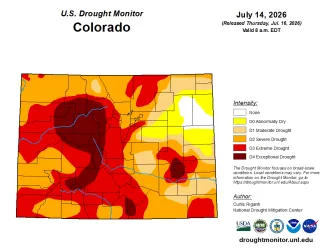
Exceptional drought - the worst category tracked by the National Drought Mitigation Center - expanded across Colorado's central mountains over the past week, even as scattered heavy rain brought localized relief to portions of the eastern plains. The latest map from the U.S. Drought Monitor, released Thursday and based on data valid Tuesday, July 14, shows just over 12 percent of the state in exceptional drought, up from 10 percent the week before.
©
Colorado drought conditions as of July 14, 2026. Map courtesy National Drought Mitigation Center.
Snowpack
With the snowmelt season over, the legacy of last winter's poor mountain snowpack is now showing up in streams, reservoirs and soils across the high country. Hot, mostly dry weather dominated areas west of the Continental Divide during the drought week, according to the U.S. Drought Monitor, with temperatures running three to six degrees above normal across much of the interior West and record-setting heat to the north.
Conditions stand in stark contrast to one year ago, when no part of Colorado was in extreme or exceptional drought and 43 percent of the state was drought-free. At the start of the water year October 1, 46 percent of the state remained free of drought and abnormally dry conditions - a figure that has since collapsed to about 3 percent.
Forecasters noted one potential bright spot: the North American Monsoon has begun delivering moisture to the southwest, and heavier rain was forecast to spread from Arizona and western New Mexico north into southwest Colorado in the coming days, according to the drought monitor outlook.
Drought Conditions
The most severe conditions remain centered on the central and northern mountains, according to the U.S. Drought Monitor. Eagle, Lake and Pitkin counties are entirely in exceptional drought, while Summit County is 88 percent exceptional with the remainder in extreme drought. Chaffee County stands at 78 percent exceptional and 22 percent extreme.
Elsewhere in the high country, Grand County is 54 percent exceptional and 41 percent extreme, with Garfield County at 48 percent exceptional and 49 percent extreme. Routt County is one-third exceptional, and in the San Luis Valley, Saguache County is 37 percent exceptional with the remaining 63 percent in extreme drought, according to the U.S. Drought Monitor.
Closer to home, Kiowa County remains in the grip of drought, with 20 percent of the county in exceptional drought, 32 percent in extreme drought, 38 percent in severe drought, and the balance in moderate drought. Spotty heavy rain - locally in the 1.5 to two-inch range - fell across eastern Colorado during the week, leading to localized improvements where soil moisture improved and precipitation deficits eased, according to the U.S. Drought Monitor.
Statistics
Overall, 3 percent of Colorado is free of drought and abnormally dry conditions, up from 2 percent the prior week. Abnormally dry conditions were steady at 7 percent, while moderate drought held at 10 percent. Severe drought fell from 38 to 34 percent, extreme drought was unchanged at 34 percent, and exceptional drought grew from 10 to 12 percent.
One year ago, 43 percent of the state was drought-free, with 12 percent abnormally dry. Moderate drought covered 14 percent of Colorado, while severe drought impacted 22 percent and extreme drought stood at 9 percent. No exceptional drought appeared anywhere in the state.
| Week | Date | None | D0 | D1 | D2 | D3 | D4 |
|---|---|---|---|---|---|---|---|
| Current | 7/14/26 | 3 | 7 | 10 | 34 | 34 | 12 |
| Last Week to Current | 7/7/26 | 2 | 7 | 10 | 38 | 34 | 10 |
| 3 Months Ago to Current | 4/14/26 | 0 | 2 | 15 | 28 | 33 | 22 |
| Start of Calendar Year to Current | 12/30/25 | 29 | 33 | 22 | 13 | 2 | 1 |
| Start of Water Year to Current | 9/30/25 | 46 | 9 | 9 | 22 | 14 | 0 |
| One Year Ago to Current | 7/15/25 | 43 | 12 | 14 | 22 | 9 | 0 |
Just over 5,019,000 Colorado residents live in a drought-impacted area. Colorado's 2023 population was estimated at 5,877,610.
Drought categories include (ranked from least to most severe) abnormally dry (D0), moderate (D1), severe (D2), extreme (D3), and exceptional (D4) drought.