Exceptional drought expands as less than one percent of Colorado remains drought-free

© KiowaCountyPress.net
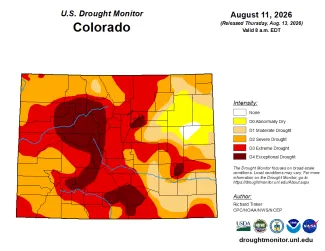
Drought conditions continued to deteriorate across Colorado over the past week, leaving less than one percent of the state free of drought or abnormally dry conditions, according to data released Thursday by the National Drought Mitigation Center. Exceptional drought - the most severe category - expanded to cover 14 percent of the state, based on data valid Tuesday, August 11.
©
Colorado drought conditions as of August 11, 2026. Map courtesy of the National Drought Mitigation Center.
Snowpack
With the winter snowpack long since melted from Colorado’s high country, mountain watersheds are depending on monsoon moisture to limit further declines. The higher elevations picked up more than half an inch of rain over the past week, according to the U.S. Drought Monitor, though most locations outside the highest terrain have recorded well below normal precipitation over the past 30 days - in many areas less than 25 percent of normal.
The dry conditions stand in sharp contrast to the start of the water year on September 30, when nearly half of the state - 46 percent - was free of drought and abnormal dryness. Impacts have mounted since: 64 percent of Colorado’s pastures and rangelands are rated in poor or very poor condition, compared with a five-year average of 23 percent, while 46 percent of the state’s corn and 57 percent of its sorghum are in similar shape.
Drought Conditions
Exceptional drought remains entrenched in the central and northern mountains. Eagle and Pitkin counties are entirely in exceptional drought, according to the U.S. Drought Monitor. In Summit County, 88 percent of the county is in exceptional drought, with the remaining 12 percent in extreme drought. Grand County is 54 percent exceptional and 41 percent extreme drought, while Routt County stands at 33 percent exceptional and 13 percent extreme drought.
Elsewhere, conditions worsened from south-central through northeastern Colorado, where the U.S. Drought Monitor noted the most widespread deteriorations in the region. Significantly above-normal temperatures over the past 30 days have added to the stress on soils, streams and crops, with reduced streamflows reported across the drought-affected areas.
Statistics
Compared to the previous week, the area of Colorado free of drought and abnormal dryness fell from three percent to one percent. Abnormally dry conditions held steady at six percent, as did moderate drought at 13 percent and severe drought at 31 percent. Extreme drought increased from 34 to 35 percent, while exceptional drought grew from 13 to 14 percent.
One year ago, 38 percent of the state was drought-free, with 15 percent abnormally dry. Moderate drought covered seven percent of Colorado, severe drought 20 percent, extreme drought 13 percent, and exceptional drought seven percent.
| Week | Date | None | D0 | D1 | D2 | D3 | D4 |
|---|---|---|---|---|---|---|---|
| Current | 8/11/26 | 1 | 6 | 13 | 31 | 35 | 14 |
| Last Week to Current | 8/4/26 | 3 | 6 | 13 | 31 | 34 | 13 |
| 3 Months Ago to Current | 5/12/26 | 0 | 4 | 14 | 36 | 32 | 15 |
| Start of Calendar Year to Current | 12/30/25 | 29 | 33 | 22 | 13 | 2 | 1 |
| Start of Water Year to Current | 9/30/25 | 46 | 9 | 9 | 22 | 14 | 0 |
| One Year Ago to Current | 8/12/25 | 38 | 15 | 7 | 20 | 13 | 7 |
Just over 4,755,000 Colorado residents live in a drought-impacted area. Colorado’s 2023 population was estimated at 5,877,610.
Drought categories include (ranked from least to most severe) abnormally dry (D0), moderate (D1), severe (D2), extreme (D3), and exceptional (D4) drought.