Feds to impose new cuts on lower Colorado River states amid climate-fueled megadrought

The federal government on Friday formalized a set of guidelines for managing water use in the Colorado River Basin over the next decade, if Colorado and six other Western states can’t come to an agreement on how to deal with declining flows caused in large part by climate change.
“The Department has a responsibility to ensure the Colorado River system remains reliable and resilient for the millions of Americans, communities and industries that depend on it,” Interior Secretary Doug Burgum said in a press release. “This framework provides the flexibility to respond to changing hydrologic conditions while preserving the opportunity for the Basin States to continue working toward durable, consensus-based solutions.”
iStock
Under the U.S. Bureau of Reclamation’s “preferred alternative” for the management of the river’s reservoir system, outlined in a extensive environmental impact statement, the burden of the most severe cuts would continue to fall on the Lower Basin states of Arizona, California and Nevada, which could face mandatory cuts of up to 3 million acre-feet of water. The Upper Basin states of Colorado, New Mexico, Utah and Wyoming would face only voluntary conservation targets totaling 200,000 acre-feet.
All seven states were parties to the Colorado River Compact, a 1922 agreement governing the use of water from the vital Western watershed. Today, the Colorado River provides water to an area inhabited by 40 million people across the Southwest, though agricultural uses account for the vast majority of consumption.
Since 2000, a megadrought caused largely by global warming — the region’s worst dry spell in at least 1,200 years — has stressed water supplies across the basin and pushed the Colorado River Compact to a breaking point. The last set of federal guidelines to address shortages, issued nearly 20 years ago, will expire January 1, and the seven Colorado River Compact states failed to reach a new agreement before a federally imposed deadline in February.
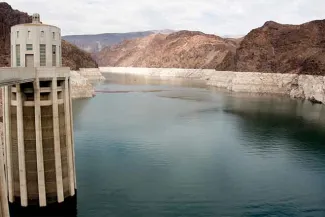
Hoover Dam on the Colorado River Drought © iStock - ngc4565
The combined amount of water stored in Lake Powell and Lake Mead, the Colorado River system’s two key reservoirs, fell this month to its lowest level since May 1957 — before Lake Powell, created by the Glen Canyon Dam, had even begun to fill.
Without a major turnaround in hydrologic conditions in the near future, water levels in Lake Powell are expected to fall by next spring to below “minimum power pool,” at which point the Glen Canyon Dam’s hydroelectric turbines would be unable to operate.
Negotiations over a comprehensive new agreement have led to an increasingly bitter dispute between the Upper Basin states — led by Colorado, the river’s headwaters state and by far the Upper Basin’s largest water user — and the Lower Basin states, especially Arizona, which has borne the brunt of the cuts imposed in recent years. Arizona is widely expected to launch a high-stakes legal challenge as soon as this summer, alleging Colorado and other Upper Basin states are failing to meet an obligation under the original Colorado River Compact to allow enough water to flow downstream.
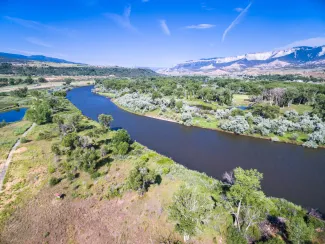
In the absence of a new agreement among the states, the Bureau of Reclamation says it will continue to update its new guidelines every two years until 2036.
Andrea Travnicek, the Interior Department’s assistant secretary for water and science, said the plan “strikes a balance between flexibility and predictability … given unprecedented hydrologic conditions and the potential for considerable impacts on water users.”
In a statement, Democratic U.S. Senator Michael Bennet of Colorado said he was “disappointed” by the failure to reach a new long-term agreement among the seven Colorado River Compact states.
“While a two-year operating plan is the bare minimum needed to operate the river, a long-term, consensus agreement that recognizes real hydrologic conditions is the only durable solution to bring certainty to the Colorado River,” Bennet said.