Food stamp changes will cost states billions, raising fears about SNAP’s future

© jetcityimage - iStock-958835100
Upcoming funding shifts in the federal food stamp program are poised to cost states billions of dollars, heightening fears that more Americans will lose access to the nation’s largest food assistance program.
Last year’s One Big Beautiful Bill Act made major changes to the Supplemental Nutritional Assistance Program, or SNAP, including new eligibility and work requirements. Already, more than 4 million Americans have lost SNAP benefits, putting more pressure on food banks and food pantries across the country.
But beginning in fall 2027, states for the first time must begin to fund some SNAP benefits themselves. Analyses of newly released data from the U.S. Department of Agriculture shows states could be on the hook for more than $9 billion. Some states, county officials and advocates fear this will remove more Americans from the safety net program and even push some states to consider dropping out of SNAP altogether.

The new law will penalize states depending on their payment error rates — a technical calculation by the feds of SNAP overpayments and underpayments, not fraud. States with a payment error rate above 6% will have to fund 5% to 15% of their benefit payments. Previously, the feds provided the aid.
In USDA’s most recent analysis, the error rate slightly improved across the states in fiscal year 2025, but officials said states still made a collective $10.1 billion in improper payments.
“These payment error rates are further proof that state accountability is severely lacking in SNAP,” Agriculture Secretary Brooke Rollins said in a June news release.
As many as 36 states will face new cost share requirements in the fall of 2027. And nearly half of those are expected to be on the hook for $100 million or more a year, according to the left-leaning Center on Budget and Policy Priorities.
For example, in Michigan, the current error rate could cost the state $300 million a year, the center estimates. Texas could be on the hook for an estimated $725 million and New York may need to spend more than $1 billion.
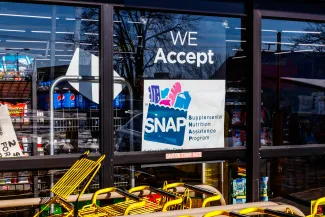
“States are going to have to make some really painful decisions as they have to balance their budgets about how they are going to cover those costs, and if they can’t fully cover the required cost-sharing requirement, by raising revenue or cutting elsewhere in their budget,” said Katie Bergh, senior policy analyst at the center.
The change is heightening fears that states will slow down benefit approval, cut access or even choose to drop out of the program altogether, Bergh said. While advocates and some officials have unsuccessfully pushed Congress to reverse its SNAP changes, many are now asking for at least a delay in implementation to give states time to improve their payment error rates.
After USDA released its new data last month, New Jersey Human Services Commissioner Stephen Cha said the error rate measurement is “fundamentally flawed.” Though the state significantly cut its error rate from 14.33% to 6.86%, it could still be on the hook for an estimated $100 million.
Cha reiterated previous calls for Congress and the Trump administration to eliminate or delay the changes.
“Penalizing states will do nothing to improve payment accuracy or meaningfully address waste, fraud, or abuse,” Cha said in a statement. “Instead, they impose a significant financial and administrative burden on State and county governments, threatening our ability to effectively administer SNAP and meet the critical needs of families across New Jersey.”
In a statement to Stateline, a USDA spokesperson noted states have had decades to improve erroneous payments. “Perhaps now, States will stop spending other people’s money so recklessly,” the statement said.
Looming budget pressures
In 10 states — California, Colorado, Minnesota, New Jersey, New York, North Carolina, North Dakota, Ohio, Virginia and Wisconsin — counties administer the SNAP program.
The National Association of Counties has said the cost shift will threaten not only food access, but could squeeze the ability of counties to fund public safety, emergency management and infrastructure needs.
“These cost shifts threaten to destabilize county budgets, forcing reductions in staffing and delaying critical nutrition assistance for vulnerable residents,” association CEO Matthew Chase said in a letter last year to congressional leaders.
The National Conference of State Legislatures, which represents lawmakers and legislative staff, said states are committed to administering SNAP benefits accurately and to being held accountable for their performance. But in a statement, the organization said USDA’s most recent data “make clear that additional time is needed” to implement meaningful improvements.

© iStock - Sergei Gnatiuk
State efforts to improve their payment accuracy also have substantial tradeoffs.
This spring, the Urban Institute and the American Public Human Services Association surveyed all SNAP agencies across the country. Thirty-nine states responded to the survey, representing a 78% response rate.
The survey found that SNAP administrators are investing in staffing, technology and automation to respond to the federal law. But many states are turning away from efforts to improve timeliness and may have to reduce staffing and benefits to comply.
In the survey, 29% of states identified narrowing eligibility policies as a potential risk and 11% saw a wholesale withdrawal from SNAP as a potential risk.
Oklahoma Governor Kevin Stitt, a Republican, said churches, food banks and other organizations would ensure that people are fed there.
Stitt, the chair of the bipartisan National Governors Association, said he believes federal programs like SNAP are operated with “a lot of fraud and abuse.” He also suggested that the program had become too seamless, with cards that resemble credit cards allowing recipients to easily purchase groceries.
“Maybe it’s going back to the day where there was a little stigma attached and you had to actually go to a food bank and pick up commodity cheese and commodity groceries, and it had a little stigma so you were a little bit embarrassed,” he told Stateline. “Maybe we should go back to a little bit of that instead of just making it so easy…”
“Nobody’s going to go hungry in Oklahoma,” he said. “…I can assure you people were eating, getting married, graduating from high school before we even had anything called SNAP benefits.”
The error rate
The federal focus on error rates is incentivizing states to slow down or entirely halt benefits in some cases, said Gina Plata-Nino, SNAP director at the Food Research & Action Center, a nonprofit working to combat hunger.
That’s because states face no penalty for wrongfully denying benefits, she said, only for paying too much or too little in benefits. The rate, calculated by a random sample of households, adds the number of overpayments and underpayments together. And states can still be penalized for overpayments they later recover from recipients.
“There is no oversight in terms of the people who are eligible and being cut off,” Plata-Nino said.
In Massachusetts, nearly 175,000 people lost SNAP benefits between July of last year and May of this year. And understaffing at the Department of Transitional Assistance has caused thousands of incoming phone calls from residents to get disconnected, according to the Massachusetts Law Reform Institute, a poverty law and policy center.
That organization has pushed for more caseworkers, though a legislative budget proposal last week would cut $26 million from existing operations, said Victoria Negus, senior economic justice advocate at the institute.
“What is happening is a version of what I’ve been calling ‘can’t see the forest for the payment error rate trees,’” she said. “They have set up this system that forces states to try to meet a number that is almost impossible for them to meet without fully decimated access to SNAP, because it takes time to methodically and carefully reduce payment error rates.”
In Alabama, officials said the state continues to prioritize staff training, automation and other changes to reduce the state’s error rate. The current error rate of 9.52% could cost the state an estimated $170 million.
Alabama’s legislature has set aside nearly $150 million for the SNAP program. But state Senator Greg Albritton, a Republican who leads the budget committee, told Alabama Reflector in April that those funds won’t be released unless the state can reduce its error rate to 6% or develop another plan to cover costs of the federal cuts.
Kathryn Shoupe, spokesperson for the Alabama Department of Human Resources, noted that the federal data can be over a year old. She also noted that it isn’t evidence of fraud, but usually unintentional reporting errors from recipients.
LaTrell Clifford Wood, the hunger policy advocate at the anti-poverty nonprofit Alabama Arise, said the state needs hundreds more employees to fully meet the need. She noted that more than 52,000 people have already lost SNAP benefits in Alabama. And with rising grocery prices, she said the focus on the error rate will force difficult budgetary decisions that could affect other parts of the state budget, such as education.
“It is a metric with moral ambiguity,” she said. “We are putting paper pushing over people.”