Heavy rain trims Colorado drought, but extreme conditions persist

© KiowaCountyPress.net
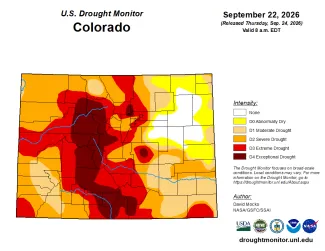
Tropical moisture and heavy rain brought drought relief to much of Colorado this week, though the worst conditions remain stubbornly in place across the state’s mountains, according to the U.S. Drought Monitor. The map, released Thursday, Oct. 1, by the National Drought Mitigation Center and valid as of Tuesday, Sept. 29, shows 35% of Colorado in extreme (D3) or exceptional (D4) drought, down from 38% a week earlier. Exceptional drought shrank from 13% of the state to 10%.
Snowpack
The new water year began Wednesday, which means Colorado’s mountain snowpack season has not yet started in earnest. Little or no snow is on the ground at most measuring sites, so the focus for now is on the moisture that will soak into soils and refill streams heading into winter.
The U.S. Drought Monitor said this week’s rain was tied to an east-Pacific tropical connection linked to El Niño, with remnants of Hurricane Polo tracking into the Southwest on Monday and Tuesday. Whether that pattern carries over into a snowy winter remains to be seen. A year ago, at the start of the 2025 water year, 46% of Colorado was free of drought, compared with just 9% now, meaning this year’s snowpack will have to work against a much deeper moisture deficit.
Drought Conditions
Despite the improvement, exceptional drought still blankets much of the high country, according to the U.S. Drought Monitor. In Eagle County, 100% of the county is in exceptional drought. In Pitkin County, 80% is in exceptional drought and 20% in extreme drought, while Summit County is 88% exceptional and 12% extreme.
©
In Grand County, 54% is in exceptional drought, 41% in extreme drought and 6% in severe drought. Routt County is split among exceptional drought (26%), extreme drought (33%) and severe drought (41%). In Jackson County, 11% is in extreme drought, 42% in severe drought and 47% in moderate drought.
Beneficial rains also fell across southern and eastern Colorado and into western Kansas and Nebraska, leading to drought relaxation there, the Drought Monitor narrative said. Temperatures across the High Plains ran up to 6 degrees or more above average, but the rainfall still produced improvement in many areas.
Statistics
Compared with last week, the share of Colorado without drought rose from 6% to 9%, and abnormally dry (D0) conditions edged up from 8% to 9%. Moderate drought (D1) grew from 18% to 24% as areas of severe drought were downgraded, while severe drought (D2) fell from 29% to 23%. Extreme drought (D3) held at 25%, and exceptional drought (D4) dropped from 13% to 10%.
One year ago, on Sept. 30, 2025, 46% of Colorado had no drought and 9% was abnormally dry. Moderate drought covered 9% of the state, severe drought 22% and extreme drought 14%. No part of the state was in exceptional drought.
| Week | Date | None | D0 | D1 | D2 | D3 | D4 |
|---|---|---|---|---|---|---|---|
| Current | 9/29/26 | 9% | 9% | 24% | 23% | 25% | 10% |
| Last Week to Current | 9/22/26 | 6% | 8% | 18% | 29% | 25% | 13% |
| 3 Months Ago to Current | 6/30/26 | 0% | 7% | 13% | 40% | 30% | 9% |
| Start of Calendar Year to Current | 12/30/25 | 29% | 33% | 22% | 13% | 2% | 1% |
| Start of Water Year to Current | 9/30/25 | 46% | 9% | 9% | 22% | 14% | 0% |
| One Year Ago to Current | 9/30/25 | 46% | 9% | 9% | 22% | 14% | 0% |
Just over 4,368,000 Colorado residents live in a drought-impacted area. Colorado’s 2023 population was estimated at 5,877,610.
Drought categories include (ranked from least to most severe) abnormally dry (D0), moderate (D1), severe (D2), extreme (D3), and exceptional (D4) drought.