Iowa State University research links pollinators and prairie plants in creating biodiversity

Iowa State University researchers have identified a causal relationship between pollinators and plant biodiversity — one that could lead to a “plant-pollinator extinction vortex,” if not addressed with actions to better support pollinators, they say.
Brian Wilsey, a professor of ecology at ISU, and doctoral graduate Nathan Soley released a report showing the link between pollinators and the plants they interact with goes both ways. That means reductions in pollination of landscapes decreases the biodiversity of that area, which in turn leads to a decline in pollinators, further reducing plant diversity.
As pollinators like bees see population declines across the world, Wilsey said identifying this causal link could help in maintaining more resilient reconstructed prairies and encouraging the public to welcome pollinators with what they plant.
“Bees maintain diversity at a lower rate. So if bees decline, plant diversity will be lower, and then that’s going to lead to fewer bees and fewer species of bees, which would in turn lead to more bee declines, which would lead to more drops in plant diversity,” Wilsey said. “It’s kind of like an extinction vortex.”
Study employed material commonly used in bridal veils
Utilizing university-owned prairie land outside of Ames, Wilsey and Soley worked with as many as 68,000 flowers over the four growing seasons included in the study, starting in 2020. Plants in some of the 54 plots were bagged in order to keep pollinators away, others were hand-pollinated by Wilsey and Soley and the rest were left undisturbed to act as control groups.
In order to still allow light in but keep pollinators away, Wilsey said he and Soley bagged flowers with fabric commonly used to make bridal veils. They had to continuously check for new flowers in the pollinator-restricted plots to bag them, and after four years of growing seasons, the pair “saw a difference in the plant community.”
© Chris Sorensen / KiowaCountyPress.net
“There are fewer animal-pollinated species and fewer species overall. So it kind of suggests, for the first time that we’re aware of … it turns out pollinators are really important to plant diversity, maintaining high plant diversity,” Wilsey said.
According to the report, published this month in the Ecological Society of America Ecology journal, plants bagged to keep away pollinators saw a 50% reduction of viable seeds, “and a 23% decline in plant species richness overall,” also described as the number of different plant species in the area.
Wilsey’s work with bison and seeing how their practice of eating dominant prairie grasses led to an increased abundance of other plants led the researcher to think more about diverse prairie landscapes, he said, as well as trends he’s seen in reconstructed prairies.
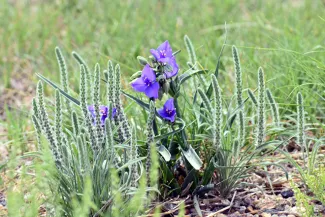
Some non-grass plants that can be found in a preserved prairie have a very hard time establishing themselves in a restored prairie ecosystem, Wilsey said, and some that do flower at first drop away quickly — a symptom of too much competition from grasses, he and others thought.
“There are a lot of species that are missing in our restorations, and we’ve been looking at that for a long time, trying to figure out how to restore those species,” Wilsey said. “And it turns out, I think pollinators are part of the equation.”
Wilsey said he hopes this study will help fill in that part of the formula they’ve been missing and encourage people to better consider pollinators in their plant establishment and management.
A project he is collaborating on with ISU natural resource ecology and management assistant professor Katherine Kral-O’Brien would create six different treatments for lawns that keep pollinators in mind, from slight to big changes in order to bolster pollinator populations.
Wilsey’s work out in the prairie plots isn’t finished either, with the professor hoping to further his study into “the next generation” of plants and which ones will reproduce the most.
“I want to look at if species composition will shift towards those wind-pollinated species and self-pollinating species and highly clonal species,” Wilsey said. “So that’ll take a few more years to see that — it looks like it’s occurring already.”