Lake Powell is up three feet. Lake Mead keeps setting record lows. What the Pacific storms did, and did not do, for the Colorado River

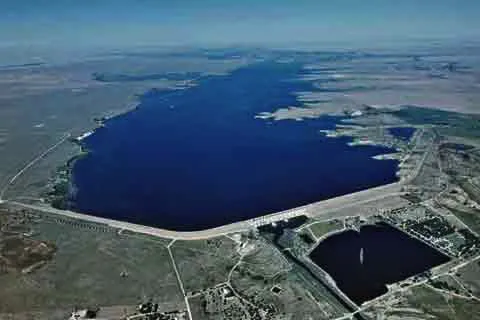
Two tropical storms in two weeks soaked the Southwest, and the water is finding its way to the Colorado River's two great reservoirs. Lake Powell has risen about three feet since September 15, when it touched its lowest level since the reservoir first filled in the 1960s. Lake Mead has not risen at all. It set a record low on October 9, and a lower one on October 15.
©
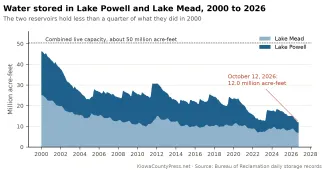
Together the two lakes held 12.0 million acre-feet of water on October 12, the last day for which Reclamation's storage records were available this week, according to the Bureau of Reclamation. In October 2000 they held 43.3 million. On the same date in 2022, the low point of the last crisis, they held 13.2 million. The storms are real, and so is the hole they are falling into.
What the storms brought
The remnants of Hurricane Polo crossed the Four Corners and southern Colorado at the end of September. The remnants of Hurricane Rachel came ashore in Southern California on October 10 and crossed Nevada and Utah on October 11 and 12. Las Vegas measured 1.08 inches on October 11, a record for the date and a tie for its wettest October day in records going back to 1937, according to the National Weather Service. Kingman, Arizona, measured 2.34 inches and the mountains above it more than 3. Utah's west desert picked up 1 to 2.4 inches.
©
Most of that country drains to the Colorado below Glen Canyon Dam, or not at all. The Colorado Basin River Forecast Center expects the tributaries that enter the river between Lake Powell and Lake Mead to deliver about 120,000 acre-feet in October, 147 percent of average, Reclamation reported in its weekly hydrologic update. That is a good month. It is also about what Hoover Dam releases downstream in a week.
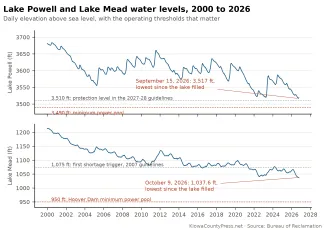
Polo did more for Powell. Its rain fell on the San Juan Mountains and the Four Corners, the headwaters of the San Juan and Dolores rivers. Vallecito Reservoir north of Durango more than doubled, from 28,700 acre-feet on September 1 to 68,500 on October 12. Navajo Reservoir gained 37,000 acre-feet and McPhee 9,000. Lake Powell itself gained 63,000 acre-feet over the same stretch and stood at 3,519 feet on October 12, up from 3,516.62 on September 15. It holds 5.2 million acre-feet, 22 percent of capacity. Rachel's runoff is still arriving: the lake rose another eight-tenths of a foot between October 12 and October 15, to 3,519.79.
Lake Mead's level has little to do with storms. It depends on how much Glen Canyon Dam lets through and how much Hoover Dam sends on to Arizona, California, Nevada and Mexico. This month Glen Canyon is releasing about 6,500 cubic feet per second and Hoover is releasing about 8,000 to 10,000, according to Reclamation's daily river report. The lake drops. On October 9 it reached 1,037.60 feet, below the previous low of 1,040.7 set in July 2022, and on October 15 it reached 1,037.53, according to the agency's Lake Mead elevation records, and it held 6.8 million acre-feet, 26 percent of capacity, on October 12.
How the year went
The water year that ended September 30 was the one the river's managers had planned for and hoped not to see, as the Press reported in its water-year recap. Unregulated inflow to Lake Powell was 3.7 million acre-feet, 39 percent of normal. The April through July runoff, when the snowpack is supposed to melt and fill the lake, was 1.1 million acre-feet, 18 percent of normal. August brought 1,000 acre-feet, which Reclamation rounds to zero percent of average.
Reclamation responded in stages. In December it trimmed winter releases from Glen Canyon Dam to protect a target elevation of 3,525 feet. In the spring, with the lake headed below 3,500, the Interior Department cut the year's release from 7.48 million acre-feet to 6.0 million, the least the dam has released in a year under the current rules, and ordered up to a million acre-feet sent down from Flaming Gorge Reservoir in Utah and Wyoming by April 2027 to prop Powell up. Lower on the river, the states and Mexico left water in Lake Mead under conservation agreements that have been in place since 2023.
None of it was enough to keep Powell off a record low in September. The number that matters at Glen Canyon Dam is 3,490 feet, the minimum level at which the turbines can run. Below that, water can leave only through four bypass tubes near the base of the dam that were never built for continuous use. On September 15 the lake was 27 feet above that line.
Twenty-five years
In January 2000, Lake Powell was 94 percent full and Lake Mead 96 percent. The drought that began that year has never really ended. Powell lost two-thirds of its water by 2005. A wet 2011 filled it back to three-quarters. The big snow year of 2023 added about four million acre-feet to the two lakes combined and bought the river two years. The two years are up.
The rules changed along the way. The 2007 Interim Guidelines wrote down for the first time how the two lakes would be run together and when the Lower Basin would take cuts. The 2019 Drought Contingency Plan added deeper cuts. In August 2021 Reclamation declared the river's first shortage, for 2022, and the August 2026 study set a shortage condition again for 2027. Lake Mead has been in a shortage condition every year since, and Lake Powell has been operated under emergency provisions since 2022.
The 2007 guidelines expire at the end of this year. On August 21, the Interior Department issued the 2027-2028 Operating Guidelines that replace them, along with a 10-year framework that runs through 2036 and leaves room for the seven states to negotiate a longer agreement. The new rules cut Lower Basin deliveries by 1.25 million acre-feet in each of the next two years: 760,000 from Arizona, 440,000 from California and 50,000 from Nevada. For Lake Powell they set 3,510 feet as the level to protect and let Reclamation release anywhere from 6.0 to 7.0 million acre-feet in water year 2027, adjusting through April to hold the line. Blue Mesa, Flaming Gorge and Navajo can be drawn on again, under an agreement among the Upper Basin states, to help.
"Forty million people, millions of acres of farmland and ranchland, industries that power the American West" depend on the river, Interior Secretary Doug Burgum said in announcing the decision.
Colorado's reservoirs
About a tenth of what is stored in Lake Powell and Lake Mead sits upstream in Colorado, in reservoirs on the Colorado River and its tributaries. Most of them are in worse shape than the big two.
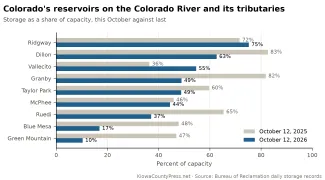
Blue Mesa Reservoir on the Gunnison, the largest in the state, held 140,000 acre-feet on October 12, 17 percent of capacity, according to Reclamation's daily record. A year ago it was 48 percent full. Reclamation's records for Blue Mesa go back to its first filling in 1966, and it has never been this low since. July inflow was 18 percent of average. Green Mountain Reservoir on the Blue River, which supplies water to the Western Slope in exchange for what Denver diverts, is at 10 percent of capacity, its lowest since 1963. Ruedi Reservoir on the Fryingpan is at 37 percent, its lowest since 1996.
©
Lake Granby, the heart of the Colorado-Big Thompson Project that sends Western Slope water to the Front Range, is 49 percent full against 82 percent a year ago. Dillon Reservoir, Denver Water's largest, is 63 percent full against 83. Taylor Park is at 49 percent, McPhee on the Dolores at 44, Ridgway on the Uncompahgre at 75.
Only one Colorado reservoir on the list is better off than a year ago, and it is the one Polo rained on. Vallecito is 55 percent full, up from 36 percent in October 2025.
Flaming Gorge, the reservoir Reclamation is draining to help Powell, is at 65 percent, down from 79 percent a year ago. Navajo on the San Juan is at 50 percent.
Outlook
Reclamation's October 24-Month Study, released October 14, is the first in a long while to come in better than the month before. It still has both lakes lower at the end of the year than they are now, and Powell is still expected to fall below 3,510 feet during the coming water year, which puts it in the new guidelines' infrastructure protection range from the start. But the most probable projection, which assumes a 6.0 million acre-foot release from Glen Canyon Dam, now bottoms Lake Mead at 1,007.73 feet in July 2027 and 1,009.85 feet in July 2028. September's study had the lake below 1,000 feet in the summer of 2028. Lake Powell's projected low in March 2028 is 3,521.54 feet, about three feet higher than September's figure. The Flaming Gorge releases continue through April, and the 2027 Annual Operating Plan, which will set the year's numbers, is being written now.
©
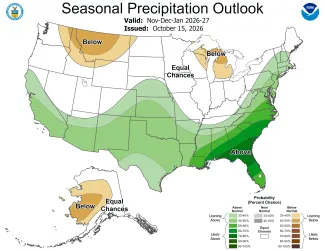
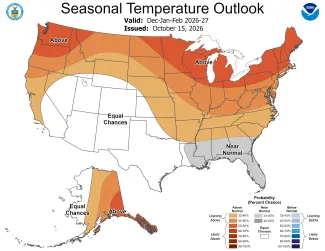
NOAA's winter outlook, issued October 15, leans the right way for the river's headwaters. The December through February precipitation outlook favors above-normal precipitation across the Southwest, the Four Corners and the southern and central Plains, with the strongest odds in Colorado over the southern and western mountains. Northern Colorado and the northern Rockies, where the Colorado's main stem and the Green River begin, are left at equal chances or tilted dry. Temperatures are favored to run above normal across the western third of the country, with equal chances over the Southwest. The Climate Prediction Center gives an 80 percent chance that at least a strong El Niño lasts through March, expects it to fade to neutral by early summer, and sees a possible La Niña by the fall of 2027.
©
Whether 2027 is another 2026 or another 2023 depends on snow that has not fallen. The 2027-2028 guidelines and the decision documents are posted by Reclamation. Snowpack above Lake Powell does not usually begin to build until late October, and the forecast center's first runoff forecasts come in January. The storms of the past two weeks have wet the soil, which means more of the first snowmelt will reach the river instead of soaking in, and that is worth something. But the Colorado's year is made between December and April, in the mountains, and a very strong El Niño, now better than 80 percent likely to last through winter, has a mixed record there. The three strongest on record brought Colorado one huge winter and two ordinary ones.
The river has about 12 million acre-feet in the bank where it had 43 million a quarter-century ago. The storms added to it. They did not change it.