Late-season storms ease drought slightly in central Colorado as exceptional drought holds firm in headwaters

© KiowaCountyPress.net
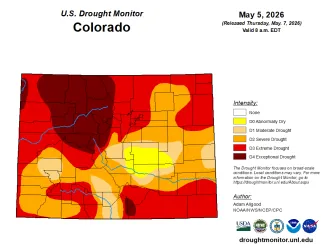
Late-season storms delivered a half-inch to an inch and a half of moisture across central Colorado over the past week, shaving back the most severe drought categories on the eastern plains and bringing a small return of abnormally dry conditions to a state that had been entirely in moderate drought or worse, according to the National Drought Mitigation Center’s U.S. Drought Monitor update released Thursday. The map, based on data valid through Tuesday, May 5, shows 18 percent of Colorado still locked in exceptional drought (D4) and 58 percent in extreme drought (D3) or worse, with conditions easing modestly across the rest of the state.
Snowpack
Mountain snowpack continues its rapid spring decline as Colorado moves through runoff season. The U.S. Drought Monitor reported this week that light to moderate precipitation overspread much of the High Plains region, with the heaviest accumulations of half an inch to an inch and a half falling across central Colorado, including late-season snow at higher elevations. The added moisture supported some drought reduction across the central part of the state.
The boost is narrow, however. The National Drought Mitigation Center cautioned that broader spring and summer water-supply concerns remain across the West, where seasonably dry weather has returned outside of northern California and recent precipitation has done little to alter the unusually low snow cover that lingers across the northern Sierras and the northern Rockies.
Conditions remain a sharp contrast to one year ago. In early May 2025, 25 percent of Colorado was drought-free and no portion of the state was in exceptional drought. A year of precipitation shortfalls and above-normal temperatures has since pushed nearly the entire state into severe drought or worse.
Drought Conditions
Exceptional drought (D4) still blankets Colorado’s headwater counties, with the footprint largely unchanged from last week, the U.S. Drought Monitor reported. Eagle County, Summit County, Jackson County, Routt County and Pitkin County remain 100 percent in exceptional drought. Grand County is 98 percent in D4 with the remainder in extreme drought (D3), and Lake County is 96 percent in D4 with the balance in D3, according to the U.S. Drought Monitor.
©
Conditions continue to ease at the margins on the West Slope. Moffat County is 72 percent in exceptional drought and 28 percent in extreme drought, and Garfield County is 51 percent in exceptional drought with 49 percent in extreme drought. Rio Blanco County is 38 percent in D4 and 62 percent in D3, while Larimer County along the northern Front Range is 30 percent in exceptional drought and 70 percent in extreme drought, the U.S. Drought Monitor reported.
Across the eastern plains, severe and extreme drought eased modestly compared with the prior week, though large swaths of the region remain in extreme drought. Yuma County, Phillips County, Sedgwick County and Baca County are each 100 percent in extreme drought. Las Animas County is 95 percent in extreme drought with 5 percent in exceptional drought, and Huerfano County is 81 percent in extreme drought with 11 percent in exceptional drought and 8 percent in severe drought. Weld County is 79 percent in extreme drought, Logan County is 66 percent, and Prowers County is 64 percent, according to the U.S. Drought Monitor.
Closer to the Front Range and southeastern plains, the picture is mixed. Boulder County is now 100 percent in extreme drought and Jefferson County is 92 percent in extreme drought. Otero County is 75 percent in severe drought with 25 percent in extreme drought, and Kit Carson County is 76 percent in severe drought. Pueblo County is 28 percent in severe drought, 31 percent in moderate drought and 37 percent abnormally dry, the U.S. Drought Monitor reported.
Statistics
No portion of Colorado is drought-free, unchanged from last week. Abnormally dry conditions (D0) returned to 4 percent of the state, up from none last week. Moderate drought (D1) edged down from 10 percent to 9 percent. Severe drought (D2) eased from 31 percent to 29 percent. Extreme drought (D3) contracted from 41 percent to 40 percent, and exceptional drought (D4) held steady at 18 percent.
One year ago, conditions were dramatically less severe. In early May 2025, 25 percent of Colorado was drought-free, 30 percent was abnormally dry, 28 percent was in moderate drought, 13 percent was in severe drought, and 4 percent of the state was in extreme drought. No portion of Colorado was classified in exceptional drought at that time.
Week | Date | None | D0 | D1 | D2 | D3 | D4 |
|---|---|---|---|---|---|---|---|
| Current | 5/5/26 | 0% | 4% | 9% | 29% | 40% | 18% |
| Last Week | 4/28/26 | 0% | 0% | 10% | 31% | 41% | 18% |
| 3 Months Ago | 2/3/26 | 28% | 18% | 29% | 18% | 6% | 1% |
| Start of Calendar Year | 12/30/25 | 29% | 33% | 22% | 13% | 2% | 1% |
| Start of Water Year | 9/30/25 | 46% | 9% | 9% | 22% | 14% | 0% |
| One Year Ago | 5/6/25 | 25% | 30% | 28% | 13% | 4% | 0% |
Just over 4,839,000 Colorado residents live in a drought-impacted area. Colorado’s 2023 population was estimated at 5,877,610.
Drought categories include (ranked from least to most severe) abnormally dry (D0), moderate (D1), severe (D2), extreme (D3), and exceptional (D4) drought.