In Nebraska, a possible new dynamic emerges as blue cities push back against a red state government

© wildpixel - iStock-1393613016
On June 16, when the Omaha City Council was discussing a proposal to alter the city’s minimum wage, putting it at odds with the state rate, Council member Don Rowe, a registered Republican, worried aloud that the move would send the city on a course for “conflict with the state of Nebraska.” Other city officials questioned the legality of what they were considering.
“My biggest problem I have with this is … I just don’t know if Omaha has the authority to do this,” Republican Omaha City Councilwoman Aimee Melton said during the hearing.
Two days later, Nebraska Attorney General Mike Hilgers sued the city of Lincoln over its passage of a similar minimum wage rule.
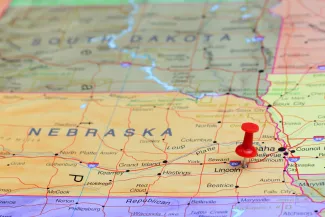
Lincoln and Omaha — both led by Democratic mayors and Democratic-majority city councils – have passed or are considering local ordinances that would follow the language approved by voters in a 2022 ballot initiative. That sets up a likely clash between the two largest cities in the state and the Republican-majority Nebraska Legislature, which this year passed a law weakening voter-approved minimum-wage increases from the 2022 initiative.
“I think one of our great problems in our political culture today is when people don’t get the outcome that they want, then they are trying to achieve it by other means,” Hilgers said in response to a question during his press conference announcing the Lincoln lawsuit.
Hilgers added that those attempts are often unconstitutional.
While there have been flare-ups between Nebraska state officials and city officials before, Hilgers told the Examiner that this is likely the first “preemption fight” he has seen as the attorney general, a post he’s held since 2023.
The clash in Nebraska isn’t unique. In other states, blue cities have faced tense relationships with conservative state leaders as Republican-dominated legislatures have passed laws to undermine Democratic mayors and city councils.
The Mississippi legislature passed a law in 2023 that expands the state’s law enforcement reach in the city of Jackson and implements major changes to the state’s judicial system.
The legislatures in Iowa and South Dakota have passed laws that would ban cities from setting minimum wage rates different from the state rate.
In 2023, Texas passed a law aimed at overturning cities’ progressive policies and preventing them from enacting future ordinances that aren’t aligned with broad swaths of state law.
Beau Ballard, a Republican state lawmaker from Lincoln, said he plans to propose legislation that would ban cities and counties from interfering with state minimum wage legislation, according to the Lincoln Journal Star.
Omaha and Lincoln are the only cities in Nebraska with home rule, which means their local governments can make their own laws under their charters rather than relying on the state government. Those charters “must be consistent with and subject to constitution and laws of state,” according to the state constitution. Hilgers argues Lincoln has exceeded its authority.
Lincoln Councilman James Michael Bowers told the CBS affiliate KOLN that other municipalities across the nation have set their own minimum wage. Bowers said the lawsuit is “another tactic that we’ve seen from the state and the attorney general’s office in terms of fighting against what people want.”
Lincoln Mayor Leirion Gaylor Baird said in a statement that signing the city’s minimum wage ordinance “reflects the will of Lincoln residents who overwhelmingly voted to increase the minimum wage.”
The 2022 ballot measure passed with about 59% of the vote. Lincoln voters supported the statewide initiative by 67%, according to Nebraska Public Media.
“People trust that when they participate in the democratic process and approve a measure at the ballot box, elected leaders will carry out their wishes,” Gaylor Baird said. “This action represents accountability to our community members who voted and made their voices heard loudly and clearly.”
Omaha Councilman Danny Begley, who introduced the Omaha minimum wage ordinance, said, “this should be a no-brainer for Omaha to pass it because the voters have spoken on it.”
“How can you not listen to the voters, man?” Begley said.
Can the city ordinances survive legal challenges?
Patrick Borchers, a Creighton University law professor, said Lincoln – and potentially Omaha – have a “puncher’s chance” of succeeding in defending their ordinances, but pointed to the state Supreme Court’s rulings from the 1960s through the 1980s that “held that Omaha didn’t have the power to create its own fair employment ordinance.” Borchers said it is likely the litigation will end up in the state Supreme Court.
“The Nebraska Supreme Court has changed its composition since the last time a big case like this came up,” Borchers said. “I just think the odds would be in favor of those who would challenge the ordinance.”
Borchers added that disagreements between city and state officials isn’t new, but this minimum wage fight is probably the most high-profile, and there could be more conflict since Omaha now has a Democratic mayor.
Omaha Mayor John Ewing Jr., a Democrat, beat incumbent Republican Jean Stothert last year. It’s the first time in 13 years that a Democrat has led Nebraska’s largest city. Democrats also have a 4-3 majority on the Omaha City Council.
Omaha City Councilwoman Melton was quoted by the online news site Plains Sentinel as saying without Stothert, the Republicans on the council can’t veto “bad bills” because Democrats now have a veto-proof majority with Ewing Jr as the mayor.
Begley told the Examiner before the Lincoln lawsuit announcement that he has to do what his constituents want, referencing the 2022 ballot measure that passed.
“I’m going to stand with my constituents every time, and upholding the will of the voters is what I’m doing,” Begley said. “In all due respect to our [legislative] colleagues in Lincoln, if they don’t want to show respect to the will of the people, I’m proud to do that.”
Begley added that Omaha is going to flex its “political will to the best we can.”
‘Will of the voters’
The “will of the voters” has become a common debate among lawmakers whose majority has prodded for changes to weaken or reverse ballot-passed laws, such as paid sick leave and medical cannabis. In response to those changes, a group of voting advocates is trying to gather enough signatures to place a measure on the ballot that would make it harder for Nebraska lawmakers to override or alter voter-passed laws.
Other ballot measures have targeted the Democrat-dominated Lincoln City Council with proposals that would add term limits, change the dates of city elections, and allow certain residents outside the city limits to vote in municipal elections.
The group, known as “Good Government Lincoln,” said the measures “are designed to give residents of Lincoln a stronger voice in city government, prevent the pitfalls of career politicians, and ensure more voters are engaged with our city elections”
Gaylor Baird’s campaign team said the Republican-led ballot measures come straight out of the “Donald Trump playbook” and “they can’t beat Mayor Leirion, so they are trying to change the rules and misrepresent their proposals.”
Hilgers told the Examiner in a short interview after his press conference announcing the Lincoln lawsuit that other red states have seen tense relationships with Democratic-led cities, but Nebraska hasn’t seen that dynamic because the state has “a lot of really good public servants.”
Hilgers, a former legislative speaker, said he tries to work within the “lines” the constitution and state law give him as the attorney general.
“I’ll tell you when I was speaker, that’s a big part of what I tried to do..We fought over stuff … but overall, the process and the system did work,” Hilgers said. “I think those two ingredients, the willingness to build the trusted relationships to problem solve and respect the rules of the road…if we can do those two things, I think we’ll be in a big spot.”
He said it’s common for elected officials to use the “tools and powers” at their disposal to achieve their political goals, but emphasized that city officials don’t have this authority.
“I hope it doesn’t become a new dynamic,” Hilgers said.