North Dakota has an anti-mask law. Could it apply to ICE agents?

© tussik13 - iStock-908521486
Could a North Dakota law that makes it illegal for people to conceal their identities in certain situations also apply to masked immigration agents?
One University of North Dakota School of Law professor says yes — though he noted part of the law presents serious First Amendment concerns.
Steven Morrison, who teaches criminal law, said they could be charged with the crime “if it were to be found that ICE agents are out there essentially intending to violate the law and wearing masks with the intent to conceal their identities.”
© danielfela - iStock-507873830
Under President Donald Trump’s administration, U.S. Immigration and Customs Enforcement and U.S. Customs and Border Protection agents have begun covering their faces on duty. The executive branch says it allows agents to choose to mask for safety reasons.
Critics of the policy have argued that immigration agents could be using masks to avoid public accountability, and some states have weighed passing laws banning the practice. California recently passed such a law, though a federal judge temporarily blocked its enforcement.
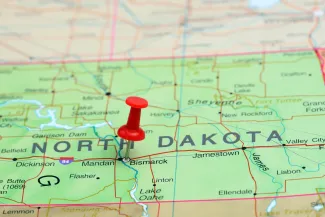
North Dakota lawmakers passed an anti-mask law in 2017 originally intended to apply to masked protesters, according to public hearings from the legislative session. It was proposed shortly after demonstrations against the Dakota Access Pipeline reached their zenith in 2016.
Supporters of the proposed law pointed to DAPL protesters who they said were wearing masks while trespassing and vandalizing construction equipment. But the law didn’t take effect in North Dakota until after those demonstrations.
Under the statute, it’s a class A misdemeanor to wear a mask or conceal one’s identity in the following circumstances:
- “With the intent to intimidate, threaten, abuse, or harass any other individual”
- For “evading or escaping discovery, recognition, or identification” while committing a crime
- For “concealment, flight, or escape” after being charged, arrested, or convicted of a crime
A class A misdemeanor is punishable by up to 360 days in jail, a $3,000 fine or both.
The North Dakota Legislature expanded the law in 2025 to not only apply to people who wear masks to harass people or flee authorities, but also those who conceal their identity “while congregating in a public place with other individuals” except during festivities like Halloween.
Morrison said an immigration agent could hypothetically be charged under the statute, if a prosecutor believed the officer wore a mask to conceal themselves while committing a crime.
He said prosecutors are generally very reluctant to file charges against law enforcement, in part because the law affords them certain protections.
However, prosecutors may feel differently about ICE and CBP agents, he noted. Minnesota’s attorney general has said state and county officials are investigating immigration agents following two deadly shootings, for example.
Morrison cautioned that the clause added to the statute in 2025, which criminalizes congregating in public while wearing a mask, appears unconstitutional.
“One, we have the First Amendment right to assemble and to associate with others,” he said. “Two, we have the First Amendment right to speak anonymously.”
If someone tried to file charges against groups of people simply for wearing masks in public, the charges would likely be dismissed, Morrison said.
Representative Lawrence Klemin, who sponsored the 2025 amendment to the mask law, disagreed that the statute could ever apply to ICE.
The Bismarck Republican and attorney said lawmakers and members of the public who weighed in on his proposal “didn’t ever say anything about applying it to law enforcement.”
He said he brought the amendment in response to college pro-Palestinian protests against Israel’s war against Hamas, which led to mass violence and starvation in Gaza. Some demonstrators who occupied college campuses during the protests wore masks to evade police, Klemin said in testimony submitted in favor of the bill.
The American Civil Liberties Union of North Dakota opposes the state’s mask law on First Amendment grounds, said Advocacy Manager Cody Schuler. Still, Schuler said prosecutors have a duty to enforce laws equally.
“ICE and other law enforcement agents are not above the law,” Schuler said in a statement to the North Dakota Monitor. “Like anyone else, they have to comply with North Dakota’s laws if they are operating in the state.”
State court data show that to date, North Dakota’s law has only been used against people already being prosecuted for other crimes like theft, burglary and drug possession. Those additional charges usually included at least one felony. People have been charged under the statute 106 times since 2017, according to the data.