USDA Update - September 2, 2026

Kiowa County USDA Service Center Staff
IMPORTANT DATES TO REMEMBER:
- USDA SERVICE CENTER CLOSED - MONDAY, SEPTEMBER 7, 2026 for Labor Day Holiday.
- CRP EMERGENCY GRAZING available. Contact FSA to begin the process. GRAZING IS NOT AUTHORIZED UNTIL FSA APPROVAL IS GRANTED.
- CRP CONTRACT MANAGEMENT - management activities are now authorized. For grazing activities, producers MUST contact FSA to determine if grazing can be completed.
- SIGNUP EXTENDED TO SEPTEMBER 30, 2026 - 2023, 2024 and 2025 SDRP - Supplemental Disaster Relief Program – Stage 1 and Stage 2 and quality loss
- AUGUST 31, 2026 - Review base allocation summary, deadline to notify FSA regarding acreage corrections, resolving subsequent acres or opting-out.
- SEPTEMBER 15, 2026 - Deadline for notifying FSA to be considered a Qualifying Pass-Through Entity or QPTE for 2026 forward. Specific to LLC’s and S-Corps only.
- LIVESTOCK FORAGE PROGRAM - Kiowa County eligible for 5-month payment. Apply before March 1, 2027.
VISIT Farmers.gov for more information regarding deadlines and programs available through FSA and NRCS
USDA Offers Drought Impacted Colorado Farmers and Ranchers Immediate Disaster Assistance
USDA’s Farm Service Agency (FSA) offers disaster assistance and low-interest loan programs to assist you in your recovery efforts following drought. Available programs and loans include:
- Non-Insured Crop Disaster Assistance Program (NAP) - provides financial assistance to producers of non-insurable crops when low yields, loss of inventory, or prevented planting occur due to natural disasters including qualifying drought (includes native grass for grazing).
- Livestock Forage Disaster Program (LFP) – provides compensation to eligible livestock producers who suffered grazing losses for covered livestock due to drought on privately owned or cash leased land
- Livestock Indemnity Program (LIP) - offers payments to eligible producers for livestock death losses in excess of normal mortality due to adverse weather. Drought is not an eligible adverse weather event, except when associated with anthrax, a condition that occurs because of drought and directly results in the death of eligible livestock.
- Tree Assistance Program (TAP) – provides assistance to eligible orchardists and nursery tree growers for qualifying tree, shrub and vine losses due to natural disasters including excessive wind and qualifying drought.
- Emergency Assistance for Livestock, Honeybees, and Farm-Raised Fish Program (ELAP) - provides emergency relief for losses due to feed or water shortages, disease, adverse weather, or other conditions, which are not adequately addressed by other disaster programs.
- Emergency Conservation Program (ECP) - provides emergency funding for farmers and ranchers to implement emergency water conservation measures including water systems for livestock and existing irrigation systems for orchards and vineyards.
- Emergency Forest Restoration Program (EFRP) - provides landowners and nonindustrial private forest (NIPF) stewards with financial assistance to restore damaged NIPF acres.
To establish or retain FSA program eligibility, you must report prevented planting and failed acres (crops and grasses). Prevented planting acreage must be reported on form FSA-576, Notice of Loss, no later than 15 calendar days after the final planting date as established by FSA and Risk Management Agency (RMA).
For more information on these programs, contact Kiowa County USDA Service Center at 719-438-5851 ext 2 or visit fsa.usda.gov/disaster.
SUPPLEMENTAL DISASTER REVENUE PROGRAM or SDRP stage 1 and 2 – signup deadline extended to September 30, 2026.
The signup deadline for SDRP stage 1 and 2 was extended to September 30, 2026. Producers who have not contacted their recording county to file an application will need to do so by September 30. These applications WERE NOT mailed to producers; it is the producers responsibility to contact the FSA office to file an application. It provides financial relief to agricultural producers for production, quality, or revenue losses cause by weather-related natural disasters during calendar years 2023 and 2024.
Program Structure
- Stage 1: Focuses on producers with indemnified losses, using existing Federal Crop Insurance or Noninsured Crop Disaster Assistance Program (NAP) data to calculate payments.
- Stage 2: Targets producers with non-indemnified, shallow, uncovered/uninsured, or quality losses that fall outside traditional insurance triggers.
CONTRACT MANAGEMENT ACTIVITES
There are many producers who are having their CRP grazed for contract management requirements. The grazing for contract management MUST END on September 30 or before if the cover is not supporting the grazing. It is the contract participant's responsibility to monitor the grazing and contact FSA once the grazing has been completed and the livestock are removed. There is paperwork that the CRP producer will need to complete to finalize the contract management, so please contact FSA when grazing is completed.
Again, contract management is a requirement on all CRP contracts (except Grassland CRP) and must be completed before the end of year six of the CRP contract. CRP contract years are not the normal calendar year; but is equal to the government fiscal year of October 1 to September 30. Failure to comply with the contract management requirement will be considered a compliance issue and those are taken to the County Committee. County Committee can terminate the contract with refunds required due to lack of good faith on the CRP participants’ part.
Contract management can be completed anytime outside of the primary nesting season which is March 15 to July 15.
STRIP TILLAGE
If producers are doing strip tillage on 51% of the acres, it’s always a good idea to contact FSA to ensure that all the necessary paperwork has been completed. NRCS maintains a list of contractors that can complete the activity. The list can be emailed if you contact the FSA office.
GRAZING
Producers begin the grazing requests with FSA, NRCS completes a site visit to determine if the land is suitable for grazing. If the land can be grazed, NRCS will complete a grazing plan and a revision of the conservation plan. The CRP producer will sign the required paperwork, not the individual with the livestock. It is the responsibility of the CRP producer to maintain compliance with the terms and conditions of the CRP contract. Once all the paperwork has been completed and approved, grazing can begin. FSA will issue final approval.
EMERGENCY GRAZING
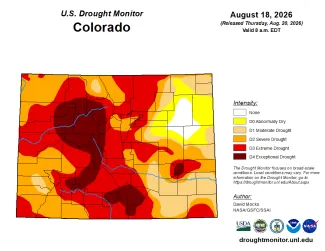
If parts of Kiowa County remain with a US Drought Monitor designation of D2 or above beginning October 1; emergency grazing is still available. Be reminded that all grazing requests begin with FSA, NRCS completes the field visit and determines if the cover can support the grazing, if so, they will write a grazing plan. If the cover cannot support grazing; the request will be denied.
FSA issues the approval for the request; grazing CANNOT begin until that approval has been granted. Unauthorized grazing can lead to termination of the CRP contract.
DROUGHT MONITOR
Didn’t see much change to the drought monitor this past week. There are still some dry areas in the county and hopefully those areas will see some rain in the weeks ahead.
©