Utah lawmakers advance bill to expand Supreme Court — and add 3 district court judges

© legacyimagesphotography - iStock-160735792
While Utah judicial leaders have been telling lawmakers the district courts have the greatest need for additional funding in order to address heavy workloads, legislators advanced a bill Thursday that would give roughly $1.5 million to those lower courts — but would also use more than $3 million to expand the Utah Supreme Court from five to seven justices.
The Senate Judiciary, Law Enforcement, and Criminal Justice Committee voted to favorably recommend SB134 to the full Senate after changing it to call for more money for three additional district court judges in Salt Lake County, Utah County and Washington County.

The bill — if fully funded during a separate budgeting process — would only partially answer the court system’s budget requests, which includes eight district court judges to help address the state’s overwhelmed lower courts.
Meanwhile, lawmakers are pressing forward with a priority of the state’s three most powerful Republican leaders, Senate President Stuart Adams, House Speaker Mike Schultz, and Governor Spencer Cox, to add two more seats to the state’s highest court, which is not something the judiciary has said the courts need.
SB134, sponsored by Senate Minority Whip Chris Wilson, R-Logan, would also expand the Court of Appeals from seven judges to nine, which is a budget priority for the judiciary.
The governor and Republican legislative leaders have said the bill isn’t aimed at “court packing” or changing the makeup of the state’s highest court to appoint justices that make decisions more in the Republican-controlled Legislature’s favor. They argue it’s to better align Utah with other similarly-populated states that have seven justices.
State populations and supreme court sizes
- Utah: 3.6 million, five justices
- Wyoming: Less than 600,000, five justices
- Montana: 1.1 million, seven justices
- Idaho: 2 million, five justices
- New Mexico: 2.1 million, five justices
- Iowa: 2.38 million, seven justices
- Kansas: 3 million, seven justices
- Arkansas: 3.1 million, seven justices
- Nevada: 3.3 million, seven justices
- Connecticut: 3.7 million, seven justices
- Colorado: 6 million, seven justices
- Arizona: 7.8 million, seven justices
But critics, including Democrats and some legal professionals, argued that the timing and optics of the Utah Supreme Court expansion is concerning. It comes after the Republican-controlled Legislature has clashed with the courts over several rulings, especially in the state’s redistricting lawsuit which recently led to a court-ordered map that included one Democratic district and three heavily GOP districts.
“The timing here is very suspicious,” said law professor Teneille Brown, who likened the situation to a children’s soccer game. “If you’re worried that your kid is losing and you decide to bring in some refs who are calling fouls (on moves) that you don’t like, when you then win it doesn’t make that victory legitimate, it makes a mockery of the game. This SB134 is no different. Packing the courts for political reasons is wrong, no matter which side is engaging in it.”
In a media availability earlier Thursday, Adams and Wilson told reporters the proposed Utah Supreme Court expansion isn’t political. Wilson said the two new justices will go through the same appointment process as the existing five.
“Governor Cox will pick and we’ll confirm, the same way we’ve done with all the other justices,” Wilson said.
Requests from the judiciary
A representative for the judiciary — which rarely weighs in on legislation — didn’t comment on the bill during Thursday’s committee hearing.
However, in his State of the Judiciary speech on Tuesday, Chief Justice Matthew Durrant highlighted key budget requests for the judiciary, including $6 million in ongoing funds to train and retain courthouse staff, and more money to fund eight district court judges, one juvenile court judge, four commissioners, and at least one if not two Court of Appeals judges.
In order to make room for two more Supreme Court justices, it would cost the state about $1.7 million in one-time money to build new chambers and modify courtroom technology, according to the bill’s fiscal note. The two additional justices would also cost more than $1.4 million in ongoing money for their salary and benefits (which would cost $793,800 for both), along with four law clerks ($557,400) and a judicial assistant ($86,200), plus operational expenses ($35,000).
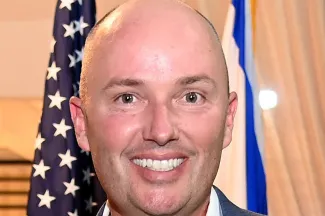
Utah Governor Spencer Cox
Wilson’s bill also calls for $1.3 million in ongoing funding for the Court of Appeals for the salary and benefits for two new justices ($761,000 for both), and four law clerks ($557,400).
The changes to the bill to add three more district court judges in Salt Lake City, St. George and Provo would cost more money — by roughly $1.5 million, or $500,000 per judge including salary, benefits, retirement and staff, the committee’s chair, Senator Todd Weiler, R-Woods Cross, said.
Adams, Schultz and Cox have been publicly saying they want to expand Utah’s Supreme Court for months now — but the changes to Wilson’s bill came after Durrant told lawmakers in his speech on Tuesday that the need for more judges in the lower courts is “much greater” than it is in the Utah Supreme Court.
“Today, our district courts operate in triage mode. We need your help to fix that,” Durrant said. “Each of our (budget) requests is grounded in measured, fact-based workload data. Historically, we have received funding for less than one judicial position per year. Although we appreciate any funding previously provided, at that historical rate it would take 20 years to fill the current need for judicial officers in Utah.”
Durrant also urged lawmakers to “weigh the facts and understand the data you’ve been provided, just as we have in developing our requests.” If the Legislature wants to expand the state’s highest court, “that, of course, is your prerogative,” he said.
The chief justice asked that “if you elect to fund two new justices, please do not do it at the expense of the judicial positions we have prioritized.”
“We heard from (Durrant) in his remarks about the need for lower court judges,” Adams said. “And we’re listening.”
But at the same time, Republican legislative leaders aren’t budging on their plans to expand the Utah Supreme Court.
Asked earlier Thursday how lawmakers will prioritize the courts in the budget — which is expected to be tight this year given GOP leaders’ appetite for another income tax rate cut, on top of the $300 million already lost due to federal tax changes — Senate Budget Chair Jerry Stevenson, R-Layton, told reporters: “There are certain things we do here we can make happen.”
“I really believe that we’ll be able to find (money) to fix the courts,” Stevenson said.
Stevenson acknowledged that in recent years, lawmakers have “had a lot of requests” for the courts. “Some of them we’ve been really, if I can use this word, a little stingy with.” But he added “I think it’s time” to invest more funding in the courts.
“This is an honorable attempt to try and get systemwide resources (for the courts),” Wilson said during Thursday’s committee hearing. “I think it’s time … to bring our state Supreme Court up to the same level as other states that are the same size.”
Debate
While many who spoke against SB134 said they liked “two-thirds” of the bill because of the additional judges for the Court of Appeals and the district courts, they urged lawmakers to listen to recommendations from the judiciary itself, which hasn’t asked to expand the Utah Supreme Court.
A retired 2nd District judge, David Connors, said he opposed expanding the Utah Supreme Court at this time “as a fiscal conservative.”
“The amount of money that would be spent to increase the number of justices on the Supreme Court is probably the least effective way to give some assistance to the judiciary right now,” Connors said. “It would be much more effective to take that money and add additional district court judges to those you’ve already agreed to add.”
In its 2026 report to the Legislature, the judiciary cited a 2025 judicial caseload study that showed district court judicial officers “carrying an average of 112 percent of a standard caseload, with some districts operating at 122 percent.” In order to meet “statutory and judicial time standards,” that study identified a need for 12 additional judicial officers. Currently, the state has 89 district court judicial officers; that study called for at least 101.
“Workload growth continues to outpace available resources. Over the past 12 years, hearings increased by 25 percent and warrant activity by 190 percent, while the number of district court judges increased by only 8 percent,” the report says.
Linda Smith, a Salt Lake City resident and a retired law professor, said “we should listen to the courts regarding what their needs are.”
“I find them to be very honorable people who will be straight with you,” she said, while arguing against expanding the Utah Supreme Court for “efficiency reasons.”
Smith said adding two justices to the court would not speed up decisions, but likely lengthen deliberation time because justices collaborate on opinions. She acknowledged, however, that adding more members could have some advantages, including the “possibility of having a more diverse body if you have more people, and I think that has value.”
“I don’t know that there’s a right size, I just don’t think today, with the courts’ requests, is the time to expand the Supreme Court,” Smith said.
Senator Stephanie Pitcher, D-Salt Lake City, was the lone “no” vote against Wilson’s bill.
“One thing that I think is clear from the judiciary is that our lower courts need resources, that the caseloads have increased dramatically, and that the resources that the Legislature is providing is not enough,” Pitcher said. “Ultimately I trust the judiciary to tell us what they need. I don’t think this is the solution.”
Weiler said he agrees with Pitcher “that the court needs more resources,” but he voted in favor of the bill. To accusations of court packing, Weiler noted that before tensions between the courts and the Legislature rose in recent years, “this was something that I was publicly exploring.”
“But it’s expensive,” Weiler said, adding “that’s a big lift for one bill without leadership support.”
Senator Brady Brammer, R-Pleasant Grove, also supported the bill, even though he noted he has had concerns about “efficiency” of the Utah Supreme Court.
“I’m not necessarily sure that adding more justices adds to that efficiency, but I do think that having more eyes on things is helpful to getting good reasoning,” he said, while also adding he believes the “most acute problem with the courts is the lack of district court judges.”
Brammer said SB134 would grant the most new resources to Utah’s courts “in a long, long time.” He said district court judges “work incredibly hard, they’re trying their best, their case loads are out of control, and they need help.”
Senate Minority Leader Luz Escamilla, D-Salt Lake City, also voted in favor of it because she viewed the amendment to add three district court judges as a way to “start addressing the lower court needs.”
“This is just a first step,” Escamilla said.