Colorado wildfires spark new debate on drought response

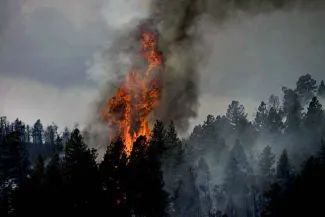
As wildfires spread across Colorado, experts are debating how Western states can meet the challenges of a decades-long drought, which shows no sign of letting up.
Climate change is exacerbating conditions for more frequent and severe wildfires.
Trent Ford, climatologist at the University of Illinois Urbana-Champaign, said changing precipitation patterns are just one driver of dried-out trees and other vegetation fueling fires.
"Warming trends have enhanced evaporation, so how much water is leaving the land, going up to the atmosphere as gas," Ford explained. "Warmer temperatures during the winter has also caused less precipitation to fall as snow."
© Pixabay - David Mark
Colorado Governor Jared Polis recently issued a statewide drought emergency declaration in response to conditions created by the lowest snowpack and hottest winter on record, and a heat wave in March, which rapidly melted the snow.
Cities and rural communities across the state have imposed water restrictions, limiting outdoor watering and irrigation at homes, golf courses and parks. Some are issuing fines if residents do not comply.
Elizabeth Koebele, assistant professor of political science at the University of Nevada-Reno, said as Colorado River Basin states struggle to manage shrinking water supplies, cities and other municipalities are tapping just 20% of the region’s water.
"Eighty percent of our water goes to agriculture," Koebele pointed out. "About 55% of our water use also goes to growing alfalfa hay, essentially feed for cattle."
Koebele believes the biggest opportunities to save water are in the agricultural sector. In 2024, alfalfa farms in the Colorado River Basin drew more than 2 trillion gallons of water, enough to supply 40 million people for more than three years. The amount of hay exported to places like China and Saudi Arabia has more than doubled over the past two decades.
"If we're really going to solve some of the deeper problems associated with drought and long-term water scarcity, at least in the Western United States, we really need to be thinking about where most of our water is used," Koebele urged.