Data center legislation begins to take shape in North Dakota

A lawmaker from North Dakota’s coal country is working on proposed legislation to regulate some of the more controversial aspects of data centers in the state.
Representative Anna Novak, R-Hazen, briefed some of her legislative colleagues Tuesday on the framework of her bill. It focuses on three aspects: the cost of electricity, water use and requirements for when a facility is decommissioned.
“Those are the major concerns of the North Dakota citizens,” Novak said. “The locals certainly have their responsibility on things. But when it comes to those three things, they’re looking for help from the state, and that’s very reasonable.”
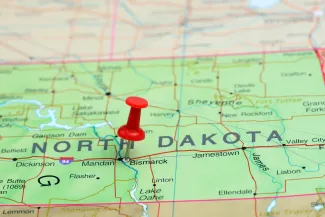
The state government does not directly regulate data center development, though there have been increasing calls for the state to take action.
The first focus of Novak’s bill is enshrining the principle of “bring your own power” into state law. The bill would formally prohibit any costs associated with data centers from being transferred to ratepayers.
Novak said it is important for North Dakota citizens to know their electricity bills are not going up because of data centers. The legislator noted there are examples of large data centers creating a benefit for electricity consumers in North Dakota, but that ratepayers should be protected in instances where that is not the case.
“We need to codify that rate shifting to residential customers cannot occur because of large loads or data centers,” Novak said.
She’s also looking for a way to ensure ratepayers have access to clear information on why the cost of electricity is going up when a utility proposes a rate increase.
“The price of milk, bread and eggs are going to go up because that’s just what happens over time. Electricity rates will also go up, but they should stay in line with those things,” Novak said. “It’s reasonable for people to want to understand why their electricity rates are increasing.”
The bill would also require all data centers to use closed-loop water cooling systems, because those facilities use less water.
© 4nadia - iStock-1444856274
“We’re just getting through a drought right now, and so this is a valid concern of citizens,” she said.
Novak is also working on a section that would require a plan for repurposing the structure when it is ready to be decommissioned. The proposal will likely include a bonding requirement for the developer. But the lawmaker said a requirement to tear down the building and fully reclaim the site is unnecessary and unreasonable.
“It seems wasteful to me,” Novak said.
Representative Mike Nathe, R-Bismarck, said he is uncomfortable requiring a specific industry to have a plan for decommissioning when other facilities, like an Amazon distribution facility, do not have to do so.
“I understand the reasons for it. But you’re picking out one industry to make sure they do reclamation. Meanwhile, we have ethanol plants, we have a soybean crushing plant, we have a battery manufacturing plant in Fargo,” Nathe said. “They’re not required to have reclamation plans.”
Representative Jonathan Warrey, the Casselton Republican chairing the interim Artificial Intelligence and Data Centers Committee, said the long-term decommissioning is a valid concern because the industry’s economics are changing so quickly and most data centers are signing 15-year lease agreements.

iStock
“These other industries that you reference have been around for decades, or centuries in some cases. And so I do wonder, as a state, what do we do in year 16?” Warrey said. “That is what we have learned is these are 15-year agreements from well-resourced companies, but year 16 and beyond becomes a question mark.”
Novak noted the potential long-term problem of decommissioning is what county commissioners are “asking for the most help on,” based on her conversations with local officials. She warned inaction from the state could lead to more stringent requirements at the local level.
Other lawmakers are developing ideas for policy changes surrounding data centers as well. Senator Dean Rummel, R-Dickinson, suggested narrowing the sales tax exemption used by data centers to only apply to computing equipment.
“Get rid of the exemptions on fiber optic, on the racking, on the cooling systems, everything else that should not have an exemption,” Rummel said. “We could still say we have a sales tax exemption, but it’s extremely narrow.”
Rummel said doing so would reduce the value of the sales tax exemption from tens of millions of dollars to a few million.
Senator Jose Castaneda, R-Minot, said the Legislature should consider requiring every county to draft a local data center ordinance that addresses certain topics, such as setbacks or noise limitations, so the public and developers both know where they stand ahead of time.

© Khanchit Khirisutchalual - iStock-1515913422
“We would still allow local control at the county level to allow them to decide what they want, how they want it,” Castaneda said. “You have to come up with an ordinance that, at a minimum, covers these items.”
He said the requirement would allow everyone to operate on the “same sheet of music.” Senator Janne Myrdal, R-Edinburg, agreed and said the state’s rules should help make local control possible, but not outshine those local ordinances.
“How they do those ordinances is up to them, as long as it doesn’t violate state law,” Myrdal said. “I think the more the Legislature does, the more we trample the local authority.”
Senate Majority Leader David Hogue, R-Minot, said in an interview after the meeting that he thinks all data center zoning decisions should be made at the county level, rather than the city or township level.
“We can’t have this multi-tiered structure of different political subdivisions trying to compete with one another for what’s the most local form of control,” Hogue said. “We do need some local decision-making authority, but it shouldn’t be multi-tiered.”
Some lawmakers are worried that Novak’s protections for electric ratepayers could have unintended consequences for other industries that also use large amounts of electricity, like oil refineries or ethanol plants.
But others are cautioning against legislation that targets data centers specifically. They warned against trying to pick winners and losers among different industries.
“We maybe need to look big picture at where we want to regulate industry as a whole, instead of pigeonholing, you know, this factory or that factory,” Castaneda said. “These are all industries that have an effect on our power grid.”
Novak’s bill is still a work in progress and the final language has not been determined. She said she is working with various agencies and stakeholders to find the right approach prior to the legislative session that begins in January.