Drought eases on Colorado's plains as exceptional drought holds in the mountains

© KiowaCountyPress.net
Chris Sorensen
(Kiowa County Press)
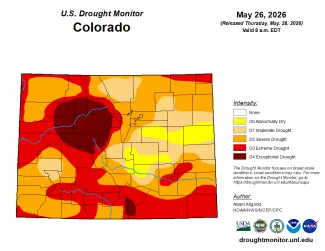
Drought eased modestly across Colorado over the past week as beneficial spring rains trimmed the most severe categories on the eastern plains, even as exceptional drought kept its grip on the central mountains, according to the National Drought Mitigation Center. The U.S. Drought Monitor map released Thursday, June 4, reflecting conditions through Tuesday, June 2, showed extreme and exceptional drought retreating statewide and a sliver of Colorado — about half a percent — returning to drought-free status for the first time in weeks.
©
Snowpack
By early June, Colorado's mountain snowpack has effectively melted out for the season, with any lingering snow confined to the highest peaks. With the snow gone, attention shifts to streamflow, soil moisture and reservoir storage, which will determine how the deepest drought in the high country plays out through the summer.
A year ago the picture was far less severe. The U.S. Drought Monitor map for June 3, 2025, carried no exceptional drought anywhere in Colorado and showed about 35 percent of the state free of any drought designation. This week, by contrast, exceptional drought covers roughly 9 percent of Colorado and only about 1 percent of the state is drought-free — a measure of how much conditions have deteriorated across a single year.
Drought conditions
The most severe drought in Colorado remains anchored in the central mountains, according to the U.S. Drought Monitor. Eagle and Pitkin counties are each blanketed entirely in exceptional drought (D4), the monitor's worst category, at 100 percent coverage. Summit County is close behind at 88 percent exceptional drought and 12 percent extreme (D3), while Grand County stands at 54 percent exceptional and 41 percent extreme drought.
Farther north and west, Routt County carries 33 percent exceptional and 13 percent extreme drought, according to the U.S. Drought Monitor. The Drought Monitor narrative noted that drier weather drove deterioration across southwestern Colorado this week. Moffat County in the northwest and Montezuma County in the southwest each hold about 23 percent extreme drought, with the remainder of both counties in severe (D2) drought.
On the eastern plains, the High Plains narrative reported that stormy weather brought soaking rains across much of the region and that beneficial precipitation brought some relief to portions of the Colorado Plains, according to the U.S. Drought Monitor. That rain, however, competed with much-above-normal temperatures that kept evaporative demand high.
Statistics
Compared with the previous week, the most severe drought categories loosened their hold on Colorado. Exceptional drought (D4) edged down to 9 percent from 10 percent, and extreme drought (D3) fell to 27 percent from 31 percent. As those areas improved, severe drought (D2) expanded to 40 percent from 37 percent and moderate drought (D1) rose to 17 percent from 16 percent, reflecting a step down in intensity rather than fresh deterioration. Abnormally dry conditions (D0) covered 7 percent of the state, up from 6 percent, and about 1 percent of Colorado returned to drought-free, up from none a week earlier.
A year ago the state was in markedly better shape. The June 3, 2025, map showed 35 percent of Colorado free of any drought, with 16 percent abnormally dry, 27 percent in moderate drought, 15 percent in severe drought and just 6 percent in extreme drought. No part of the state carried an exceptional-drought designation at that time, compared with roughly 9 percent this week.
| Week | Date | None | D0 | D1 | D2 | D3 | D4 |
|---|---|---|---|---|---|---|---|
| Current | 6/2/26 | 1 | 7 | 17 | 40 | 27 | 9 |
| Last Week to Current | 5/26/26 | 0 | 6 | 16 | 37 | 31 | 10 |
| 3 Months Ago to Current | 3/3/26 | 21 | 22 | 20 | 26 | 10 | 1 |
| Start of Calendar Year to Current | 12/30/25 | 29 | 33 | 22 | 13 | 2 | 1 |
| Start of Water Year to Current | 9/30/25 | 46 | 9 | 9 | 22 | 14 | 0 |
| One Year Ago to Current | 6/3/25 | 35 | 16 | 27 | 15 | 6 | 0 |
Just over 4,603,000 Colorado residents live in a drought-impacted area. Colorado’s 2023 population was estimated at 5,877,610.
Drought categories include (ranked from least to most severe) abnormally dry (D0), moderate (D1), severe (D2), extreme (D3), and exceptional (D4) drought.