Wildfire smoke puts Colorado's unhoused population at increased risk

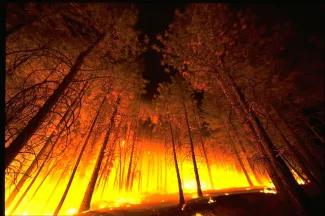
The air quality in Denver has ranked among the worst in the world since wildfires erupted near Pueblo and Ouray, in Dolores and Montezuma counties and along the Colorado-Utah border.
The vast majority of Coloradans experiencing homelessness are in the Denver metro area and health experts are sounding the alarm.
James Crooks, associate professor of biostatistics at National Jewish Health, studies the effects of climate change, including air pollution. Crooks said exposure to wildfire smoke can be very damaging for workers and others who have no choice but to spend long periods of time outside.
"They can't go inside, so it can be very hard for them to limit their exposure," Crooks observed. "Hopefully, they can find a shelter to spend at least part of the day in, especially the hottest part of the day in the afternoon, when pollution tends to be the highest from ozone."
Providing housing can actually reduce fire risk, according to a recent report from the Colorado Coalition for the Homeless.
Without affordable housing options, many people experiencing homelessness are forced to use propane, for example, to cook food and keep warm in alleyways or camp sites. The clear fire hazard has led to explosions.
The biggest threats from wildfire smoke come from the tiniest particles in the airborne ash known as PM2.5, which are 30 times smaller than the width of a human hair. Once absorbed by the lungs, Crooks pointed out the particles can slip into the bloodstream and flow around the body pretty much anywhere.
"That's a problem because it can cause inflammation, not just in the lung but it can cause inflammation in the blood vessels, in the heart and in the kidneys," Crooks outlined. "There are even ways for the tiny particles to get into the brain and cause inflammation in the brain."
Crooks added people experiencing homelessness should do their best to get inside on bad air quality days, pointing to options like shelters, libraries, recreation centers and other spaces open to the public.
He noted there are respirators people can use to reduce exposure but most masks people got used to wearing during the pandemic do not capture smoke particles.
"You really need an N95 or better, like really tight-fitting around the chin and nose, to make sure there's a good air seal for it to be effective against the smoke," Crooks advised.