Exceptional drought blankets Colorado mountains as heat, failed snowpack drive historic degradation

© KiowaCountyPress.net
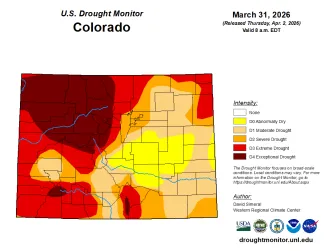
Colorado's drought situation worsened dramatically in the week ending March 31, 2026, as record-breaking heat combined with historically poor mountain snowpack to drive sweeping upgrades across the state — with exceptional drought, the most severe category on the scale, now blanketing most of the state's high-country counties. The U.S. Drought Monitor, published Thursday by the National Drought Mitigation Center, shows that the data valid Tuesday, March 31, reflects the most severe drought footprint Colorado has seen in years, and continues the trend from last week.
©
Colorado drought conditions map, valid March 31, 2026. Source: National Drought Mitigation Center.
Snowpack
Mountain snowpack across Colorado and the broader West has collapsed to record or near-record lows for the time of year, with many Natural Resources Conservation Service (NRCS) SNOw TELemetry (SNOTEL) network stations reporting little to no snow on the ground as of the end of March. According to the National Drought Mitigation Center, the Upper Colorado River Basin — the primary water source for much of the state — stands at just 24 percent of median snow water equivalent (SWE), while the Rio Grande basin to the south is at a critically low 8 percent of median.
The consequences for water storage are already evident. Lake Powell, the massive reservoir on the Utah-Arizona border that receives much of the Colorado River's mountain runoff, sits at just 25 percent of capacity. Flaming Gorge Reservoir in Wyoming/Utah holds 82 percent, while Blue Mesa Reservoir in Gunnison County stands at 50 percent capacity and Navajo Lake at 62 percent. Peak snowmelt runoff is occurring earlier than normal in many locations — or has already passed — raising concerns about reduced inflows into reservoirs as the spring progresses into summer, according to the U.S. Drought Monitor.
One year ago, Colorado's statewide drought conditions were far less severe: 45 percent of the state was drought-free, with only scattered moderate and severe drought in the mountains and just a trace of extreme drought (D3). No exceptional drought (D4) existed anywhere in the state on April 1, 2025. The contrast with current conditions could hardly be starker.
Drought Conditions
Exceptional drought, the highest category on the U.S. Drought Monitor scale, now dominates the Colorado mountain counties that feed the state's major river basins. According to the U.S. Drought Monitor, Jackson County, Routt County, Eagle County, Summit County, and Pitkin County counties are each 100 percent in D4 exceptional drought. Moffat County County is 96 percent D4 with the remaining 4 percent in extreme drought (D3), and Grand County County is 98 percent D4 with 2 percent D3.
The week's changes were driven by a combination of record to near-record heat and very poor snowpack conditions. According to the U.S. Drought Monitor, the recent heat wave has accelerated snowmelt across the region over the past several weeks, with NRCS SNOTEL stations reporting unseasonably low snow levels or bare ground across much of the high country. The National Drought Mitigation Center notes that continued degradations are expected in the coming weeks and months due to anomalous heat and record-low snowpack levels.
The broader statewide picture is equally alarming: 100 percent of Colorado is now affected by some level of drought or abnormal dryness — with not a single acre of the state drought-free. Extreme (D3) and exceptional (D4) drought together now cover nearly half the state (48 percent), compared to just under a quarter (24 percent) the prior week.
Statistics
This week's U.S. Drought Monitor data shows the full breadth of the deterioration. The share of Colorado in exceptional drought (D4) leaped from 6 percent last week to 22 percent, while extreme drought (D3) grew from 18 to 27 percent. Notably, the severe drought (D2) category shrank dramatically from 35 percent to 16 percent — not because conditions improved, but because those areas were upgraded into D3 and D4. Abnormally dry conditions (D0) fell from 17 to 11 percent, and the share of the state with no drought designation dropped from 9 percent to zero as conditions spread eastward onto the plains.
One year ago — the week of April 1, 2025 — conditions were dramatically different. Forty-five percent of Colorado was drought-free, with abnormally dry (D0) conditions covering another 24 percent. Moderate drought (D1) affected 19 percent, severe drought (D2) covered 12 percent, and extreme drought (D3) was present in just 1 percent of the state. Exceptional drought (D4) was absent entirely. Today's statewide drought severity index (DSCI) of 323 compares to just 100 a year ago.
Week | Date | None | D0 | D1 | D2 | D3 | D4 |
|---|---|---|---|---|---|---|---|
| Current | 3/31/26 | 0% | 11% | 24% | 16% | 27% | 22% |
| Last Week to Current | 3/24/26 | 9% | 17% | 15% | 35% | 18% | 6% |
| 3 Months Ago to Current | 12/30/25 | 29% | 33% | 22% | 13% | 2% | 1% |
| Start of Calendar Year to Current | 12/30/25 | 29% | 33% | 22% | 13% | 2% | 1% |
| Start of Water Year to Current | 9/30/25 | 46% | 9% | 9% | 22% | 14% | 0% |
| One Year Ago to Current | 4/1/25 | 45% | 24% | 19% | 12% | 1% | 0% |
Just over 4,157,000 Colorado residents live in a drought-impacted area. Colorado's 2023 population was estimated at 5,877,610.
Drought categories include (ranked from least to most severe) abnormally dry (D0), moderate (D1), severe (D2), extreme (D3), and exceptional (D4) drought.