Exceptional drought erased from Kiowa County as rain improves eastern plains

© KiowaCountyPress.net
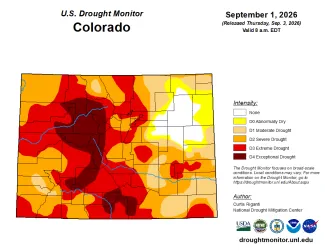
Exceptional drought was wiped from Kiowa County and severe conditions retreated across much of southeast Colorado in the weekly drought update released Thursday by the National Drought Mitigation Center. The map, which reflects conditions as of 8 a.m. Sept. 1, marked the first broad eastern plains improvement in weeks — even as extreme and exceptional drought held firm, and locally expanded, across the central and western mountains.
©
Colorado drought conditions as of September 1, 2026. Map courtesy National Drought Mitigation Center.
Snowpack
Colorado’s snow season is long over, and the 2026 water year closes Sept. 30 with the mountains in worse shape than they entered it. On Sept. 30, 2025, nearly 46 percent of the state was free of drought and no ground was in exceptional drought at all. Twelve months later, drought-free acreage has fallen to about 6 percent and roughly 12 percent of Colorado sits in the exceptional category.
The U.S. Drought Monitor pointed directly at the winter that never delivered, reporting that streamflow across parts of the western High Plains remains low as a result of poor high-elevation snows and warm temperatures through the water year. Those thin high-country snowfields left reservoirs and rivers short heading into a summer that turned hot early and stayed that way.
Monsoon moisture has provided partial cover. Locally heavy rain from the North American Monsoon fell across the Rocky Mountains in Colorado over the past week, and areas west of the Front Range saw conditions improve. But temperatures ran 4 to 6 degrees above normal across much of the West, keeping atmospheric demand for moisture high and limiting how much of that rainfall stuck. Portions of south-central and southwest Colorado missed the heavier storms entirely, and long-term precipitation deficits there grew worse.
Drought Conditions
Exceptional drought — the most severe category the monitor recognizes — now blankets all of Eagle, Lake and Pitkin counties, each at 100 percent D4, according to the U.S. Drought Monitor. Alamosa County is close behind at 94 percent exceptional and 6 percent extreme, followed by Summit County at 88 percent exceptional and Chaffee County at 78 percent. Grand County stands at 54 percent exceptional and 41 percent extreme drought.
The San Luis Valley and the southern mountains remain among the hardest-hit areas in the state. Saguache County is 40 percent exceptional and 60 percent extreme, while Costilla County registers 39 percent exceptional and 61 percent extreme. Conejos County shows 14 percent exceptional and 80 percent extreme drought, and Hinsdale County sits at 27 percent exceptional with another 59 percent in extreme drought. Farther north and west, Garfield County is 34 percent exceptional and 63 percent extreme, and Routt County is 33 percent exceptional and 57 percent extreme. In the southern Front Range foothills, Huerfano County reports 26 percent exceptional and 71 percent extreme drought.
The picture on the eastern plains looks considerably different than it did a week ago. Exceptional drought vanished from Kiowa County, where it had covered nearly 17 percent of the county on the Aug. 25 map. Extreme drought there now stands at 43 percent, up from 37 percent as the exceptional category emptied into it, while severe drought spread to 53 percent from 46 percent and moderate drought appeared on 5 percent of the county. Bent County also shed its exceptional drought, dropping to 7 percent extreme and 54 percent severe. Severe drought in Prowers County fell by more than half, from 45 percent to 22 percent, while Cheyenne County cleared its remaining extreme drought and picked up its first drought-free ground of the summer at about 4 percent. The Drought Monitor credited a swath of one-half to two inches of rain that fell from western Nebraska and western Kansas into Colorado and Wyoming, which eased short-term precipitation deficits and improved soil moisture and streamflow. Southeast of the Arkansas Valley, Las Animas County still carries 6 percent exceptional and 18 percent extreme drought.
Statistics
Statewide, drought-free area grew to 6 percent from 4 percent a week ago, and abnormally dry conditions eased to 5 percent from 6 percent. Moderate drought expanded to 14 percent from 11 percent, absorbing ground that had been in worse shape, while severe drought held steady at 31 percent. The two most intense categories both retreated: extreme drought slipped to 32 percent from 34 percent, and exceptional drought fell to 12 percent from 14 percent. Colorado’s statewide Drought Severity and Coverage Index dropped to 314 from 326.
A year ago, on Sept. 2, 2025, Colorado was in far better condition. Forty percent of the state was free of drought and another 10 percent was merely abnormally dry. Moderate drought covered 10 percent and severe drought 15 percent, with 25 percent in extreme drought and no exceptional drought anywhere in the state.
| Week | Date | None | D0 | D1 | D2 | D3 | D4 |
|---|---|---|---|---|---|---|---|
| Current | 2026-09-01 | 6 | 5 | 14 | 31 | 32 | 12 |
| Last Week to Current | 2026-08-25 | 4 | 6 | 11 | 31 | 34 | 14 |
| 3 Months Ago to Current | 2026-06-02 | 1 | 7 | 17 | 40 | 27 | 9 |
| Start of Calendar Year to Current | 2025-12-30 | 29 | 33 | 22 | 13 | 2 | 1 |
| Start of Water Year to Current | 2025-09-30 | 46 | 9 | 9 | 22 | 14 | 0 |
| One Year Ago to Current | 2025-09-02 | 40 | 10 | 10 | 15 | 25 | 0 |
Just over 4,477,000 Colorado residents live in a drought-impacted area. Colorado’s 2023 population was estimated at 5,877,610.
Drought categories include (ranked from least to most severe) abnormally dry (D0), moderate (D1), severe (D2), extreme (D3), and exceptional (D4) drought.