Fall floods lift Lake Powell's outlook by 27 feet, but Lake Mead is still headed lower

Lake Powell is no longer expected to sink back toward September's low this winter. The U.S. Bureau of Reclamation's November 24-Month Study, released Monday, November 16, is the agency's first monthly forecast to count the October floods on the San Juan River. It projects the lake will stay above 3,532 feet through the winter and rise to about 3,576 feet by the end of June 2027.
A month earlier, the October study had the lake falling to about 3,516 feet by the end of February, slightly below the 3,516.62 feet it reached September 15. That was the lake's lowest level since 1968, when it was still filling for the first time. The October study had the lake peaking near 3,549 feet next June. The new forecast is 27 feet higher.
The difference is water. Reclamation estimates the natural flow into Lake Powell in October at 1.61 million acre-feet, about three and a half times the average for the month. Forecasters now expect a natural flow of 10.01 million acre-feet into the lake in the water year that runs through next September, 104 percent of average, according to Reclamation's summary of the study. The October study had assumed 7.8 million.
Already ahead of the forecast
The lake was already above the new study's projection when the study came out, and it has kept rising. Reclamation's daily record put Lake Powell at 3,541.22 feet on Thursday, November 26. That is the highest since December 20, 2025, and 24.6 feet above the September low. It is also 8.5 feet above the 3,532.71 feet the study projected for the end of November.
About 979,000 acre-feet flowed into the lake from November 1 through November 26, by Reclamation's daily figures. That is more than twice the 458,000 acre-feet the study expected for the whole month. More than half of it came in the first week of November, as the second flood came down the San Juan. The Press reported November 6 on that water arriving at the lake.
Inflow has since slowed. On November 26 it was about 8,300 cubic feet per second, still more than the roughly 6,600 the dam was releasing. The lake gained about six-tenths of a foot in the week ending November 26.
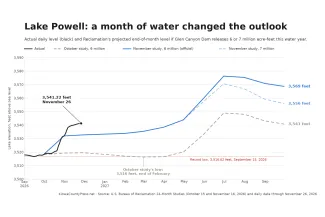
Lake Powell's daily level and the October and November 24-Month Study projections. Kiowa County Press chart; data from the U.S. Bureau of Reclamation
The release stays at 6 million acre-feet
The extra water does not change how much Glen Canyon Dam plans to send downstream. Reclamation set a release range of 6 million to 7 million acre-feet for this water year in August, when it expected the lake to drop below 3,510 feet. The river's new operating guidelines call that the "Low Elevation Infrastructure Protection Range." The official November study plans for 6 million, the same as the October study.
Reclamation also ran the numbers with a release of 7 million acre-feet. In that case, the lake would peak near 3,571 feet in June and end next September near 3,556 feet. With a 6 million release, it would end September near 3,569 feet.
Under a drought response plan, Reclamation is sending 660,000 to 1 million acre-feet of extra water to Lake Powell from Flaming Gorge Reservoir on the Utah-Wyoming line by April. Both studies assume the full 1 million. Flaming Gorge has dropped 4.4 feet since October 1, to 6,002.73 feet on November 26. That is its lowest level since May 1980.
A wide range
Most of next year's water still depends on snow that has not fallen yet. In the November study, April through July brings 5.6 million of the 10 million acre-feet expected at the lake.
Reclamation also models a dry year and a wet year. In its dry case, which it expects to be beaten nine years out of 10, the natural flow into the lake is 6.21 million acre-feet, 65 percent of average, and the lake ends next September near 3,523 feet. In its wet case, the natural flow is 17.51 million acre-feet, 182 percent of average.
Even at 3,541 feet, Lake Powell is about 159 feet below full. It is 51 feet above 3,490 feet, the level at which Glen Canyon Dam can no longer generate power. At the end of October, it held 26 percent of its capacity, Reclamation said. The water year that ended September 30 brought 3.72 million acre-feet, 39 percent of average and the fourth-driest year on record, according to Reclamation. On October 1, the reservoirs across the whole Colorado River system held 18 million acre-feet, 31 percent of capacity and 3.8 million less than a year earlier.
Lake Mead still headed lower
The planned release from Glen Canyon Dam is the same in both studies, so most of the extra water is projected to stay in Lake Powell. Lake Mead stood at 1,041.30 feet on November 26, 4.1 feet above the 1,037.16 feet it reached October 22. That was Mead's lowest level since 1937, when it was first filling.
With a 6 million acre-foot release from Lake Powell, the November study projects Lake Mead will fall to about 1,014 feet by the end of July 2027, about 23 feet below the October low. The October study had projected about 1,008 feet. With a 7 million release, Mead would bottom out near 1,022 feet at the end of May. Reclamation will operate Lake Mead under a shortage condition in 2027, the same as this year, the study says.
Colorado's reservoirs
Navajo Reservoir, on the San Juan River in northern New Mexico and reaching into Colorado, took in flood water. Its October inflow was more than 10 times average, and it rose about 49 feet from October 21 to November 12, Reclamation said. On November 26, it stood at 6,074.66 feet, its highest since July 2019.
McPhee Reservoir on the Dolores River held 270,300 acre-feet on November 26, its fullest since August 2024 and about 85,000 more than a year earlier.
Blue Mesa Reservoir on the Gunnison River, the largest body of water entirely in Colorado, is in worse shape. It held 192,600 acre-feet on November 26, less than half of the 402,500 a year earlier. It ended September at 17 percent of capacity, and Reclamation forecasts its inflow this water year at 89 percent of average.
Reclamation updates the 24-Month Study about the middle of each month and posts the reports on its website. All daily reservoir figures are provisional.