How tensions over religion molded Colorado’s constitution

A committee made up of five delegates to the constitutional convention in Denver had been assigned to draft the new constitution’s section on elections and voting rights.
By a 3-2 vote, it had adopted language extending the franchise to “every male person over the age of twenty-one years,” though it granted women the right to vote in school board elections and allowed for a future referendum on universal suffrage. The two dissenting members were Henry Bromwell, a Denver Republican, and Agapito Vigil, a Las Animas County Democrat.
Bromwell and Vigil submitted a so-called minority report to the full convention, endorsing the committee’s draft with the exception that “the one word ‘male’ in the first section be stricken out, to follow that other word ‘white,’ lately expunged from thirty-seven Constitutions to the same charnel house of ancient abuses.” Like many suffragists at the time, they invoked the commemoration of the Centennial as an opportunity for the nation to live up to its revolutionary ideals.

© ogichobanov - iStock-1088402018
“All the arguments — if sneering and cracking jokes are to be called arguments — brought against the exercise of universal suffrage are the very same used by the favored class one hundred years ago against the right of just such men as now compose this Convention,” they wrote.
“The truth is we are a human race; part of us are men, part of us are women — both equal — each superior and each inferior,” the report continued. “Each is part and parcel of the same humanity.”
On a vote of the full convention, however, the minority’s proposal failed, with just eight delegates in favor and 24 opposed. Women in Colorado wouldn’t get the franchise until a suffrage referendum was approved in 1893.
In a body composed of 39 men and no women, Bromwell and Vigil’s pairing nonetheless hinted at the broad spectrum of backgrounds and experiences among the 100,000 or so people then residing in the Colorado Territory.
Bromwell, an influential jurist and Freemason, had served two terms as a U.S. representative from Illinois before moving to Denver in 1870. Vigil, a Catholic and staunch Democrat, had been born a citizen of Mexico in Taos in 1833, 15 years before the U.S. seized much of the southwest in the Mexican-American War, and had since established himself as a prominent stockgrower in Las Animas County.
Convention delegates had been elected in October 1875, with Republicans capturing a 24-15 majority over Democrats. The youngest member of the body was 29 years old, the oldest 61, with a median age of 40. Two delegates had been born in Germany, two in England, and one, Alvin Marsh of Black Hawk, in Canada. The Union Army veterans among them outnumbered ex-Confederates six to one — Byron Carr, delegate from Longmont and a future Colorado attorney general, had lost his right arm at the Battle of Appomattox on April 8, 1865, one day before the South’s surrender.
A majority of delegates were true Colorado pioneers, having settled in the territory before the end of the Civil War, while others had arrived during its post-1870 population boom. Wealthy capitalists fresh from the East, like Lewis Ellsworth, the Chicago-bred ex-banker who owned the Denver City Railway, framed the constitution alongside veteran frontiersmen like Bent County’s John Hough, who at age 15 had seen his father die from illness on the Overland route to California in 1849, and went on to become a trader on the Santa Fe Trail under the tutelage of Kit Carson.
Religion and the constitution
By mid-February, with the territorial Legislature now adjourned, the pace of the constitutional convention’s deliberations was beginning to draw criticism from newspapers around the territory.
It took delegates weeks to decide whether to acknowledge “the Almighty God” in the constitution’s preamble. “The ‘God Idea’ Tabled for the Time Being,” read a headline in the Rocky Mountain News in January.
© Evgeniy Grishchenko - iStock-2155580431
On Feb. 11, the body settled on a reference to “the Supreme Ruler of the Universe.” A motion to append the phrase “Grateful for His goodness and humbly invoking His guidance” was defeated, 12 votes for to 22 against.
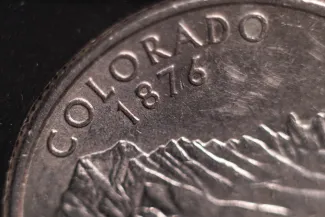
The opening words of the Centennial State’s constitution — “We, the people of Colorado, with profound reverence for the Supreme Ruler of the Universe” — make it one of four state constitutions not to use the word “God” at least once.
As the episode illustrated, the role of religion in American civic life had become a fraught topic in the 1870s. Even as they dispensed with the suffrage question, Colorado’s constitutional delegates were wading into a thicket of controversial issues concerning the separation of church and state.
Americans at the time were grappling with questions about the future of the public or “common school” system in an increasingly large and diverse country. Children in U.S. public schools had long received a nondenominational Protestant religious education centered on Bible-reading and moral instruction — but by the Reconstruction era the country’s growing Catholic population put these traditions under strain. Catholics objected to a school system that they said subjected their children to Protestant indoctrination, but they also opposed, as did many Protestants, further secularizing public education to take religion out entirely.
Republicans saw political advantage in pressing the issue, launching campaigns against “sectarian” schooling that often exploited nativist and anti-Catholic bigotries. In 1875, President Ulysses S. Grant backed a federal constitutional amendment mandating that “no money raised by taxation in any State, for the support of public schools … shall ever be under the control of any religious sect,” preempting efforts by some Catholic communities to secure public funds for parochial schools. The amendment was approved overwhelmingly in the House but failed to win a two-thirds majority in the Senate.
North-south divide
Supporters of the so-called Blaine Amendment, named for GOP congressional leader James G. Blaine, then turned their attention to state constitutions, including the one being drafted in Colorado. Republicans demanded the document include strong language prohibiting school funds from being “divided” between different religious denominations.
Bishop Joseph Machebeuf of Denver’s Catholic diocese led the campaign against such a clause, organizing petitions, delivering a series of lectures in Denver on the “school question” and making his case to the convention itself in a written address on Feb. 17.
A native of France, Machebeuf had spent 15 years in New Mexico before his transfer to Colorado in 1868, and his flock included both the Hispanos of southern Colorado as well as growing numbers of Irish and other European immigrants in Denver and the mining districts. Though he professed discomfort with taking “any part in political affairs,” his message to the convention showed a degree of shrewd calculation.
“We would feel bound, both as Catholics and as citizens, to oppose the adoption of a Constitution which should so utterly disregard our civil and religious rights,” he told delegates. “I can not construe this to be a threat, but simply an expression of our feeling.”
Such a warning couldn’t be ignored in the Colorado Territory, where proponents of statehood feared a repeat of a previous attempt in 1864, when a constitution had been drafted only for voters to overwhelmingly reject its ratification.
Mirroring the national political climate, debates over the proper relationship between church and state in Colorado turned increasingly bitter. On Feb. 19, delegates debated, and defeated, a motion for a full ban on Bible-reading in public schools, a proposal blasted by the Denver Tribune as “irreligious bigotry.” Some Republicans, embracing a policy endorsed by Grant himself, sought to abolish or cap the longstanding tax exemptions granted to church property, which they accused Catholic parishes of exploiting to hoard land and wealth.
On Feb. 12 the Silver World of Lake City warned of a “strong probability now that Colorado will not become, as many have fondly hoped, the Centennial State.”
“The northern portion of the territory has unfortunately seen fit to array itself against the southern portion,” wrote its editors, “and have insisted on the incorporation … of certain features which do not accord with the views of those who have cast their lots in southern Colorado.”
Skittish northern papers took these warnings seriously. In a Feb. 11 editorial on the “The Prospects of Admission,” the Denver Tribune urged delegates to “frame a constitution to which no reasonable and well grounded objection can be made, and that will contain no provisions calculated to excite special opposition.” Like the Bible ban, efforts to roll back church property tax exemptions were ultimately scrapped.
After a “red hot debate” on the topic, however, convention delegates held firm against the division of public school funding. The language in Colorado’s 1876 constitution — stating that the school fund shall “forever remain inviolate and intact,” and barring government entities from paying to “support or sustain any school … controlled by any church or sectarian denomination whatsoever” — remains unchanged today.
But such restrictions remained deeply unpopular among religious conservatives. More than 140 years after its ratification, Colorado’s Blaine Amendment, along with similar provisions in 37 other state constitutions, was dramatically weakened by the U.S. Supreme Court in two decisions in 2020 and 2022. Legal scholars and proponents of “school choice” expect the court’s conservative majority to soon go further and allow states to fund religiously-affiliated public charter schools, though justices deadlocked on the issue last year.
Selected sources
- “Proceedings of the Constitutional Convention held in Denver, December 20, 1875,” Smith Books Press, 1907
- Denver Tribune supplement, “Our Constitution Makers,” Feb. 14, 1876
- White, Richard. “The Republic For Which It Stands: The United States During Reconstruction and the Gilded Age, 1865-1896”