Millions of Americans don’t get SNAP benefits even though they’re eligible

© jetcityimage - iStock-958835100
A Republican spending law that President Donald Trump signed last summer made the deepest cuts in history to the largest federal anti-hunger program. It comes as millions of Americans — and thousands of Ohioans — already aren’t getting benefits for which they’re eligible, according to a new analysis of government data.
The man who conducted the analysis said the changes will make what is already a severe problem much worse.
“Food assistance is terrible,” said Dayton native Eric Pachman, founder of the data analysis nonprofit Data 4 the People. “And now it’s about to get way worse.”
In 44 states, big portions of the population eligible for food assistance didn’t get it in 2023. And in half of states — including Ohio — not even everybody officially qualifying as impoverished received help.
Despite their need, millions of Americans who are eligible for food assistance aren’t getting it, according to the analysis by Pachman and Data 4 the People.
Provisions buried deep inside Trump’s “One Big Beautiful Bill Act” could create an incentive for other states to restrict access to similarly meager levels. If they do, it could exacerbate the country’s already exploding inequality.
Holes in the safety net
Benefits under SNAP — the federal Supplemental Nutrition Assistance Program — are modest, about $6.20 per person, per day. But they fill a critical need for people living near or below the official poverty line. People at 100 percent of that level live on just $15,650 a year for an individual, $32,150 for a family of four.
SNAP has been shown to help people maintain employment and bridge gaps between jobs. It’s also been shown to help kids succeed in school. In 2024, Columbus-based Scioto Analysis estimated that the program kept 1.5 percent of Ohioans out of poverty, second only to Social Security among government programs protecting against poverty.
© iStock - Mukhina1
The Data 4 the People study found that in 63 percent of U.S. counties in 2023, there was a gap between the Americans who were eligible for food benefits, and those who actually received them.
It’s a coverage rate Pachman described as “terrible.”
His analysis also found a partisan dimension to the problem. Over the past 15 years, states in which Republicans controlled the governorship and both houses of the legislature provided SNAP to a much smaller share of residents under the poverty line than those with divided government or Democratic “trifectas.”
Pachman said that beyond pointing partisan fingers, he hoped people would use his findings to get help to the needy more effectively.
“This isn’t about whether poverty got better or worse in red or blue states,” he said in his report. “It also isn’t about the 1.6 percent percent of benefits that were wrongfully issued. Rather, it’s about whether we’re collectively OK with so many people living in poverty going without food assistance simply because of where they live and the politics of their state.”
Partisan comparisons
When last year’s government shutdown started on Oct. 1, the Trump administration suspended SNAP benefits, despite the fact that two courts ruled that it had no right to. The decision cut off assistance to 42 million low-income Americans and 1.45 million Ohioans and prompted a run on already-overburdened food pantries.
While benefits to hungry families were blocked, U.S. Department of Agriculture Secretary Brooke Rollins claimed the SNAP program was “so bloated, so broken, so dysfunctional, so corrupt that it is astonishing when you dig in.”
She pointed to 686,000 instances of improperly issued benefits as proof of massive fraud in the SNAP program. But Pachman pointed out that that’s an error rate of just 1.6 percent.

© fitimi - iStock-528483210
“Every program, every process, every system is going to have some level of failure,” he told the Capital Journal. “That’s not a surprise. The question is whether there’s too much.”
Pachman explained that for the simplest of processes — say, robots performing a straightforward task — a 1.6 percent error rate might be far too high. But what about a program that serves 42 million individuals and is administered at the federal, state and county levels?
“I would argue that SNAP is extraordinarily complex,” Pachman said. “To me, a 1.6 percent error rate is fantastic. It seems very, very low.”
Pachman’s analysis also shows that partisan hostility to the food program isn’t new.
In 2010, riding sentiment against then-President Barack Obama’s Affordable Care Act, Republicans swept state governments, taking control of the governorship and both houses of the legislature in 22 states, compared to the Democrats’ 17.
According to Pachman, there was a subsequent divergence when it comes to the rate of impoverished residents getting SNAP. With very few exceptions, states with Democratic trifectas in their government provided benefits to the poor at considerably higher rates than those with Republican trifectas.
In 2023, for example, 154 percent of people living at or below federal poverty guidelines were getting SNAP in Democratic Massachusetts. In Republican Wyoming, just 45 percent were.
Arkansas is a particular example of the partisan effect.
When control of state government was still divided in 2014, food benefits were flowing to 90 percent of Arkansans living at or below 100 percent of federal poverty guidelines. But after nine years of solid Republican control — and after the imposition of strict work requirements — that figure plummeted to 54 percent in 2023.
Pachman said the polarization of state government has “subjected people on SNAP to more politicized views on food assistance.”
Going to get worse?
In cutting $186 billion from SNAP over 10 years, Trump’s “One Big Beautiful Bill Act” imposes several new burdens on recipients and on states administering benefits.
The Ohio Department of Job and Family Services said that starting this week, recipients between 55 and 64 and those with kids between 14 and 18 will now have to meet an 80-hour-a-month work requirement.
The Republican spending law that was passed last summer also removed exemptions from work requirements for veterans, the homeless, and those aging out of foster care.
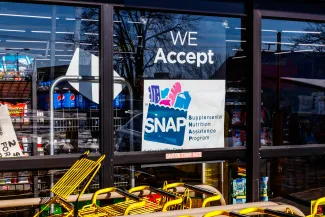
SNAP is “designed to supplement income, not replace it,” Ohio Job and Family Services Director Matt Damschroder said in a written statement.
“The most reliable path to long-term financial stability is through employment,” he said. “A good job provides not only greater independence, but also a buffer against future disruptions to public assistance.”
However, when Arkansas in 2018 experimented with similar work requirements for participants in the Medicaid program, it didn’t produce the outcome proponents said they wanted. The mandate created confusion, 18,000 residents lost coverage, and the state’s employment level was unchanged, the Urban Institute reported last year.
Crucially, the law threatens huge increases in states’ administrative costs by imposing penalties if they exceed error rates that Ohio food bank operators say are impossibly low. For example, if Ohio’s error rate is as high this year as it was in 2024, the state will have to pay the feds $318 million, according to an estimate by the Cleveland-based Center for Community Solutions.
The point, Pachman said, is to create incentives for states to serve as few people they can.
“If you’re restricting access to the program, then you’re going to have a very low error rate,” he said. “It just makes sense. If I never go out and drive, I can guarantee I’ll never get in an accident. That’s a very simple way to eliminate all car accidents — no one drives. That’s the incentive the federal government is sending right now.”