Offshore wind triumphs in court, but future projects face delays

© imaginima - iStock-513672220
The five East Coast offshore wind projects that recently won court victories over the Trump administration have restarted construction, but they make up just a small fraction of Atlantic states’ ambitious plans for offshore wind. And the dozens of projects that have yet to start construction have little chance of advancing while Trump remains in office.
“If you were going to make the best estimate of what’s going to happen, it would be that no other projects other than these five are going to move forward over the next three years,” said Warren Leon, executive director of the Clean Energy States Alliance, a nonprofit coalition of state energy agencies.

State leaders have been relying on these projects to underpin their transitions to clean electricity and to meet their growing energy needs, largely driven by data centers and artificial intelligence. But Trump’s hostility toward offshore wind has shown the political vulnerability of an industry that operates in federal waters and relies on the government as a landlord.
Trump has opposed offshore wind for years, making false claims that it harms whales, is unreliable and drives up energy costs. He seems to have adopted that stance following the construction of an offshore wind farm near his golf course in Scotland, viewing the turbines as an eyesore.
In trying to halt the five East Coast projects, the Trump administration cited classified national security threats. But judges reviewed the classified materials and ruled that those concerns were not sufficient to stop work. They also noted the irreparable economic losses from delays and the likelihood that the developers’ lawsuits could eventually succeed.
Some analysts have noted that Trump’s long-standing campaign against wind may make it difficult for federal lawyers to convince the courts that the stop-work orders were not politically motivated.
If completed, the five projects will produce nearly 6 gigawatts of electricity to East Coast states, enough to power roughly 2.5 million homes. Offshore wind advocates say the projects will provide a massive boost to the region’s energy stability.
Projects move ahead
In December, federal officials issued a stop-work order for the five offshore wind projects currently under construction, off the coasts of Connecticut, Massachusetts, New York, Rhode Island and Virginia. Developers and states sued to block the orders.
In a ruling earlier this month, Judge Royce Lamberth of the U.S. District Court for the District of Columbia granted an injunction blocking the federal order for the Sunrise Wind project off New York. He cited the four previous cases in which offshore wind developers had prevailed against the feds.
“Every court to review this question has now found that the loss of specialized vessels and resulting delays amounts to irreparable harm,” Lamberth said from the bench, according to the East End Beacon. “I agree.”
© zhaojiankang - iStock-802436842
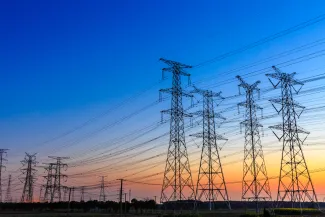
The Empire Wind project, off the coast of New York, is expected to provide enough electricity to power 500,000 homes.
“We absolutely need this energy, and we need it yesterday,” said state Sen. Andrew Gounardes, a Democrat. “The fact that now we are back on track and anticipating energy to start coming through by the end of this year is enormously exciting and enormously beneficial.”
Sam Salustro, senior vice president of policy and market affairs with Oceantic Network, an industry lobbying group for offshore wind energy, noted that many states have seen surging electricity demands in recent years, adding to the urgency of completing the projects.
“These projects are so close to the finish line and putting electricity on the grid,” he said. “Every single time we get another turbine up, it gets harder to justify stopping the industry from moving forward.”
Some Republicans have joined Trump in challenging offshore wind and clean energy. But nine U.S. House Republicans wrote a letter to federal officials last month questioning Trump’s efforts to halt construction on the projects.
“America’s energy policy should be grounded in facts, fiscal responsibility, and the national interest — not ideology or politics,” the lawmakers wrote, according to E&E News.
While developers resume work, some observers have noted the rulings were specific to the construction phase on the projects, not their operation. Some expect Trump to mount a fresh challenge once turbines are actually spinning.
“This administration has had fervent and frequent opposition to offshore wind and has demonstrated a retaliatory posture when they lose in court,” said Timothy Fox, managing director at ClearView Energy Partners LLC, an independent research firm. “We could see the administration trying to stop these projects again.”
Backers note that the projects have already undergone extensive, yearslong reviews in consultation with federal agencies that found no national security concerns.
Officials with the federal Bureau of Ocean Energy Management declined a Stateline interview request, citing ongoing litigation.
Larger plans stalled
Across the East Coast, eight states have committed to building more than 45 gigawatts of offshore wind energy by 2040 — enough to power more than 30 million homes. Those states have also invested heavily in upgrading their ports to handle specialized vessels and giant turbines, building manufacturing facilities, expanding transmission infrastructure and training an offshore wind workforce.
While no states have yet abandoned their commitments to offshore wind, even industry backers say their timelines will be nearly impossible to reach after Trump’s attacks on the industry.
“You’re going to have to change the timeframe,” said New Jersey state Sen. Bob Smith, the Democratic chair of the Senate Environment and Energy Committee. “I don’t think there’s any way you can avoid that.”
Since taking office, Trump has halted permits and leases for other planned offshore wind projects, canceled $679 million in funding to support manufacturing and ports, ended clean energy tax credits and announced plans to cancel the approval of a Maryland offshore wind project.
Maryland state Del. Lorig Charkoudian, a Democrat who has been a key backer of offshore wind, said the state’s commitment of 8.5 gigawatts by 2035 is “probably not going to happen.”
Trump’s administration has said it will revoke the permit for a pending project in federal waters off Maryland, but Charkoudian expressed hope that it will survive legal challenges and move toward construction. But in two other lease areas that Maryland was counting on to meet its target, developers have been thwarted by Trump’s halt on new permits.
States still committed
Despite the setbacks, state lawmakers say they still believe in the long-term future of offshore wind.
Smith, the New Jersey legislator, said it’s a matter of basic economics. He pointed to the country’s rapidly increasing energy demands, and the massive amounts of power offshore wind can provide.
“The more wind farms that are up and the more they’re providing electricity for America, the more they prove the value of the concept,” he said. “My bet is that in two years and 11 months [when Trump is out of office] we’re going to have a very robust wind program in the U.S.”
Smith is pushing for improvements to the state’s transmission infrastructure, so new projects can be added quickly in the future.
Massachusetts Democratic state Sen. Jamie Eldridge said he also believes offshore wind can outlast Trump.
“Massachusetts is facing high utility bills, brownouts and blackouts as energy use goes up,” he said. “Offshore wind is a very dependable source of energy, and projects coming online will provide assurances for that power in times when there’s significant energy needs on the grid.”
In Maryland, state leaders are focused on building more battery energy storage facilities as they wait for wind to catch up.
“I don’t want to downplay the damage that this administration is causing, but we’re resilient,” Charkoudian said. “We’ll be a couple of years delayed for sure, but we do have a path forward.”
But some analysts say Trump has exposed the political vulnerability of offshore wind, which could make developers and investors wary even if a new administration takes office. Fox, with the energy research firm, said that the best case for offshore wind may actually be a more traditional Republican winning the presidency.
“A Democratic administration could revert right back, but if you saw a pivot among the Republican party to a more traditional all-of-the-above energy ethos, favoring state rights, that could provide the four-plus year stability that may be necessary to rebuild this industry,” he said.