Passage of federal science funds a lifeline for Colorado’s aerospace industry

Colorado’s aerospace economy is built on long timelines. Corporate fortunes depend on multiyear spacecraft development cycles, a talent pipeline that has its hubs in university labs, and federal budgets that determine whether companies can confidently bid, hire and build.
That dynamic explains why the science appropriations “minibus” package Congress enacted last month matters so much for the Centennial State.
The new law, approved by President Donald Trump on Jan. 23, funds NASA for fiscal year 2026 and also carries funding for other science agencies, including the National Science Foundation and the National Institute of Standards and Technology, that help supply the research base and skilled workforce feeding the state’s space and other technology industries.

© flickrcc - Wall Boat
The administration had originally proposed extraordinary cuts to NASA. The stakes are higher for Colorado than for many other states.
“The aerospace industry is one of the core pillars of Colorado’s economy,” said Parker White, vice president of government affairs for the Colorado Chamber of Commerce, who noted the state has “over 2,000 companies” in aerospace or related supply-chain work. That estimate squares with one provided by the state’s Office of Economic Development and International Trade, which also said recently that the sector accounted for nearly $23 billion in federal contracting during 2024 and employs more than 55,000 people.
That stable and predictable appropriations are central to keeping that economic engine functioning smoothly, White said.
“Consistent funding across programs is incredibly important,” he said, adding that the importance of not operating under perpetual stopgap funding measures can be hard to overstate, because instability ripples from prime contractors to smaller suppliers and employees.
One way to see the minibus package’s space economy impact is through NASA’s Science Mission Directorate, which covers planetary exploration, space telescopes, Earth-observing satellites, and heliophysics missions that underpin both discovery science and the technical capabilities that industry later commercializes.
The NASA appropriation approved in January allocates $7.25 billion to the Science Mission Directorate, including $2.5 billion for planetary science, $1.6 billion for astrophysics, $2.2 billion for Earth science, and $875 million for heliophysics.
Those fiscal bottom lines matter to Colorado because the state’s aerospace workforce does not split neatly between “science” and “commercial.” Engineers and advanced manufacturers often move across civil, national security, and private sector projects, with specialized expertise built on programs that frequently originate as federally-funded science missions.
Worst-case outcome avoided
Michael Beavin, the director of strategic business development and government relations at Westminster-based Advanced Space, said the scale of defense budgets shape the aerospace sector more than does NASA funding.
“The Space Force budget dwarfs NASA,” he pointed out, arguing that the national security space enterprise sets a high and less wavering baseline for government demand even when civil programs run through the space agency face uncertain funding prospects when presidents propose to cut expenditures.

© zimmytws - iStock-511889079
But aerospace companies generally avoid reacting too quickly to a White House spending proposal impacting NASA, because Congress controls appropriations, Beavin said.
“The administration proposes a budget and the Congress disposes of the budget,” he said, describing a legislative process that tends to temper even sharp proposed changes once committee hearings and bicameral negotiations begin.
For the current fiscal year the administration recommended a 24 percent cut in NASA’s overall expenditures. Casey Dreier, the chief of space policy at The Planetary Society, a nonprofit what works to advance space exploration, explained that Trump’s desire to slice NASA spending to the extent he asked Congress to do would have been “extinction-level cuts designed to create chaos and undermine U.S. leadership in space.”
“The level of cuts proposed were extreme,” he said. “They weren’t about saving money or running things more efficiently.”
The Trump administration last year called for a 24 percent cut in NASA’s overall expenditures. The reductions included:
- $2.3 billion cut for space sciences activities
- $1.1 billion cut for mission support programs
- $1.2 billion cut for Earth sciences programs
- $879 million cut for “legacy human exploration systems” including Orion and the Space Launch System
- $531 million cut for space technology programs
- $508 million cut for the International Space Station
- $346 million cut for NASA aeronautics work
- $143 million cut for the STEM education programs
And, as Beavin highlighted when he described the dynamic that aerospace firms confront, economic chaos can ensue when proposed cancellations collide with long-running missions and industrial planning.
Not all NASA programs do survive the appropriations gauntlet. This year, Congress chose to impose a reset on the Mars Sample Return initiative, for example, choosing to cancel it “as a program of record” and to move technological development of its aims to future Mars missions. Littleton-based Lockheed Martin is one Colorado company whose fortunes are tied to the MSR mission. It received a contract in 2022 to build a vehicle to lift sediment samples off the Martian surface.
Even where allocated funds for a NASA program remain substantial, the practical effect on Colorado’s economy often hinges on how NASA translates appropriations into procurement timelines, competition structures, and staffing capacity in its contracting offices. White cautioned that it is too early to speak with confidence about the impacts of recent Department of Government Efficiency-driven personnel and Congressionally-mandated budget decisions. “We don’t yet know . . . what impact personnel cuts in NASA will have on the aerospace industry across the board,” he said.
At the same time, White described the minibus package as avoiding a worst-case outcome.
“This bill retains … much of the funding that NASA needs,” he said, arguing that at least “on paper” NASA appears equipped to support major missions while agencies work through how resources translate into execution.
And Beavin argued that the sector should consider the overall appropriations environment, noting that the One Big Beautiful Bill Act enacted in July 2025 may mean that NASA might now have its most expansive budget ever. He said that, if OBBBA funds are considered, that agency may have “$28 billion” this year.
Aerospace tied to Colorado history
Dreier pointed to Americans’ strong support for space programs as a political force Congress was unwilling to resist.
“There was a very large public outcry,” he said, adding that the tide created by public sentiment was reinforced by the administration’s own actions. “The administration made no effort to argue for (suggested) cuts after they were proposed,” he said. “They didn’t bother to justify them.”
Members of Congress from both parties did not buy into the administration’s rationale for NASA expenditure reductions.

© iStock - monsitj
“What NASA does — capability and leadership — still carry very strong, bipartisan support,” Dreier explained. “And the overall amount of money we’re talking about was so modest that there wasn’t much reason to cut to that degree.”
White also emphasized that Colorado’s aerospace sector strength is closely tied to the state’s history and geography and entangled with U.S. military missions and public education systems. During the Cold War, he said, Colorado became strategically important for defense infrastructure, and that footprint laid the groundwork for the industrial concentration that followed. He cited installations and anchor institutions including U.S. Northern Command, the Air Force Academy, and Lockheed Martin’s Waterton Canyon facility, and emphasized that the state’s universities have continued to reinforce that foundation by producing talent and research capacity.
White explained that even high-profile federal decisions do not necessarily alter the fundamentals of the ecosystem. For example, he said, the planned relocation of U.S. Space Command to Alabama is “a prestige loss” that “will not have any major long term impact” on the broader aerospace and defense industry in Colorado, because a combatant command does not drive acquisition budgets the way major missions and bases do.
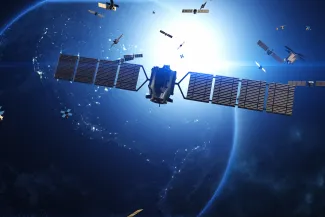
While NASA anchors Colorado’s civil space story, NSF and NIST play a quieter but often decisive role in the state’s innovation economy by underwriting research, instrumentation, standards and early-stage technology development.
© yucelyilmaz - iStock-2101393672
In White’s telling, NSF’s impact is both direct and indirect. He pointed to an NSF-supported initiative involving the Denver Metro Chamber of Commerce, saying, “Those resources are going directly into” work that supports capabilities “to track things like wildfires,” alongside other environmental and resource-monitoring applications that can draw on space assets.
It is critical for the state’s political and business leaders to think beyond the first-order grant dollars to what the supported capabilities mean for Colorado, including resilience and risk management, he said.
White also stressed that funding stability for research institutions affects workforce development and, by extension, aerospace competitiveness. He said the state’s educated workforce depends heavily on the quality of its higher-education institutions and warned that lapses or disruptions in research funding can carry “second-, third-order effects” on Colorado’s ability to attract and develop the talent that industry needs. “That talent is what fuels the aerospace and defense industry,” he said.
The Trump administration proposed a 55.8 percent cut in NSF’s budget for the current year, seeking to slice its funds from $8.8 billion to $3.9 billion. Those cuts would have included a $3.5 billion cut in the agency’s general research and education activities.
NIST’s presence in Colorado, including its measurement and standards work that supports everything from precision manufacturing to communications and quantum research, similarly connects federal appropriations to the practical competitiveness of Colorado firms and labs. As with NSF, the administration sought substantial cuts at the agency, suggesting a $325 million reduction in its budget.
The minibus package’s NIST and NSF provisions will shape those agencies’ operating budgets for the current fiscal year, though agency-level operating plans and award cycles will determine how quickly Colorado institutions see downstream effects.
Broad impact on economic activity
Projects like the Artemis moon program intersect with Colorado broadly, White said.
“The Artemis program … touches nearly every part of the state,” he said, describing a network that runs “from … a large prime contractor down to … advanced manufacturing capabilities throughout the state.”

© iStock - marchmeena29
That breadth is central to how Colorado converts federal appropriations into local economic activity. Stable funding supports not only the largest contractors but also smaller firms that build components, test systems, and hire skilled technicians and engineers who may later move across civil, defense and commercial projects.
The science appropriations minibus package resolves the basic question of whether NASA, NSF and NIST will have appropriations authority for this year. The next questions for Colorado will come in the details, including how agencies translate toplines into specific competitions, how quickly contracts move through procurement offices, and whether research funding remains predictable enough for universities and companies to plan beyond the next quarter.
For Colorado’s aerospace economy, that may be the most important point of all. The state’s advantage is not a single mission or a single company. It is instead an interconnected system, built over decades, that depends on federal science and technology decisions being stable enough for a workforce, a supply chain, and a research base to keep moving in the same direction.