Proposed Indigenous medical school aims to boost Native physician numbers

As of 2024, 0.3% of practicing physicians in the nation were Native American.
A proposed Indigenous School of Medicine in Rapid City could help change that.
The school would be the first of its kind in the nation, said Donald Warne, a physician, co-director for the Center for Indigenous Health at Johns Hopkins, and member of the Oglala Sioux Tribe.
Warne envisions weaving traditions, ceremonies and cultures into the accredited school and its curriculum. Rather than cramming students full of information within four years, the school would prioritize wellbeing and competency — which would allow students to take longer to complete the program if needed, Warne said.
The approach allows students to bring their full cultural selves into their medical training, he added.
“There is still a sense we have to check our culture at the door to become a cookie-cutter doctor as opposed to maintaining who we are,” Warne said. “There are still students who feel they aren’t adequately represented or supported in medical school.”
The proposed Indigenous School of Medicine received a $1 million grant from the Robert Wood Johnson Foundation to conduct a feasibility study and business plan, along with a $100,000 NDN Collective capacity building grant. Warne hopes to start enrolling students in 2030. The location within Rapid City has not been finalized.
Tim Ridgway, dean of the University of South Dakota Sanford School of Medicine, said the state likely couldn’t sustain two public medical schools. But he said the Indigenous school would complement — not compete with — USD’s mission.
“How could I not be part of this?” Ridgway said. “It is, in essence, part of the mission of this school.”
The schools could collaborate on curriculum, share faculty, and work together to create residency programs tailored toward Indigenous students, Ridgway said.
The school’s presence in Rapid City could inspire young Native children to pursue medicine, Warne said, and help fill deep vacancies in rural and tribal health facilities with culturally adept physicians. South Dakota has one of the largest health disparities between Native Americans and white residents in the United States, according to a recent report from a foundation that advocates for equitable healthcare.
“Quality of care is improved when there is culture concordance between doctor and patient,” Warne said. “Quality of care and quality of communication are based on cultural competence.”
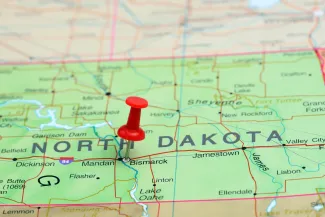
Kenzie Lindemann is a member of the Oglala Sioux Tribe and a medical school student at USD. Both her parents are physicians; her mother is a member of the Oglala Sioux Tribe and practices on the Cheyenne River Reservation. Lindemann participated in the InMED program — a pipeline initiative through USD and the University of North Dakota to support Native students pursuing medical careers.
Still, she’s drawn to the idea of a school where a Native American student wouldn’t constantly “have to explain yourself” — one surrounded by Indigenous peers, taught through the holistic, competency-based model Warne envisions.
During observed standardized clinical encounters, Lindemann sets aside Native American jewelry or a ribbon skirt. The patient — who determines her grade — is usually non-Native.
“I can’t really change the way I look — my skin or my face shape — but if I can take away some level of unknown biases the standardized patient might have about Native Americans, I’ll do that,” Lindemann said.
She sees the proposed school as a way to shift that dynamic.
“By slowly but surely increasing the number of Native American physicians, maybe people won’t see the stereotypes,” Lindemann said. “Maybe they’ll just see us as physicians in the community.”