New Mexico's dust storms double down in 2025's record-breaking year

A good chunk of New Mexico is desert, which explains why the state ranks fourth in the U.S. for dust storms, which are becoming an increasing threat as alarming weather trends escalate.
The annual Dust Bulletin compiled by the World Meteorological Organization showed how many sand and dust storms the planet experienced in 2025 and their danger to air quality, health and the environment.
Daniel Tong, associate professor of atmospheric science at George Mason University, developed a wind-blown dust emission model used by the National Oceanic and Atmospheric Administration to forecast dust storms across North America and globally.
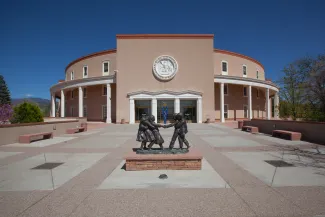
© jdwfoto - iStock-1487999298
"We are seeing this increasing trend over the U.S. It has already a lot of alarming impacts on human health, transportation safety and renewable energy generation," Tong explained.
Over the past 30 years, there has been a significant increase in the occurrence of severe dust storms in the Southwest but California, Illinois, Kansas and Oklahoma also make the top 10 list. NOAA listed 50 reported events in New Mexico between January and March of 2025. Across the globe, North Africa, the Middle East and China were hit the hardest last year.
Tong has studied dust storms for 40 years and acknowledged to most of us they just look like swirling dirt but they can carry much more, especially in a state like New Mexico.
"A dust storm is like a soup. Anything of the right size at the right time and location can be part of the dust storms, including heavy metal, radioactive materials from the past, the nuclear tests," Tong outlined.
During a 2025 dust storm, an 11-car pileup led to three deaths along Interstate 10 at the Arizona-New Mexico border, a stretch of road where drivers normally can see for miles around. Tong stressed a lack of visibility can leave drivers very little time to react.
"You might think the big dust storms are more worrisome but the smaller dust storm can be equally worrisome because they come out of nowhere as a surprise," Tong emphasized.
America’s Dust Bowl, affecting the southern and central Great Plains in the 1930s, was fueled by severe, prolonged drought and poor agricultural practices.